A story of Padma Shri Anke Gowda
In an era when mobile phones have replaced books as the preferred companions of many, one man from rural Karnataka has spent more than half a century proving that the printed word still matters.
Amour and Anger is the latest book of sonnets by Subodh Sarkar, translated into English from Bengali by Bappaditya Roy Biswas.




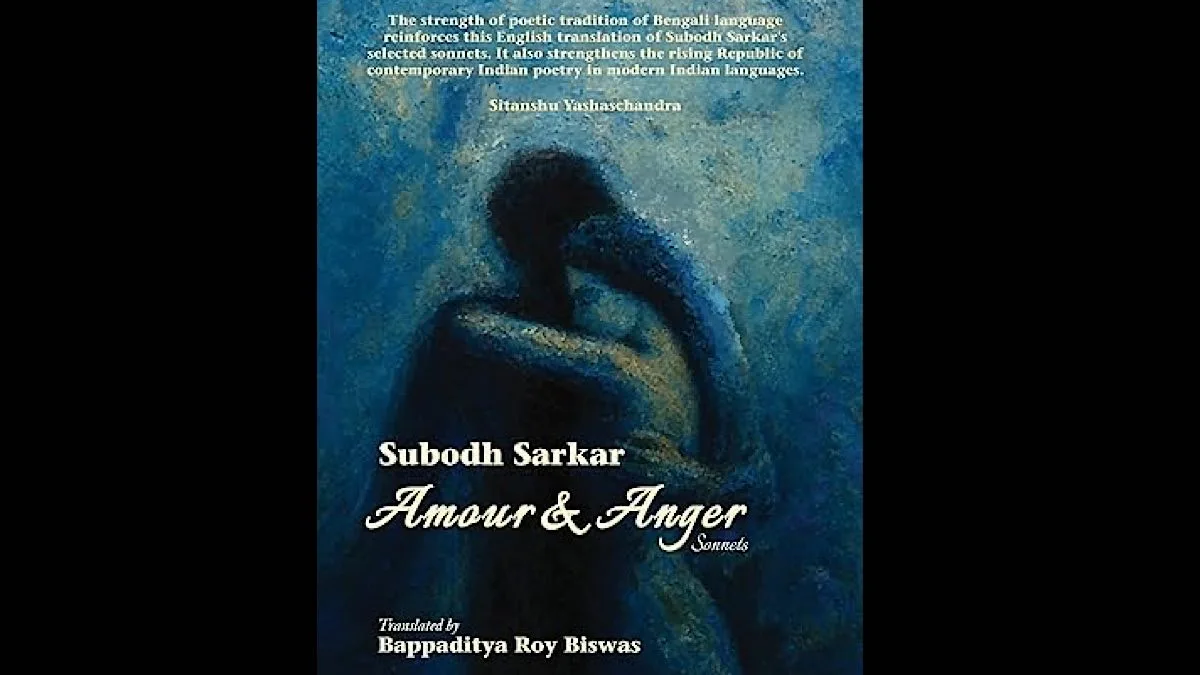
Photo:SNS
Amour and Anger is the latest book of sonnets by Subodh Sarkar, translated into English from Bengali by Bappaditya Roy Biswas. A book of 50 sonnets on love, desire and rage, it is a tribute to his signature style. Ascribed to Italian origin in the 13th century, the sonnet was adopted by English poets and made its way into Bengali literature in the late 19th century by poets such as Michael Madhusudan Dutt, who adapted the rhythm, prosody and sensibility of English sonneteers into Bengali. The sonnet form gave expression to a range of themes other than the convention of love through the pens of Bengali sonneteers such as Rabindranath Tagore, Jibanananda Das, Sudhindranath Dutta, Joy Goswami, Buddhadeva Bose and Shakti Chattopadhyay.
Subodh Sarkar, a retired professor of English with 48 books of poems and a creative career spanning five decades, inherited the sonnet as a legacy. An acclaimed and much-awarded Bengali poet, Amour and Anger is Sarkar’s second book of sonnets, following Kangaroo Sonnet Sequence, published in 2003.
Advertisement
A book of 50 sonnets with a brilliant preface by Ashwini Kumar, Amour and Anger, juxtaposes love and desire along with rage. The sonnets in Bengali are followed by its English translation on the corresponding pages. This allows the reader the joy of reading and comparing it to its English rendition if s/he happens to know both the languages.
Advertisement
Amour and Anger is a must-read for those familiar with Sarkar’s oeuvre and also for those who do not want to be left out of the current trends in contemporary Bengali poetry. An academician and poet with international exposure and in constant interaction with global poets, his work is a testimony to his erudition and expansive influences.
Sonnet as a form is difficult to work with, keeping in mind the tight structure and rhyme scheme. Sarkar does follow the usual pattern of three quatrains and a couplet, though he has taken liberty and experimented with the form, language and aesthetics. The sonnets shock and startle by its use of profane language and explicit sexual innuendoes. Once the reader gets over the shock, the aesthetics gradually sink in as does the images, use of culture specific idioms and phrases that delight by its use. Sarkar’s use of rage and profanity as an aesthetic and political force shows the influence of his predecessors- Philip Larkin, an anti-modernist poet of the late 19th century, writes to voice his bitterness about family and inherited flaws. Allen Ginsberg, in his poem “Howl” wrote so openly about sexuality and drugs that it led to an obscenity trial, thereby decisively changing the way America understood free speech in legal terms. Sarkar has been engaging with British poet Sir Stephen Spender, Chilean poet Nicanor Parra, American Beat poet Allen Ginsberg and Yusef Komunyakaa, the first black male American Pulitzer Prize winning poet. These influences find reflection in his sonnets that testify his courage and boldness to voice the intimacy of love, erotic jealousy, wounded masculinity, self-mockery, irony and emotional crises in explicit physical terms using local idioms. Sarkar is self-assured, he says, “Sexuality is a part of my poetics that I cannot circumcise from my sonnets or other poems.” He deliberately uses a jarring, obscene tone and his rage is framed as protest that disrupts bourgeois aesthetic expectations and the illusion of stability in intimate relationships.
Translating poetry is a huge challenge, let alone sonnets with a fixed rhyme scheme and structure. Translators debate if poetry should be translated only by poets and if the translated poem should reproduce the exact rhyme scheme of the original poem or focus on the content. These areas of difficulty in translation also form the core of discussion between the poet and translator in the Q & A section of the book. Poet and translator Bappaditya Roy Biswas contends the “lost in transit” theory with the “mirror in translation” argument. Sarkar argues that one should not be frustrated by the former and try to recapture the latter: “A translator should be both beautiful and faithful.” The translator must take into account the linguistic as well as non-linguistic elements of the poem, i.e. the pattern of sounds in words, rhyme and rhythm, as well as the imagery, ideas and symbols of the culture of the original language.
“They say my sonnets do lack greens
No tree, no rain, no shade by leaves
Nothing I write remains untold
I amble in black shades and black jeans” (Sonnet 45)
Amour and Anger is a treasure not only for poetry readers but also those with academic leanings for it presents a nuanced study of translation from one culture into another! Poet and translator Biswas does justice to both the form and substance of Sarkar’s sonnets in Bengali in translating them into English. As Sarkar himself concurs that Biswas’s translation is “a page-to-page dedication” to his sonnets. However, the sting of Sarkar’s language – raw, profane, dismantling is somewhat tamed in the English language, perhaps as they say in the act of translation, the Bakhtinian carnivalesque goes missing.
The wounded masculinity of the poet is depicted in a freakish, hyperbolic manner,
I ran out of fuel, and my bag went dry
Your love doesn’t make much of a difference
You rogered me, – dinars and dollars rained
A full tummy you load with love discreet. (Sonnet 2)
The poet comes across as an undying romantic despite the betrayal and disillusionments he faces in love, “A home we had. It lies in ash / We folks, however, can still love. (Sonnet 48)
Builders are rich, are buyers poor?
Middle-class fears lest roofs collapse
You’ve said whate’er occurred to you
Yet, destiny’s darling you’ve been. (Sonnet 42)
The mood of the poet becomes sombre towards the end of the book, paying homage to his mother tongue, “Mother-tongue I yearn at your waist/ I’ll burn you, and in flames meet death.” (Sonnet 50) Impeccably produced in a hard-bound cover in reader friendly font and a spacious layout, the book is an attractive collection of sonnets in translation! Amour and Anger unveils that Subodh Sarkar’s love poems still hold the capacity to surprise, shock and delight his readers in his unique style!
The writer is an Assistant Professor, Department of English, Bamanpukur Humayun Kabir Mahavidyalaya, West Bengal
Spotlight
Amour and Anger
by Subodh Sarkar
translated by Bappaditya Roy Biswas
Penprints Publisher, 2025
Price: Rs 499, 119 pages
Advertisement