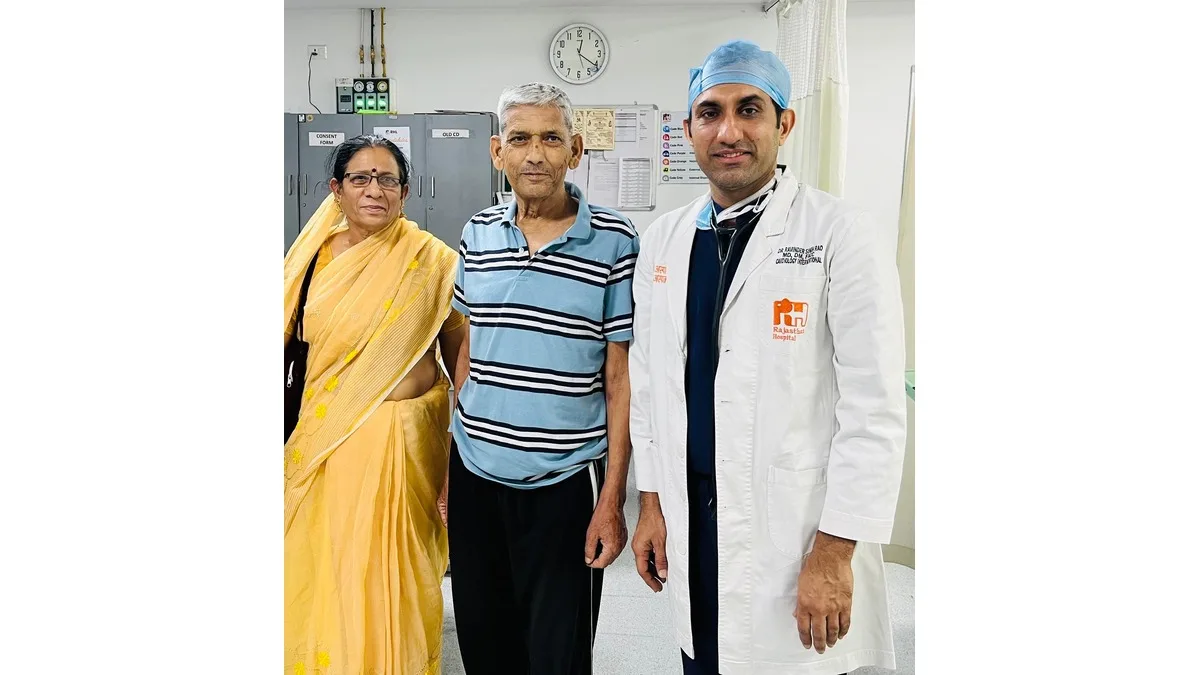
Now, there is nothing to worry about patients who unfortunately have both legs’ blocked arteries and require valve replacement without surgery, as the interventional cardiologists team in Rajasthan successfully performed Percutaneous Trans-Axillary (PTA) to replace a non-working heart valve of a patient through the ‘Arm Artery’ without surgery.
Dr Ravindra Singh Rao, renowned interventional cardiologist at Rajasthan Hospital in Jaipur, claimed, “In India, around 3–5 per cent of patients suffering from aortic stenosis may have blocked femoral arteries, making the standard TAVI approach unfeasible. For such patients, this alternative arm artery route can be life-saving.”
Advertisement
The patient, a 78-year-old man (name changed to Hemendra), had severely blocked arteries in both legs due to calcium buildup, which made the conventional transcatheter valve implantation through the femoral artery impossible.
A cardiologist’s team led by Dr Rao performed this innovative and life-saving procedure, claiming it as the first such case in India. Normally, TAVI (Transcatheter Aortic Valve Implantation) is done by passing an artificial valve through the femoral artery in the thigh. However, in Hemendra’s case, this route was blocked, and the patient’s heart was functioning at only 25 per cent capacity. The patient also had difficulty breathing, worsening kidney function, and had previously undergone two stent procedures, according to Dr Rao.
Refusing to give up, Dr Rao’s team opted for a rare and complex approach. Using ultrasound guidance, they precisely punctured the subclavian artery near the collarbone in the left arm. A small tube (sheath) was inserted, followed by placement of a percutaneous suture system to secure the access point. A larger delivery system was then advanced through the artery, allowing the team to successfully implant the new artificial heart valve.
After valve deployment, the artery was sealed using a ProGlide closure device. Until now, the subclavian artery route for TAVI in India was used only through open surgery. This was the first ever percutaneous (completely non-surgical) trans-axillary TAVI in the country.
The patient’s symptoms improved almost immediately after the procedure. His breathing eased, kidney function normalised, and heart efficiency improved significantly. He was discharged from the hospital just five days later, fully stable. The success of the percutaneous trans-axillary TAVI has demonstrated that with innovation and courage, even the most complex medical challenges can be overcome.
Key Highlights:
First-ever heart valve replacement through the arm artery without surgery in India
Conventional femoral route was blocked due to severe calcification
Patient’s heart functioning only at 25 per cent; kidneys also deteriorating
Innovative approach led to full recovery; patient discharged in five days
Sets a new path of hope for patients with similar vascular limitations.
The writer is a senior science correspondent.