Bengal’s chance to plant a new tree
In O. Henry’s The Last Leaf, ailing Johnsy clings to life because one painted leaf refuses to fall. Such is the power of optimism; it does not need to be certain to be effective.
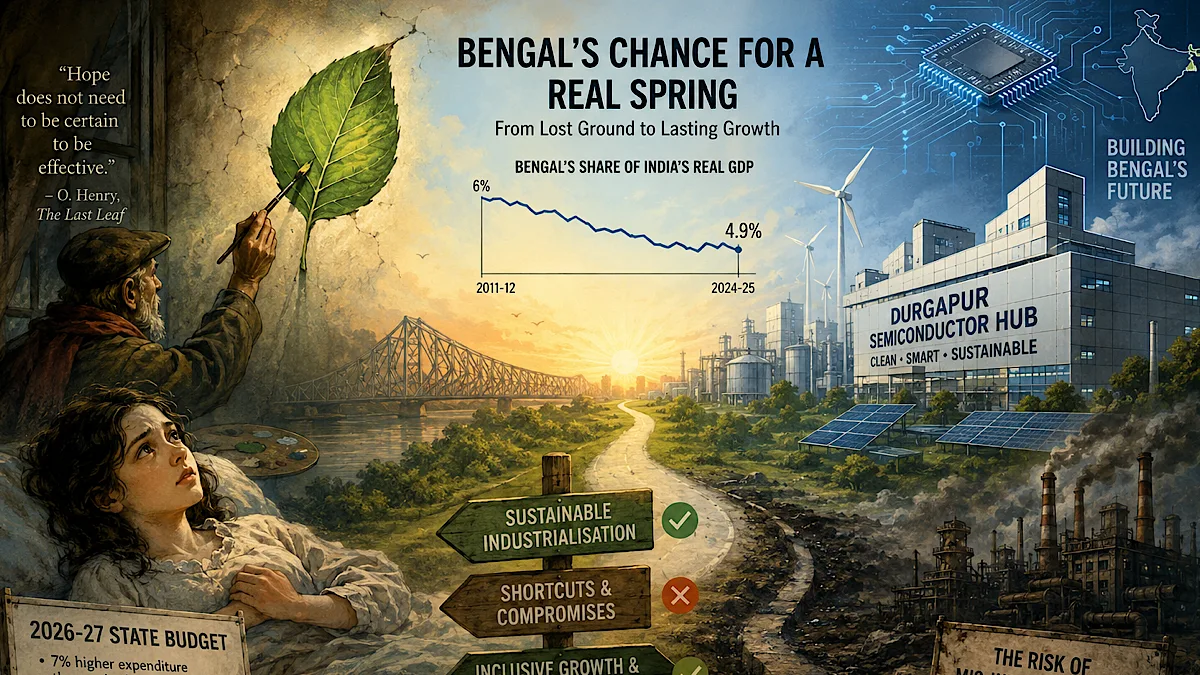
In O. Henry’s The Last Leaf, ailing Johnsy clings to life because one painted leaf refuses to fall. Such is the power of optimism; it does not need to be certain to be effective.

S&P Global Ratings cut India's GDP growth to 6.6 per cent in the current fiscal year, driven by energy stress, a sub-par monsoon and slowing global growth.
India's Gross Domestic Product (GDP) is set to grow at 6.6 per cent in the current fiscal as compared to 7.7 per cent in FY26, said BMI, a Fitch group company, citing weaker investments and consumption growth and trade shocks from the West Asia crisis.
India’s current account surplus moderated to $7.1 billion, or 0.7 per cent of GDP, in the fourth quarter (January-March) of financial year 2025-26, compared with $13.7 billion in the same period a year ago, according to the Reserve Bank of India’s latest Balance of Payments data.
Prime Minister Narendra Modi on Friday welcomed India’s latest GDP data, calling it proof of economic resilience, reform impact and the hard work of 140 crore Indians.

India's tax collections could surge in FY27, with gross tax buoyancy rising to 1.1 from a projected 0.64 in FY26, a report said on Wednesday.

Indian specialists accounted for roughly 34 per cent of specialist‑level talent moving to Finland in 2025, with tech and engineering professionals employed at firms including Nokia, Kone, Wärtsilä, HCL, Infosys and TCS

The growth of India’s economy will be domestically driven by consumption and credit in FY27, with real GDP to rise about 7.2 per cent and nominal GDP improving by 11 per cent, a report said on Tuesday.
Recognising the critical importance of infrastructure spending to boost GDP, create jobs and have a multiplier impact on the economy, the Central government dramatically increased spending on infrastructure capital expenditure over the last decade - more than quintupling it from around Rs 2 trillion in 2014-15 to Rs 11.1 trillion in 2024-25.

The artificial classifications of the World Bank and IMF at best serve their limited institutional purposes ~ to determine for eligibility of poorer developing countries for concessional loans, favourable trade terms etc., and for phasing these countries in or out of aid windows.