Bengal’s chance to plant a new tree
In O. Henry’s The Last Leaf, ailing Johnsy clings to life because one painted leaf refuses to fall. Such is the power of optimism; it does not need to be certain to be effective.
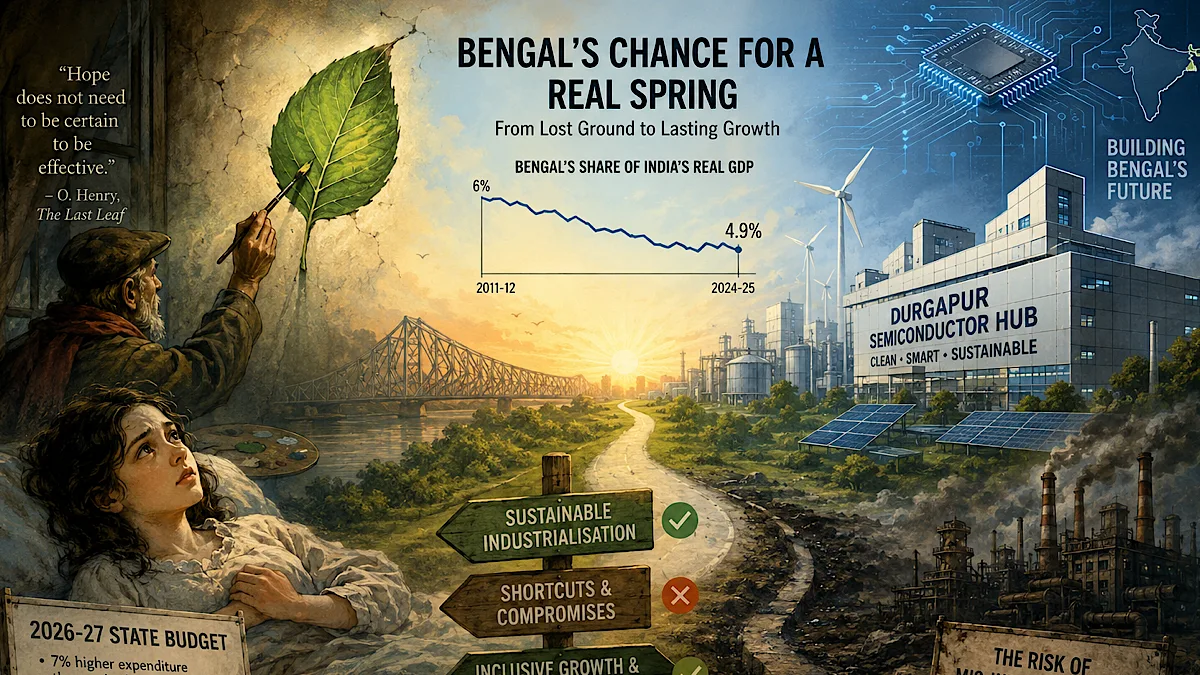
In O. Henry’s The Last Leaf, ailing Johnsy clings to life because one painted leaf refuses to fall. Such is the power of optimism; it does not need to be certain to be effective.

S&P Global Ratings cut India's GDP growth to 6.6 per cent in the current fiscal year, driven by energy stress, a sub-par monsoon and slowing global growth.
India's Gross Domestic Product (GDP) is set to grow at 6.6 per cent in the current fiscal as compared to 7.7 per cent in FY26, said BMI, a Fitch group company, citing weaker investments and consumption growth and trade shocks from the West Asia crisis.
India’s current account surplus moderated to $7.1 billion, or 0.7 per cent of GDP, in the fourth quarter (January-March) of financial year 2025-26, compared with $13.7 billion in the same period a year ago, according to the Reserve Bank of India’s latest Balance of Payments data.
Prime Minister Narendra Modi on Friday welcomed India’s latest GDP data, calling it proof of economic resilience, reform impact and the hard work of 140 crore Indians.

The structural transformation of the Indian economy over the past decade has been anchored by a fundamental shift in the credit architecture, moving away from a historically top-heavy banking model toward a decentralized, inclusion-driven framework.
S&P has revised the 2025-26 growth upwards by 0.4 percentage points to 7.6 per cent, and for 2026-27 fiscal by 0.2 percentage points to 7.1 per cent.

Artificial intelligence (AI) has emerged as a pivotal force in reconfiguring India’s educational landscape, enhancing pedagogy, boosting classroom effectiveness, and contributing to national development.
Reliable macroeconomic statistics are fundamental to economic governance. Last year, the IMF, even while revising India’s GDP growth projections upwards, assigned a “C” rating to our National Accounts Statistics in its Data Quality Assessment due to methodological weaknesses.

The report suggested that to achieve the Viksit Bharat goal by 2047, India may need to significantly increase its tax-to-GDP ratio, primarily through improved tax compliance, as major tax reforms have already been undertaken.