“The lights! Where are the lights?”
“The lamps have burnt out, Huzur. It’s almost dawn. Soon, the sun will rise.”
Advertisement
Jalsaghar (1958)
That famous dialogue is now a distant memory. Like the sound of clods of dirt falling on a coffin. The darkness, congealed, is now spilling through the walls into our filthy, tumbledown rooms. Twenty years after Pather Panchali (1955), Ray made Jana Aranya (1976), bringing to life one of the gloomiest chapters in India. Today, five decades on, it still pulverises our souls.
The last of the Kolkata trilogy, in Jana Aranya, the cycle of social atrophy is almost complete. We see the middle-class Somnath (Pradip Mukherjee) take a tumble on the road, before he finally finds himself poised to sell his soul, the tiger claws of a burgeoning neo-capitalism bared right at him.
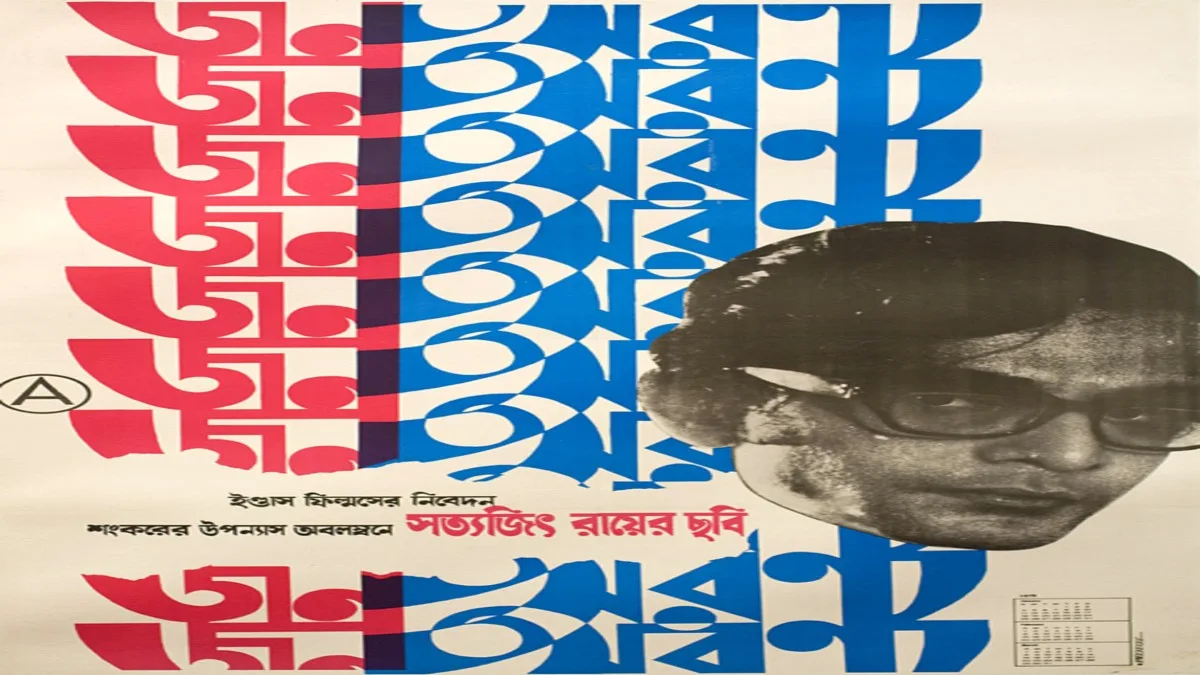
Unlike the final sequence of Pratidwandi (1970), where the dreamlike birdsong eclipses the chantings at a funeral procession, Jana Aranya offers no respite. The pale skeletons that thronged the balcony in Pratidwandi are now jostling with multitudes of men. The city transforms into a many-tentacled monster–the crawling alphabets on the poster fusing to form the shape of a jungle.
As Somnath struggles to find a job, we see a volley of questions thrown at him like bullets from a machine gun. — “Who is the…? What is the…? Where is the…? When was the…? How was the…?”
And then the most ludicrous one.
—“What is the weight of the moon?”
We are taken into the pitch black underbelly of 1970s Calcutta. Mass cheating surrounds Somnath as he sits writing his exam; a blatant disregard for authority is manifest as outsiders saunter in casually, handing out answers inside the exam hall, and rousing Naxalite wall slogans, written in Ray’s own hand. –“Counter violence with violence”, “Do away with class enemies”— kick a near-forgotten rebellion in the gut. A scraggy outline of Mao Tse Tung dozes idly in a forlorn corner of the wall.
In Jana Aranya, Ray takes us as far away from the glossy, upper-middle-class, corporate sphere of the ambitious, conscious-stricken Shyamalendu (Seemabaddha, 1971) as possible. There are no lush apartments here, no elite clubs, or race courses. Instead, we are brought face-to-face with raw men of flesh and blood. The camera zooms in on piles of job applications. The postbox, old and derelict, has a gaping hole in the middle.
The director’s anguish bursts into each frame. While years ago, Apu had refused to turn away from life despite unyielding misery, a crucial character in Jana Aranya, Bisuda (Utpal Dutt), unflinchingly spouts a gospel truth– “Pitfall, pitfall, everywhere.”
The dodgy manoeuvrings in Kolkata’s Burrabazar area are captured with ruthless wit, each image a snapshot frozen in time. The audience gets transported into the devious world of order-supplies, swarming with the snakelike Bisu, Heeralal Saha, Adak, and Natabar Mitter.
Bisu inducts Somnath into the dubious rules of the game.
“You’ll be cleaning up your own mess.… You know what your goal should be?”
“The moon?”
“Close enough! Money….”
Like a scene out of absurd theatre. Bisu’s analogy between the moon and money throws light on the ruthless greed and social erosion of the times. This same Bisu would soon be off on pilgrimage with his wife, a macabre combination of piety and duplicity.
The bleakest, most fatalistic of Ray’s films unfolds in bouts of wry humour as Somnath finds himself dragged into the almost Kafka-esque darkness of a hitherto unfamiliar world. We encounter a strange medley of characters–the middle-class housewife of a drunken municipal worker who moonlights as a high-profile hooker, and an elderly, widowed woman whose blind greed has forced her own daughters into active sex work. Set in the depths of a cruel, empty, loveless world, Ray sprinkles this film noir with fierce satire; this is also the only film where he keeps the background music to a minimum, preferring, instead, to use natural sounds.
The image of the squalor and the two ramshackle rooms that is the whole of Sukumar’s sombre universe hits hard. In an almost Brechtian alienation, the director transforms the socio-economic turbulence of the decadent post-Naxalite era into a canvas for critical engagement.
We notice the way that language is transposed to fit the natural milieu that the characters inhabit. In an interview with Henri Micciolo, Ray admitted to having experimented with an unrefined, coarse vocabulary for the first time in Jana Aranya.
We watch as Sukumar discovers a bunch of young men gaping through an open window. He rushes in, finds his sister, Kauna, hooking on her brassiere in front of the window, bangs it shut and smacks her on the face.
–Giving those boys a show, are we?
Kauna retorts angrily.
–It’s dark outside. How should I know who’s watching?
Ray’s Kauna, who turns to prostitution soon after, comments on the darkness that engulfs the world outside.
–Sometimes I wish I could just buzz off to the moon.
Sukumar’s silent cry for help punctures the ribs in a fierce spurt of blood.
Somnath’s first meeting with ‘public relations man’ Natabar Mitter (Robi Ghose, a Ray staple) happens at his own newly acquired desk in the office space he shares with multiple other men. In this slippery, dog-eats-dog world of business, Natabar hides his crafty self behind a lopsided smile; in his own words–“Natabar Mitter doesn’t allow grass to grow under his feet”.
Time plays a crucial role in the narrative. Natabar’s digital watch anticipates a fast-paced universe where time never stands still. In Somnath’s world, time is a double-edged sword. On his way to find a suitable escort for his client, Somnath asks Natabar grimly, “What’s the time?” As he buries himself deeper in moral vicissitudes, he forgets his watch–a gift from his sister-in-law (Lily Chakrabarty), a symbol of everything that is pure and right.
When Somnath realises that the only way to clinch a deal that could change the trajectory of his life is by pimping himself out, Natabar assures him, “I’ll get you the goods. All you have to do is deliver it safely to him at the agreed-upon hour.” The ‘goods’ are for Somnath’s client who ‘suffers’ a polio-stricken wife at home. The rotting fabric of the 1970s society, hailed in Bengal as the decade of liberation, calls out to Somnath. It is Natabar that helps him cross over.
Moments before finding out that he was escorting Sukumar’s sister, Kauna, to spend the night with his client, Somnath, ends up in the shady premises of a commercial school, doubling up as joint for a prostitution racket. The gatekeeper sets aside his reading of The Ramayana and runs to meet Natabar. He assures him of some fresh, young ‘goods’ if only he could wait a few minutes.
When Somnath’s gaze falls in the cab on Kauna, who professionally calls herself Juthika, there is stunned silence.
–You just need the money, right?… I won’t take you to the hotel, Kauna.
–My name is Juthika.
–Listen to me, Kauna…
–My name is Juthika.
Is Kauna, then, the toughest character in the film?
Upon returning home, amidst a baffling interplay of light and dark, Somnath finds his father seated in his customary armchair in the modest verandah of the house.
–It’s done, Baba…The deal. It’s come through.
The old man’s tired face breaks into a slow, jubilant smile; he sighs deeply as relief washes over him.
–Finally!…After all this time…
With the corner of his dhoti, he wipes his eyes.
The darkness has turned to stone. We see Somnath disappearing inside the jaws of pitch blackness as it gulps him up whole.
The writer is Professor Emeritus, University of Calcutta.