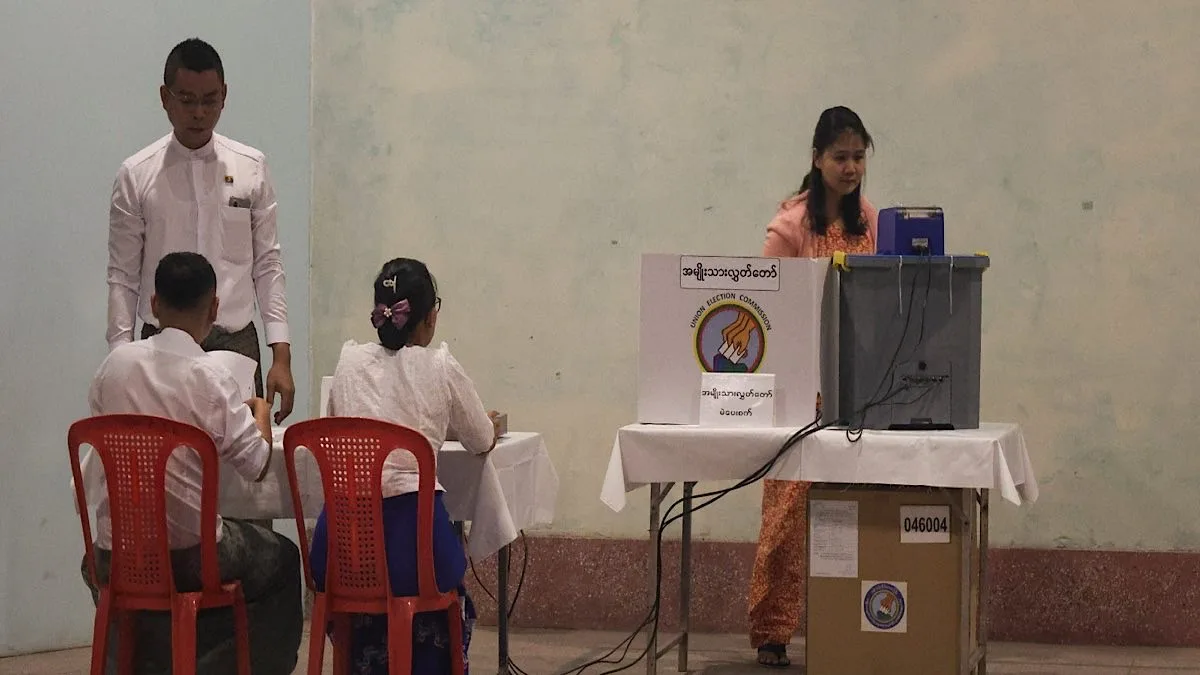
Nearly five years after Myanmar’s military seized power, the generals have returned to a familiar ritual: the ballot box. But this election, held in phases amid an active civil war, is not an exercise in democratic renewal. It is an attempt to convert control into consent at a moment when the state itself is fractured. The conditions under which the vote is being conducted tell the real story. Large parts of the country are excluded on grounds of “instability,” opposition parties have been dissolved, and prominent leaders remain imprisoned or exiled.
The National League for Democracy, which won decisive mandates in earlier elections, is absent, its leadership jailed under charges widely seen as political. In such circumstances, the vote cannot serve as a mechanism of representation; it can only function as a managed outcome. The junta’s argument is procedural: that phased voting, security arrangements, and participation by registered parties, amount to progress towards a multi-party system. Yet, procedure divorced from political freedom is a hollow substitute. Laws criminalising criticism of the election, with penalties extending to long prison terms and even death, invert the meaning of civic participation.
Advertisement
Voting under threat is not a choice; it is compliance. That some citizens still line up to vote is not evidence of legitimacy, but of complexity. Years of conflict, economic collapse, and inflation have left ordinary people desperate for stability. For many, casting a ballot may feel like a small assertion of normalcy or a hope ~ however faint – that prices will fall or daily life might improve. These motivations are human and understandable. But they cannot repair a process structurally designed to exclude dissent. The broader context makes the exercise even more tenuous. Myanmar remains a battlefield, with the military facing armed resistance groups and ethnic militias across multiple fronts.
Air strikes continue even as polling proceeds, underscoring the contradiction at the heart of the exercise: a government claiming democratic intent while relying on coercion as its primary instrument of rule. External support, particularly diplomatic and material backing from major powers, has allowed the stalemate to persist, but not to resolve. Regional and international reactions reflect this scepticism. Western governments have rejected the polls outright, while Asean has urged dialogue before any election – an implicit admission that ballots cannot precede reconciliation. The junta’s leadership, embodied by Min Aung Hlaing, insists the process is free and fair, but legitimacy cannot be asserted by declaration.
It must be earned through inclusion. For India and the wider region, Myanmar’s election poses an uncomfortable truth. Stability achieved through exclusion is rarely stable for long. An electoral timetable that sidelines a popular political force associated with Nobel Laureate Aung San Suu Kyi and ignores half the country’s population may deliver an administration, but not authority. In the end, this vote is less about choosing a future than about freezing the present. Without dialogue, ceasefires, and the restoration of political freedoms, Myanmar’s ballot risks becoming another milestone in the normalisation of military rule.