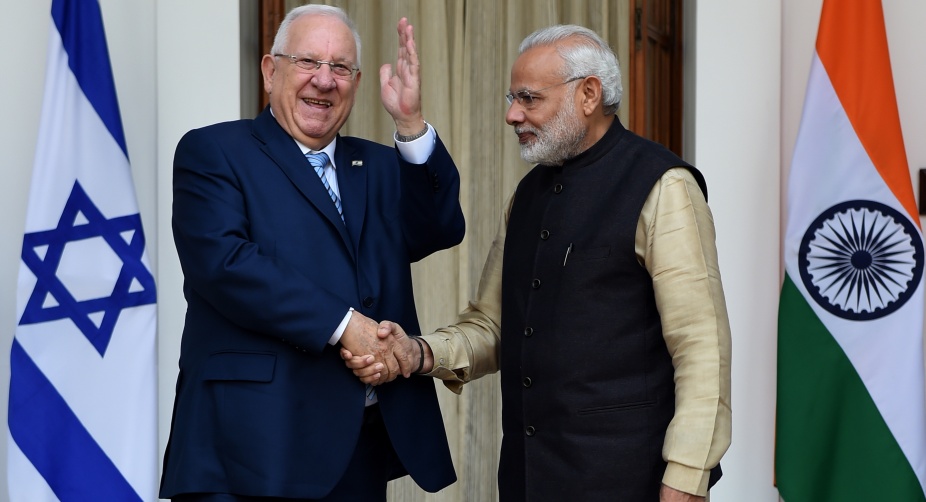
The recent visit of the Israel President to India and the expected visit of our Prime Minister there early next year, to celebrate 25 years of formal diplomatic ties, has raised the bar of the relationship. India had always maintained relations with Israel, since recognising it in 1950, but for a long time kept its proximity under wraps, mainly due to our support for the Palestine movement. We supported the Palestinians vocally and voted against Israel on many occasions, mainly due to fear of curtailment in oil supplies emanating from the Middle East, countries which were sworn enemies of Israel, as also our involvement with the non-aligned movement. Another factor which played an important role in maintaining official distance was our large Muslim population, which preferred support to Palestine rather than Israel. With passage of time, as our relationships changed and the non-aligned movement moved into hibernation, the relationship came out of the bag. In fact, it was Israel-manufactured 130 mm ammunition which the Indian artillery extensively fired during the successful 1971 war. Both the nations face common threats from fundamentalist terror groups and hence are natural allies.
Israeli citizens have been targets of terror strikes in India. Soon after the commencement of militancy in J&K, six Israeli tourists were kidnapped from a houseboat in Dal lake in June 1991. One died while the others managed to overpower their kidnappers and escape. They were later rescued. During the Mumbai attacks, Nariman house (now renamed Chabad house), a residence occupied by visiting Jews, was specifically targeted. It resulted in the loss of six lives, including four Jews. This site was also visited by the Israeli President.
Israel has faced terrorism from its inception as a nation state. In fact, while India attained freedom following a non-violent struggle, Israel attained it through a violent one, suppressing the Palestinians and engaging in wars against its neighbours. It has hence learnt to battle militants supported by its enemies, while it simultaneously continues to develop. Its remarkable advancements in agricultural reforms and water conservation as also its willingness to share its knowledge with India has benefitted us economically.
Israel proved its military and intelligence capability to the world by launching the famous Entebbe airport raid in Uganda and rescuing its nationals. It also retaliated against the Munich massacre of its athletes and eliminated everyone responsible, even though it took time. Militarily, our two nations have always been close. Indian special forces prefer Israel manufactured small arms as weapons of choice. Our special force personnel have been attending specialised training courses in Israel for years. India currently employs Israel-manufactured Heron and Searcher Unmanned Aerial Vehicles (UAVs). It is also likely to induct the missile-armed Heron TP UAVs. These would give a major boost to our cross-border strike capabilities. We also use Israeli technical equipment in various branches of the army.
The air force has Israeli radars mounted on Russian IL 76 aircraft as Airborne Warning and Control Systems (AWACS). A major success has been the jointly developed Barak Missile system. It is a missile designed to defend against any form of aerial threat including air, helicopters, anti-ship missiles and UAVs. Barak 8, post-successful testing from on-board INS Kolkata, is now being inducted into the Indian Navy. India is Israel’s largest defence procurer. The nations also share terror intelligence data, which is of immense benefit as both nations are on the terrorist radar.
Israel, facing terror from all directions, has secured its borders, employing a mix of walls, fencing and electronic surveillance means. It has been internationally claimed that Israel has the most modern border security network, with reliance on electronic rather than the human eye. It has announced its willingness to share its technology with India. While we have begun copying the Israeli model, we need to interact and replicate it, especially in riverine terrain on both our western and eastern fronts, where visual means and fencing have limited value.
For Israel, relations with India are of primary importance. Other than India being the largest purchaser of its defence equipment, its trade ties with India enables it to balance restrictions imposed by the EU on import of goods manufactured in occupied territories. Trade with Israel is presently around $5 billion and has been growing steadily over the years. Further, India has never persecuted Jews. The two Prime Ministers also share a close bond.
Similarities between the two nations have given rise to a myth. Many in India believe that we should replicate the Israeli methodology of massive retaliation against terror strikes. India and Israel face two varying force levels. The Palestinians are generally unarmed and possess limited military resources, and can be economically choked. Further, the Palestinians are compressed in small areas, thus if attacked by air or artillery, destruction is immense. Pakistan, which sponsors terrorism on Indian soil, is a nuclear nation, with a sizeable military. Hence any action against them would need deliberate planning and implementation. The level and manner of retaliation can therefore never be the same.
The major difficulty for India is attempting to balance its multitude of relationships. Iran and Israel are sworn enemies. India is developing Chabahar port in Iran as also constructing the link to Afghanistan and Central Asia. India appears to have become a master in the art of balancing. It has managed to juggle between the US and Russia, Iran and Saudi Arabia and would now do so between Israel and Iran. Logically, we need to tap into the strengths of Israel in military technology and border security, as also terror monitoring in addition to our traditional cooperation in water and agricultural sectors. Cooperation between like-minded nations enhances the abilities of both and permits mutual development. Israel for us is such a nation and hence a natural ally.
The writer is a retired Major-General of the Indian Army
Advertisement