Print or Digital?
Is Generation Z (or Gen Z) really out and out rejecting hardcopies of things, like books, and opting for the digital versions or softcopies? Do they even read the newspaper, far less in print?
We Indians are often mocked on social media as belonging to “the dirtiest country” or being “the dirtiest people.”




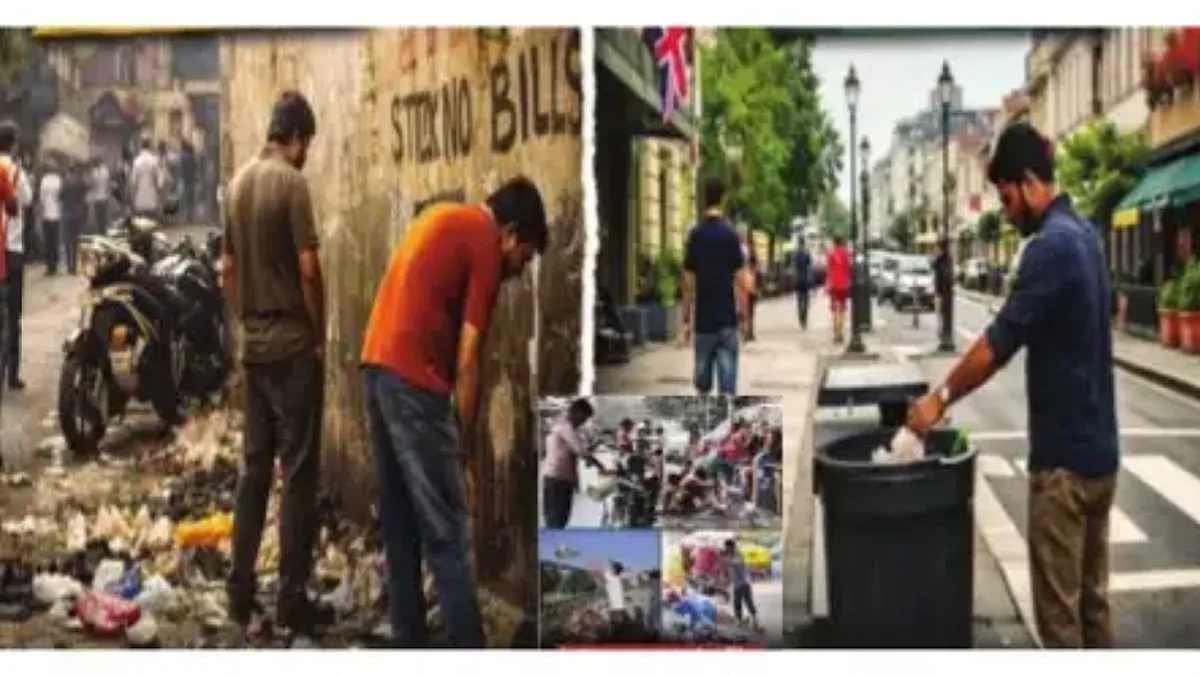
Photo:SNS
We Indians are often mocked on social media as belonging to “the dirtiest country” or being “the dirtiest people.” The words sting because they are unfair ~ yet they are fueled by civic habits we have ignored for too long, both within the country and when we travel abroad. Before we examine how these habits affect our global image, we must confront the uncomfortable truth: our civic crisis begins at home. We do not transform into different people when we land in another country.
We simply carry with us the behaviours we have tolerated and normalized in our own surroundings. Walk through any major Indian city ~ Delhi, Kolkata, Mumbai, Chennai, Bengaluru ~ and the evidence is unmistakable. Public spitting is so common that red paan stains have become a near-permanent feature of our urban landscape, splashed across walls, staircases, post offices, hospitals, and even government buildings. No other large society tolerates this level of disregard for public spaces.
Advertisement
Yet we treat it as ordinary, barely pausing to reflect on how such actions erode the dignity of our shared environment. Then there is public urination, which remains distressingly widespread despite years of government effort. Walk under any flyover or behind any bus stand, and the stench reaches you long before the sight does. This behaviour has been normalized to such an extent that many no longer perceive it as offensive or shameful. For women, however, this is not merely unpleasant ~ it is degrading. They are often forced to walk past men relieving themselves openly, without the ability to avert their eyes or change their route.
Advertisement
It is an everyday assault on modesty, privacy, and basic dignity. Compounding this humiliation is the chronic shortage of safe, clean public toilets for women, who frequently have no facilities available to them at all. In a country where women cannot even find a hygienic restroom outside their home, public urination becomes not only a civic failure but a glaring gender injustice. Our disregard for shared hygiene is equally evident in trains and airplanes.
Anyone who has travelled on long-distance Indian trains knows how quickly washrooms become unusable ~ not only because of heavy use, but because many passengers refuse to flush, leave faucets running, or treat the space as if no one else will ever need it. Even on airplanes, where facilities are regularly cleaned, the same habits often surface: wet floors, unflushed toilets, discarded tissues in corners. These spaces are used by hundreds, yet the prevailing mindset remains individualistic: I have used it, and now it is someone else’s problem. It is a small but revealing glimpse into a deeper cultural malaise – our failure to see cleanliness as a collective responsibility. Open defecation, though significantly reduced, has not vanished.
In many semi-urban and rural regions, people continue to relieve themselves outdoors, sometimes out of habit rather than necessity. These practices have consequences that go far beyond aesthetics: they affect health, sanitation, and the dignity of communities. Littering, perhaps the most pervasive failure of all, cuts across class, region, and education. We throw garbage out of car windows, dump plastic bags in drains, and leave parks and beaches strewn with waste. The belief that public spaces belong to no one ~ and therefore can be treated carelessly ~ has become deeply embedded in our civic psyche. We maintain spotless homes but discard waste freely the moment we step outside. Noise, too, is an overlooked aspect of civic discipline.
Loudspeakers blare at midnight during festivals, weddings claim entire streets, firecrackers erupt without warning, and honking has become a substitute for patience. This lack of sound discipline is not merely inconvenient; it reflects how casually we disregard one another’s peace. What ties these behaviours together is a simple truth: we have never cultivated a culture of civic pride. We do not teach civic sense in schools with the seriousness it deserves. We do not enforce rules consistently. And somewhere along the way, we stopped believing that public cleanliness and order are expressions of national self-respect. But the crisis does not end at our borders.
These habits travel with us when we go abroad. I have seen it myself ~ at airports, hotels, tourist sites, and public transport across Europe and Asia. We cut queues without embarrassment. We speak loudly in quiet public spaces. We hoard food at buffet breakfasts, sometimes even slipping extra items into handbags despite clear instructions not to. We litter on beaches and trails that locals treat with reverence. Some refuse to follow tipping norms, claiming cultural difference as an excuse for basic discourtesy. These behaviours may seem small to us, but to those who encounter them, they reinforce negative stereotypes.
A few careless individuals can shape the perception of an entire nation. When locals abroad witness such actions, they generalize ~ not because they wish to, but because human beings form impressions from what they repeatedly observe. If we want respect abroad, we must earn it through our behaviour ~ not demand it as a right. Yet the situation is not hopeless. Nations do not change overnight, but they change when their people do. A blueprint for civic renewal is entirely within our reach. The first step is civic education, introduced early and reinforced throughout childhood. Children must learn that cleanliness, queuing, noise discipline, and respect for shared spaces are fundamental aspects of citizenship. Countries celebrated for their civic sense began by teaching these values early. There is no reason India cannot do the same.
Japan offers one of the most compelling models for how civic sense can be taught effectively. In Japanese schools, children clean their own classrooms, corridors, and even toilets. This daily practice is not merely about hygiene; it cultivates humility, ownership, and respect for communal spaces. By adulthood, the idea of spitting, littering, or defacing public property becomes unthinkable ~ not because of strict laws, but because the culture has shaped their character. India, too, could adopt elements of this approach, allowing children to internalize civic responsibility as a natural part of daily life. The second requirement is strict and uncompromising enforcement.
Civic behaviour improves dramatically when rules are not merely written but enforced with consistency and seriousness. Countries admired for their cleanliness rely heavily on firm penalties ~ and India must do the same. We already have laws against spitting, littering, public urination, and noise violations, but they are rarely implemented, or implemented selectively. Stiff, non-negotiable fines must become the norm, applied uniformly and without political interference. For enforcement to work, authorities must keep a clear record of offenders. Without documentation, penalties lose their deterrent effect. Police and municipal bodies should maintain simple digital records of individuals fined for spitting, littering, urinating in public, or vandalizing shared spaces.
This allows officers to identify repeat offenders and escalate the consequences appropriately. Higher fines and mandatory community service, especially cleaning the very spaces that were dirtied, can serve as effective deterrents for those who repeatedly violate civic norms. Some countries, like China, use public shaming to deter civic violations ~ displaying images of those who spit, jaywalk, or vandalize property. While such practices are unsuitable for our democratic society, India can still adopt elements that discourage bad behaviour without violating individual dignity. Municipal authorities can publish anonymized statistics on civic fines, make penalties visible, and require offenders to perform community service.
The goal is not to humiliate people, but to send a clear, unmistakable message: civic violations will be taken seriously. A third necessity is the expansion of public infrastructure, especially toilets. It is unreasonable to expect civic discipline when basic facilities are missing. The shortage of safe public toilets for women is particularly unacceptable and demands urgent correction. More – and better maintained ~ public toilets in markets, parks, transport hubs, tourist sites, and highways are essential for meaningful change. Equally important is the use of mass media to reshape civic consciousness. India has successfully used media campaigns to change attitudes around polio, sanitation, and tax compliance. A nationwide civic-sense campaign ~ on television, radio, public transport, and social media ~ can shift norms and expectations.
If lasting change is to occur, we must foster two deeper values: national pride and empathy. Pride ensures we protect our nation because it is ours. Empathy ensures we consider how our actions affect others – the next person using a public toilet, the woman forced to endure the sight of public urination, the tourist walking through a heritage site, or the neighbour longing for quiet. Civic behaviour is ultimately a moral choice: my actions shape someone else’s experience. India deserves admiration, not mockery. But admiration cannot be demanded; it must be earned. And it begins with how we conduct ourselves ~ on our own streets and in someone else’s country. The world will respect us when we learn to respect the spaces we share, at home and abroad.
(The writer is Professor Emeritus at Loyola Marymount University, Los Angeles)
Advertisement