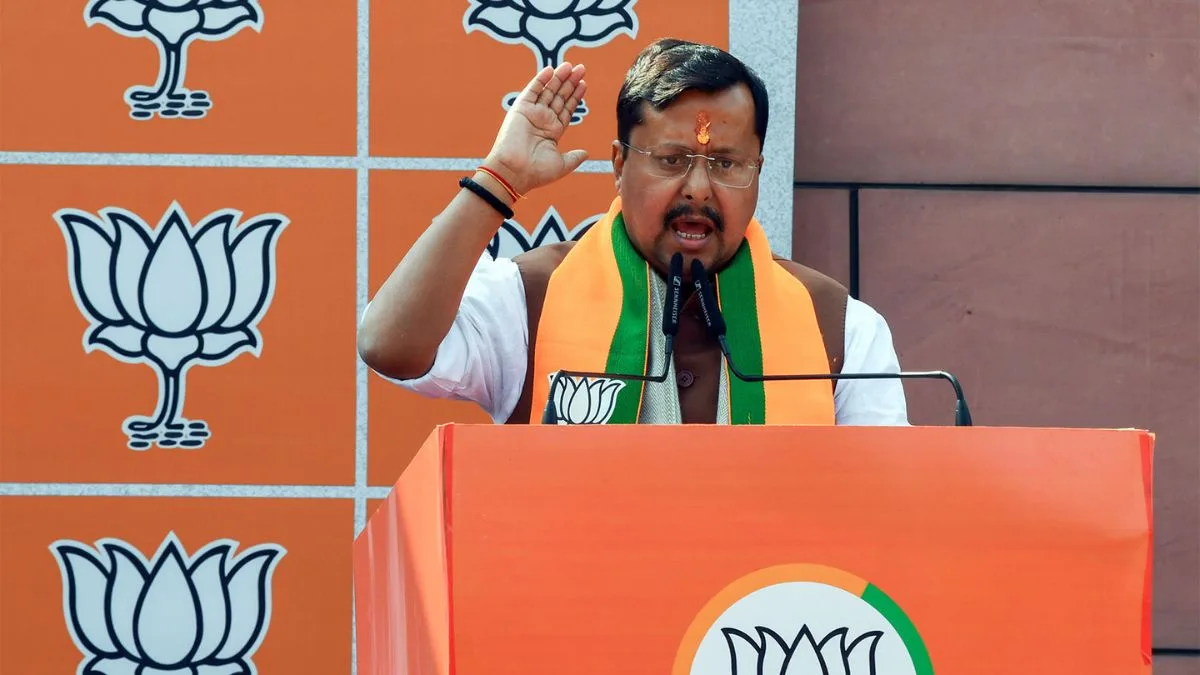
In the vast and vibrant tapestry of Indian democracy, few moments carry the weight of quiet transformation quite like the election of Nitin Nabin as national president of the Bharatiya Janata Party. To helm the world’s largest political party – one that boasts over 13 crore members-is to shoulder a responsibility that transcends mere organisational leadership. It is to steward a movement whose roots run deep into the soil of India’s nationalist awakening.
The BJP’s soul is shaped by the towering vision of Dr. Shyama Prasad Mukherjee, who laid its foundations as a bold alternative to the prevailing political order, and Pandit Deen Dayal Upadhyaya, whose profound philosophy of Integral Humanism and Antyodaya – the upliftment of the last man standing – continues to illuminate its path. “Nation First” is not a catchphrase here – it is a lived conviction. Antyodaya is not rhetoric – it is the moral thread that binds every policy and every worker.
Advertisement
In stark contrast to the Congress party, where leadership has too often been a matter of inheritance, the BJP has always celebrated the ascent of those who rise from the dust of the ground, forged by toil, sacrifice, and an unshakeable devotion to the country. Nitin Nabin’s election is the latest, luminous chapter in this enduring story of merit over lineage. Nitin Nabin steps into a legacy that is both humbling and exhilarating – a lineage of leaders who, across decades, turned a fledgling party into the dominant force of Indian politics. It begins, of course, with Atal Bihari Vajpayee and L.K. Advani, the twin pillars on whose shoulders the modern BJP stands.
Vajpayee was poetry in motion – an orator whose words could soothe a restless nation or stir its deepest pride. As Prime Minister between 1998 and 2004, he mastered the delicate balancing of coalition politics, holding together a large alliance while boldly asserting India’s place on the world stage with nuclear tests and economic reforms that still echo today. L. K. Advani, the steadfast crusader, brought fire to the cause. His Rath Yatra of 1990 was more than a journey across miles; it was a pilgrimage that reawakened India’s civilisational memory, touching chords of cultural identity that had long lain dormant. It changed the grammar of Indian politics forever.
Then came Murli Manohar Joshi, the scholar-statesman whose intellectual depth added philosophical gravitas to the party. His Ekta Yatra from Kanyakumari to Kashmir in 1992 was a defiant hymn to national unity at a time when forces of separatism threatened to tear the country apart. A young Narendra Modi, organising quietly in the background, was already preparing himself for a larger role in the years to come. The setback of the 2004 defeat tested the party’s resilience. Rajnath Singh and Nitin Gadkari stepped in, revitalising party cadres, restoring confidence, sharpening ideology, and preparing the ground for the seismic return in 2014. The Modi era brought out Amit Shah’s relentless organisational genius.
As party president, Shah redrew India’s political map – planting the saffron flag deep in the North East, making serious inroads in Bengal, and orchestrating the staggering 2017 Uttar Pradesh victory. His revolution lay in the booths: empowering the humble karyakarta, perfecting the science of micro-management, turning every worker into a pillar of electoral strength. J.P. Nadda, with his calm efficiency, carried the baton forward. He presided over the BJP’s first government in Odisha, engineered stunning recoveries in Maharashtra and Haryana, and guided the party’s fightback after the slight dip of the 2024 Lok Sabha elections – where, though short of an outright majority, the NDA under Modi’s leadership retained power with renewed purpose.
Now Nitin Nabin inherits this extraordinary legacy. His challenges are clear and compelling: to deepen the party’s roots in the south, particularly in Tamil Nadu and Kerala, where cultural and political terrain demands patient, thoughtful cultivation; and to convert the BJP’s growing electoral strength in West Bengal into enduring governance. These are not quick battles but long campaigns that call for strategic depth, coalition sensitivity, and unwavering grassroots energy. What makes Nabin particularly suited to this moment is the quiet power of his style. He is not a man of thunderous proclamations but of steady, tireless work. Low-profile yet deeply effective, he has repeatedly proven his organisational mettle.
In Bihar, he played a pivotal role in multiple assembly victories for the NDA. In Chhattisgarh, as sah-prabhari in 2023, he orchestrated one of the BJP’s most decisive triumphs, uprooting the Congress regime through meticulous planning and ground-level connect. Still in his mid-forties, he carries the gift of time. Guided by the experience of Prime Minister Narendra Modi and Home Minister Amit Shah, Nabin has the rare opportunity to grow into a stature entirely his own – blending the wisdom of tradition with the vigour of youth. Perhaps the most profound message the BJP has sent through this choice is to its millions of karyakartas: the party is ready for a graceful generational transition.
No rival formation in India matches the BJP’s foresight in nurturing tomorrow’s leaders today. Silent service is seen, recorded, and ultimately rewarded. There is no need for restless ambition when the organisation itself is a patient, meritocratic ladder. This matters immensely as India strides towards the dream of Viksit Bharat by 2047. A developed India will demand not only visionary governance from the top but also fresh, energetic leadership at every level to translate ambition into reality. In elevating Nitin Nabin, the BJP has signalled its commitment to exactly that renewal – leaders who marry ideological clarity with modern organisational craft.
In a deeper sense, Nabin’s rise is a quiet homage to Shyama Prasad Mukherjee and Deen Dayal Upadhyaya. A party that places nation above party, and party above self, now stands poised for its next leap. From strengthening its southern presence to consolidating gains across the east and beyond, the BJP under Nabin appears primed for a new era of sustained influence. In a political landscape often swayed by fleeting charisma or inherited privilege, the BJP’s institutional resilience and ideological constancy remain its greatest strengths. Nitin Nabin’s presidency is more than continuity – it is renewal. It is a watershed moment that reaffirms the party’s singular place in the story of modern India.
(The writer is a national spokesperson of BJP and an acclaimed author)