Jammu and Kashmir: Army’s rescue operation in flood-hit Rajouri saves 11 civilians
Among the 11 rescued persons, five were children. They were stranded at different places in the flood-affected district following incessant rainfall.
He was addressing the day-long National Governance Conference on “Holistic Development of Districts: Transforming Governance for Viksit Bharat”, organised by the Department of Administrative Reforms and Public Grievances under the Ministry of Personnel, Public Grievances and Pensions, Government of India, in collaboration with the Government of Jammu and Kashmir.




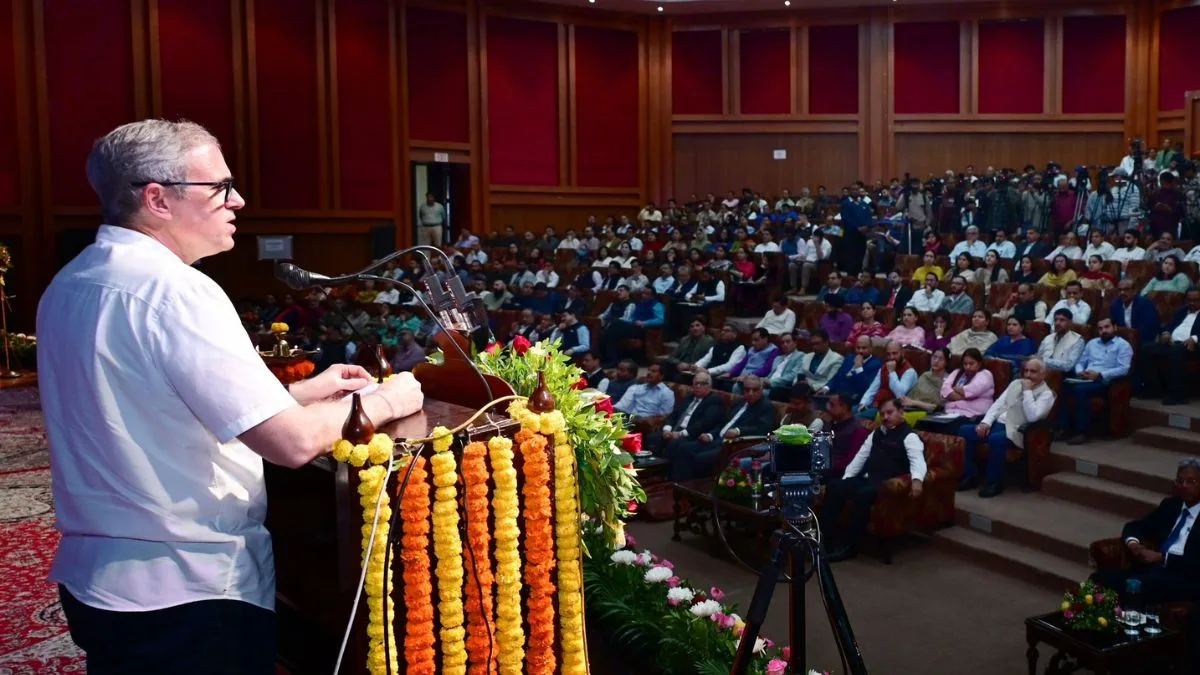
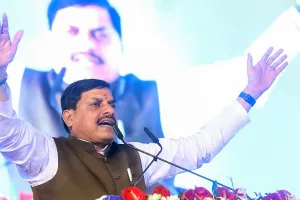
Photo: X/@CM_JnK
J&K Chief Minister Omar Abdullah on Tuesday asserted that the vision of Viksit Bharat can only be realised through inclusive and equitable development across every state and region of the country, emphasising that progress confined to select pockets would leave the national dream unfulfilled.
He was addressing the day-long National Governance Conference on “Holistic Development of Districts: Transforming Governance for Viksit Bharat”, organised by the Department of Administrative Reforms and Public Grievances under the Ministry of Personnel, Public Grievances and Pensions, Government of India, in collaboration with the Government of Jammu and Kashmir.
Advertisement
Union Minister Dr Jitendra Singh, Member of Parliament Jugal Kishore, Chief Secretary Atal Dulloo, Secretary DARPG Rachna Shah, Additional Secretary DARPG Puneet Yadav, Joint Secretary DARPG Sarita Chauhan, Commissioner Secretary, General Administration Department M Raju, senior IAS and JKAS officers, retired civil servants, and participants from across the country were present on the occasion.
Advertisement
The Chief Minister said, “The truth is that Viksit Bharat or a developed India will only be a reality if all of India develops. A developed India will not become a reality if that development is confined only to a handful of states or regions.”
Highlighting the pathway to national transformation, the Chief Minister advocated a bottom-up governance model. “India develops through conferences like this and through taking a ground-up approach rather than a top-down approach,” he observed.
He underlined that development must be anchored in good governance at the district level. “If our districts perform, our states and Union Territories perform. If our states perform, our country performs. And if our country performs, the goal of Viksit Bharat by 2047 may perhaps be realised even before the timeline we have set for ourselves,” he said optimistically.
However, he cautioned that governance challenges rarely have universal solutions. “There is no quick-fix solution. What works in one state may not work in another. What works in J&K may not work in Gujarat or Maharashtra. But we can certainly adapt and modify successful practices to suit our local conditions,” he said.
The Chief Minister, who was the guest of honour on the occasion, also spoke extensively about the transformative role of technology in governance. Referring to the shift towards digital administration, he said, “One reform that has made a huge difference is the e-office system. Paper files have virtually disappeared. We have come a long way to a point where I rarely see a paper file.”
He noted that digitisation has enhanced efficiency and accountability, though it has also introduced new challenges. “Every file is now time-stamped. Technology has made life easier but also more transparent and demanding,” he observed.
Emphasising practical reforms, the Chief Minister called for genuine implementation of citizen-centric initiatives. “If we have a single window, it should actually function as a single window,” he remarked.
Advertisement