A woman from a remote village in Jharkhand’s Ramgarh district has transitioned from informal wage labour to diversified rural enterprise with the support of a self-help group and state livelihood mission. Her journey reflects the incremental but significant transformation taking place at the grassroots level.
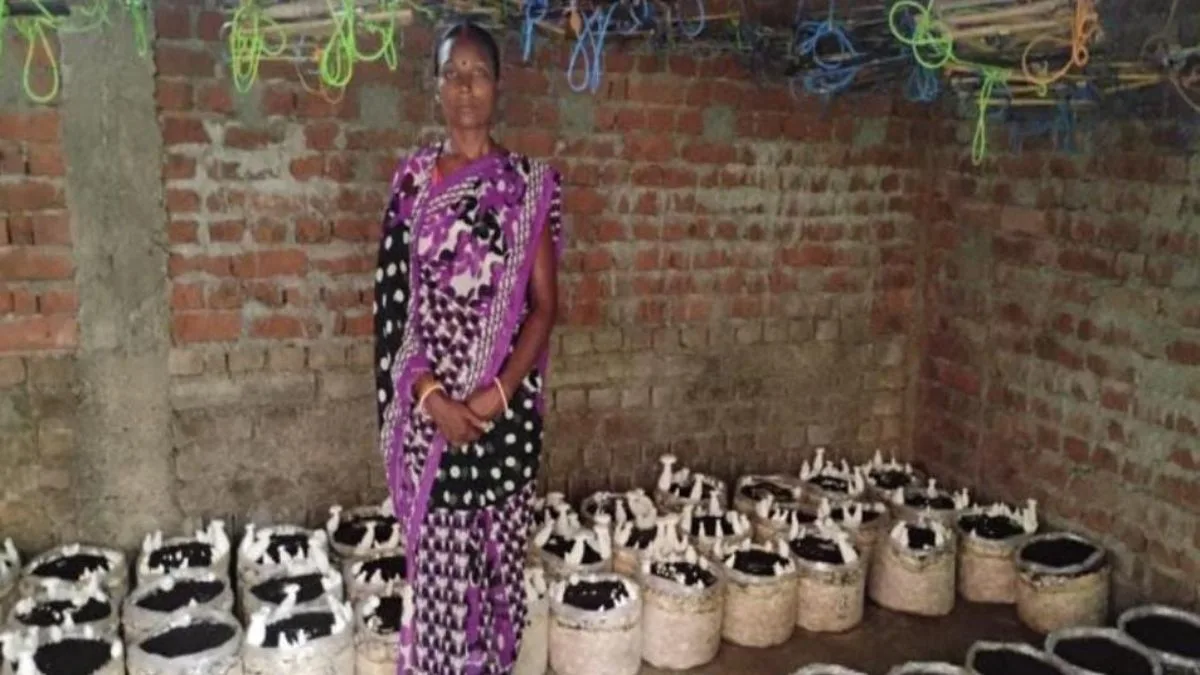
Arpana Devi, a resident of Nawaadih (Harubera) in Gola block, was once dependent on seasonal agricultural labour to sustain her family. With her husband physically disabled and no steady source of income, she carried the full burden of raising children and managing household expenses. Income was irregular and options were limited.
Advertisement
In 2016, she joined Sanyukt Mahila Samiti, a self-help group (SHG) formed under the Jharkhand State Livelihood Promotion Society (JSLPS), an implementing body under the National Rural Livelihoods Mission (NRLM). The SHG began with collective savings and regular meetings, enabling women to access credit and livelihood support.
The following year, Arpana underwent training in mushroom cultivation, facilitated by JSLPS. With a loan of ₹10,000 from the SHG, she started a small production unit. Over time, she scaled up operations and now produces 250–300 kilograms annually, earning ₹45,000–₹60,000 through local sales.
She diversified her activities by purchasing two cows, generating additional monthly income from milk sales. She also initiated vermicompost and organic manure production using cow dung, adding an estimated ₹10,000–₹15,000 annually. Her total annual income now exceeds ₹1.1 lakh.
Besides financial gains, Arpana’s involvement in the SHG led to increased confidence and participation in local training programmes. She now helps other women understand basic enterprise planning, savings discipline, and financial literacy. Her engagement has positioned her as an informal leader in the community.
The SHG model, supported by NRLM and state missions like JSLPS, has expanded in Jharkhand over the last decade, focusing on women-led microenterprises in agriculture, livestock, and allied sectors. In areas like Nawaadih, such groups have evolved into platforms for local knowledge exchange, credit access, and livelihood planning.
While still vulnerable to market fluctuations and limited by scale, Arpana’s case demonstrates the role of structured support and collective effort in enabling women to build sustainable rural livelihoods. Her transition from informal labour to diversified enterprise underlines the relevance of the multi-income model for rural economic stability.
Her story is being cited by field workers and livelihood coordinators as a replicable example in nearby blocks. Though her unit remains modest, the model reflects a larger trend of women-led enterprise growing in rural Jharkhand.