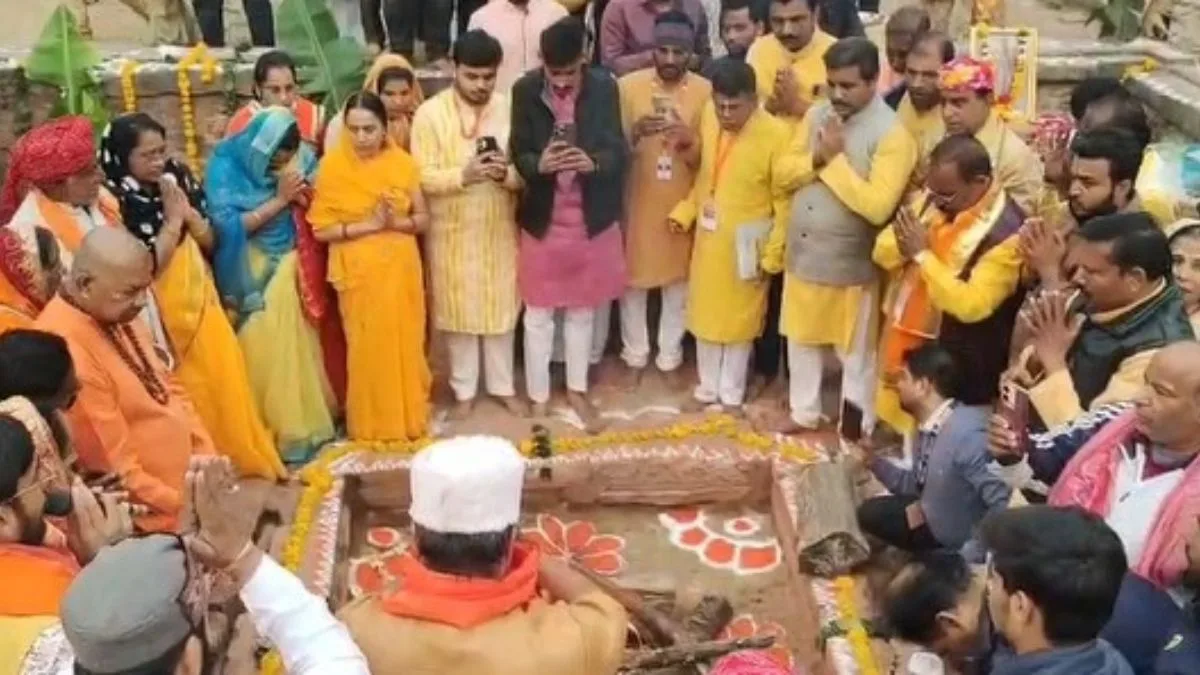
Saraswati Puja was held on Friday at the disputed Bhojshala Temple–Kamal Maula Mosque complex under heightened security, following clear directions from the Supreme Court of India. The order allowed Hindu prayers from sunrise to sunset on Basant Panchami, while permitting Muslim congregational prayers between 1 pm and 3 pm.
The arrangement mattered because Bhojshala remains one of central India’s most sensitive religious sites, with overlapping claims by Hindu and Muslim communities. Any deviation has historically raised fears of unrest.
Advertisement
From early morning, Hindu devotees arrived to offer prayers to Goddess Saraswati. Later in the day, members of the Muslim community were scheduled to gather for namaz. Authorities sealed the area with layered security to ensure the two prayer windows remained separate and peaceful.
What the Supreme Court allowed
The top court’s decision came a day earlier, after the Madhya Pradesh government assured it could manage law and order. Acting on that assurance, the district administration deployed more than 8,000 personnel, including police and Rapid Action Force units, across the town.
Dhar Collector Priyank Mishra said preparations were complete and maintaining public order was the administration’s primary responsibility. He also warned that any attempt to provoke religious hatred, through print, broadcast or social media, would invite strict legal action under the Bharatiya Nyaya Sanhita and the IT Act.
The site itself is protected by the Archaeological Survey of India. Since April 2003, an ASI-arranged schedule has allowed Hindus to perform puja on Tuesdays and Muslims to offer Friday prayers, a system designed to prevent clashes.
Chief Minister Mohan Yadav, currently in Davos, marked Basant Panchami with a public message. “Heartfelt greetings of Basant Panchami to the people of the state and the entire country. May the grace of Maa Saraswati… fill everyone’s life with wisdom, creativity, happiness, and prosperity,” he wrote on X.
‘Decision is temporary’: Sadhvi Pragya questions long-term resolution
Political reactions followed quickly. BJP leader and former MP Sadhvi Pragya Singh Thakur described the Supreme Court’s order as an interim step rather than a final settlement.
“I have great respect for the Supreme Court because it is a constitutional institution. However, this decision is temporary. There is a systematic way regarding this decision, so that they can offer their namaz and we can perform worship according to our own religion,” she told IANS.
Referring to the site’s contested past, she added, “The Saraswati garden, where an axe-like blow was struck during the period of slavery, has still not received justice as a temple even today.”
The Supreme Court bench also directed that copies of a scientific ASI survey of the site be shared with all parties. The survey relates to the monument’s structure and history — material that could shape the next phase of legal proceedings.
For now, prayers are underway as ordered. The dispute, however, remains open.