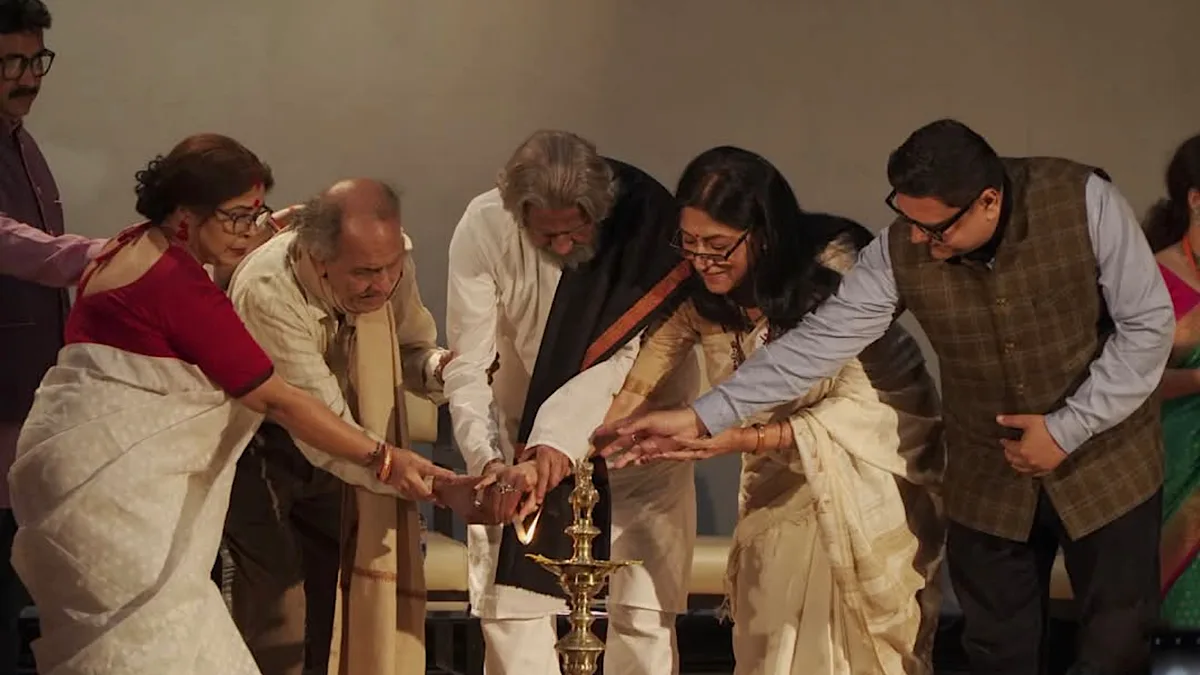
In an age when independent artistic expression often struggles to find room to breathe, a new cultural initiative from Bengal is attempting to reclaim a space once intrinsic to India’s creative conscience. Roopantor—literally meaning ‘transformation’—has launched as an alternative platform to nurture voices and visions that often remain unheard in the mainstream. With the guiding credo “Onno Shor, Ononno Shilpo” (A Different Voice, A Unique Art), the platform seeks to reconnect Bengal’s historic artistic identity with the larger canvas of India’s cultural life. Envisioned as a home for independent theatre practitioners, filmmakers and craftspeople, Roopantor intends to counter what its organisers call a growing “noise over nuance” in contemporary cultural discourse. Its emblem and philosophical foundation draw from Abanindranath Tagore’s famed 1905 painting—a modern reinterpretation of the ‘New Bharat Mata’, not as a fixed icon but as a living idea of empathy, awakening and national self-reflection. Roopantor’s journey began with its first major event, the ‘Bongiyo Natyo Utsob’, organised in collaboration with the Indian Museum and curated by Titas Noyabad. The festival was inaugurated on 3 December by veteran theatre personality Rudraprasad Sengupta of Nandikar, whose presence underscored the continuity between Bengal’s theatrical past and its evolving present. The opening evening featured Dakshineswar, staged by the theatre group Srijon—a performance that set the emotional pitch for a festival showcasing ten carefully selected plays. The productions, organisers said, were chosen to mirror the tensions, anxieties and aspirations shaping modern society, offering audiences a space for reflection beyond the predictable cycles of mainstream entertainment.
Roopantor will launch its inaugural film festival on 20–21 December.
Advertisement
At its core lies a Film Creators Contest that offers prize money and jury-selected awards, aiming to support emerging talent at a time when independent cinema faces shrinking platforms. The event will screen shortlisted films and host conversations with directors, actors and technicians whose work has redefined cinematic language or pushed boundaries in recent years. Former Rajya Sabha MP and actor Roopa Ganguly, associated with the initiative, articulated the sentiment driving Roopantor. “It rises not as nostalgia, but as a new note in an unfinished song,” she said. “We recognised the need for an alternative space in Bengal where independent voices could thrive outside the mainstream spotlight. This platform is that bridge—for every dreamer who believes cinema can still heal, not hurt. My message is for every filmmaker who believes art is meant to unite, not divide.” Her words echo a deeper historical memory.
For decades, Bengal had shaped India’s creative imagination—from the fires of its literary movements to the quiet revolutions of its cinema. It offered the nation its first lens of introspection, teaching images to carry humanity and silence to hold meaning. The legacy of auteurs such as Satyajit Ray and Ritwik Ghatak positioned Bengal at the heart of global cinematic discourse. Yet as cultural priorities shifted, many felt that the region’s once-defining artistic pulse had softened. Roopantor seeks to counter that drift, signalling a renewed assertion of Bengal’s place in the national cultural conversation. The platform’s founders see it not simply as a festival, but as the revival of an idea—that art stands above divisions, transcends geography and predates fear. In its ambitions, Roopantor frames itself as a meeting point where Bengal and Bharat reconnect—not through political symbolism, but through shared creative purpose. The initiative carries an implicit reminder: each time Bengal rises artistically, India often rediscovers a part of its own cultural soul. Roopantor hopes to be that spark again—where the east becomes light, where art remembers its origins, and where a new generation of creators finds the courage to speak in their own voice.