I had visited Rome twice before, rushing from one grand monument to another—the Colosseum, the Vatican, the Roman Forum—unaware that just a few steps from the bustling staircase leading up from the Piazza di Spagna, one of the world’s greatest poets had lived his final days.
Only during my recent sojourn did I discover that John Keats, the young Romantic genius whose poetry has stirred generations, died in Rome at the age of twenty-five. What followed was a profoundly moving experience: visiting the modest room where he breathed his last, and the quiet cemetery where he now rests.
Advertisement
Standing in those spaces, I felt his loneliness, his despair, and the cruel injustice of a life cut short—far from home, far from love, far from hope.
A Young Poet Arrives in Rome — Already Dying
Keats arrived in Rome in November 1820 accompanied only by his devoted friend, the young artist Joseph Severn. Tuberculosis—which had already taken his mother and his brother Tom—was now ravaging his own lungs. The doctors had recommended a warmer climate, but it was already too late.
He settled into a small room overlooking the Spanish Steps, now preserved as part of what became the Keats–Shelley House in 1909. The furnishings are not original—everything Keats owned was burned after his death for fear of infection—but the simplicity remains true to his final days. A narrow bed, a wooden chair where he often sat, and a small balcony where Severn would carry him to watch passersby formed the quiet world in which he awaited the end.
Keats was physically exhausted, coughing blood almost daily, often too weak to stand. Emotionally, he was devastated. He had left behind his beloved Fanny Brawne, aware that he would never see her again.
In these final weeks, his inner world was a mixture of unbearable longing, resignation, and astonishing tenderness.
Tender Letters Written on the Edge of Death
To Fanny’s mother, Keats wrote a heartbreaking note describing his regret at leaving Fanny behind, his helplessness, and his awareness that the end was near. To Fanny herself, he wrote one of the most poignant letters in literary history:
“Every hour I am more and more concentrated in you… I cannot leave you. I shall never taste one minute’s content until it pleases chance to let me live with you for good… I am glad there is such a thing as the grave—I am sure I shall never have any rest till I get there.”
These lines reveal a young man clinging to love as the only remnant of life worth holding.
The Balcony and the Fading World Below
During his last days, too weak to walk, Keats would ask Severn to carry him to the small balcony so he could watch people climbing the staircase below. Their laughter, their conversations, their everyday joys reminded him of the life slipping away from him.
He occasionally looked up at the painted flowers on the ceiling, telling Severn he imagined them “growing behind my grave.” It was a haunting image—a young poet envisioning blossoms over the soil that would soon cover him.
The Final Four Days: Agony and Acceptance
In February 1821, Keats’s condition worsened dramatically. Dr. James Clark, who treated him in Rome, eventually halted all medical treatment, believing that further intervention would only prolong suffering. Keats refused laudanum because he feared it would hasten death, which meant he faced his final days without relief from the unbearable pain.
Severn recorded that Keats would cry out in the night, saying:
“Severn—I feel the flowers growing over me.”
On some mornings he asked if he had died in the night, disappointed to find he had not. On others, he tried to speak about poetry but lacked the strength.
Then, on 23 February, the end came. Keats, struggling for breath, looked at Severn and whispered his final words:
“Severn—lift me up, for I am dying.
I shall die easy—don’t be frightened—thank God it has come.”
He died around 11 p.m., in the arms of his loyal friend, after months of unrelenting suffering.
He was twenty-five.
A Tombstone Without a Name
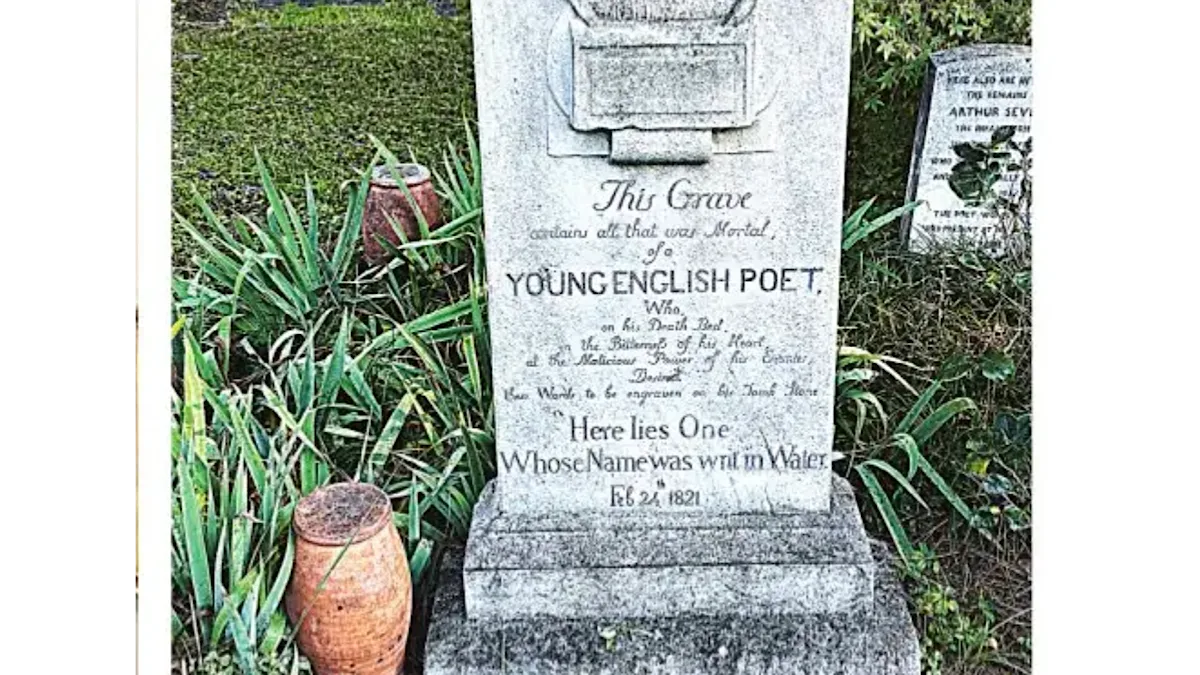
Keats was buried in the Protestant Cemetery in Rome, a serene corner watched over by cypress trees and the ancient Pyramid of Cestius. His tombstone bears no name, only the words he chose:
“Here lies One
Whose Name was writ in Water.”
He believed he would be forgotten—that his name would dissolve like writing on a river’s surface.
When I visited his grave, I was struck not only by the simplicity of the stone but by the absence of visitors. There were no fresh flowers, no crowd paying homage. It felt unbearably tragic that a poet who gave the world so much beauty died believing his work was worthless.
But he was wrong.
His poetry endures.
His lines still stir the heart.
His voice has not faded.
A Final Reflection
Keats’s final days remind us that the human spirit does not always roar—sometimes it simply endures. What moves us is not the triumph of a hero, but the quiet courage of a young man who kept feeling, kept hoping, kept loving, even as life closed its doors around him.
He wrote with lungs full of blood.
He loved knowing he would never marry.
He dreamed of spring while watching his own life fade in a Roman winter.
His suffering was real, and so was his tenderness. And somehow, through all that pain, he preserved a gentleness of soul that time has not erased.
Keats teaches us that even when circumstances crush the body, they cannot extinguish the capacity for beauty. He left the world with almost nothing—no wealth, no health, no acclaim—and yet he gave us lines that make strangers weep two centuries later.
He believed no one would remember him.
Today, the world knows his name.
And perhaps that is the real lesson of Keats:
that a life can be unbearably tragic and still be filled with meaning;
that we may be broken, yet still capable of giving something luminous to others;
that the final measure of a human being lies not in victory, but in the tenderness we carry even as we lose.
(The writer is professor emeritus at Loyola Marymount University, Los Angeles.)