The newly elected West Bengal government is actively working to reopen closed jute mills across the state, with a specific focus on reviving all 18 jute mills in the Barrackpore industrial belt along the river Hooghly. But little did we remember that across the river, a jute mill in Rishra holds an immense historical uniqueness. History often remembers wars through battles. Cities remember them through ruins.
But sometimes the deepest impact of war lies not in destruction but in the habits and memories it leaves behind. For over three centuries, since its emergence as an early modern urban centre under the East India Company, Kolkata has remained remarkably untouched by war. Empires rose and collapsed here. Famines killed millions. Refugees repeatedly altered its demography. Political upheavals changed its destiny. Yet military conflict unfolding physically within the city was witnessed only twice: Siraj-ud-Daula’s siege in 1756 and the Japanese bombing raids during the Second World War.
Advertisement
On 15 April 1944, while Bengal was still emerging from severe famine and the war in Asia was entering its final violent phase, another extraordinary wartime experiment quietly began on the banks of the Hooghly. It would survive barely twenty months, ending in December 1945, and yet Kolkata has almost entirely forgotten it. At Rishra, barely twenty-five kilometres north of the city, the United States Army Air Force created what may have been the largest fully functioning self-contained wartime city in Bengal: Hastings Air Base, Headquarters of the U. S. Army Air Force in the China-Burma-India (CBI) Theatre under Lieutenant General George E. Stratemeyer. It was not an airfield. It was not a military barracks. It was something stranger.
It was America itself, temporarily built in Bengal. The story began inside the old Hastings Jute Mill. Originally owned by Warren Hastings in the eighteenth century, the property later passed into the hands of the Birkmyre family of Glasgow and became one of India’s largest jute mills. In early 1944, as Allied operations intensified against Japan, U.S. commanders decided to shift the CBI Air Force headquarters from Delhi to a location closer to the Burma front. They selected Hastings Jute Mill for the purpose. The mill’s production was shifted elsewhere.
Machinery was dismantled and removed. Within weeks, forty acres of industrial Bengal were transformed into the nerve centre of the U.S. Air Operations in Asia. And a point to note is that the U.S. had no dedicated cantonment or air base entirely under its own control till then. But why convert a jute mill into an American city? The answer lay in the peculiar nature of the war being fought from Bengal. Unlike the brutal ground war being fought through Assam, Nagaland and Burma by British and Indian forces, America’s war in the China-Burma-India theatre was fundamentally an ‘air war’.
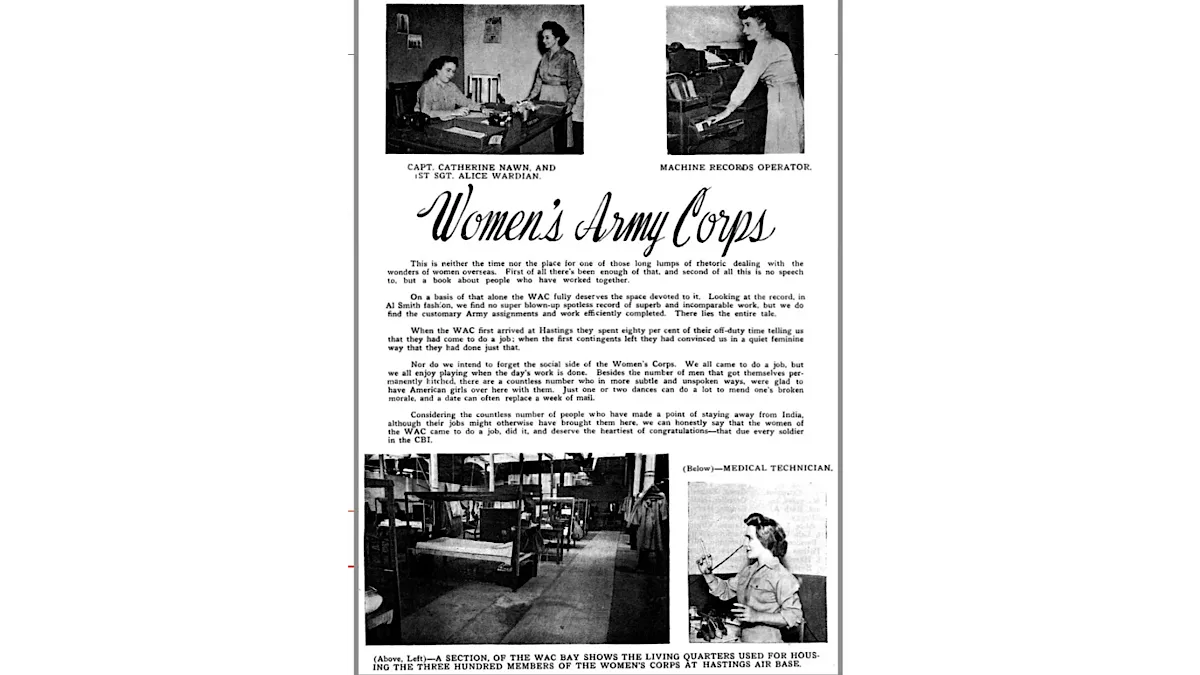
Aircraft carried fuel, men, ammunition, equipment and supplies into China and toward the Burma front. In such a war, pilots, navigators, radio operators, engineers and maintenance crews became irreplaceable assets. Disease could be as dangerous an enemy as the Japanese bombs for such people. A December 1945 official publication, preserved today by veterans through the China-Burma-India Theatre archive, Remembering the Forgotten Theatre of World War II, reveals what emerged inside Hastings over those twenty months.
More than 6,000 American military personnel, including over 700 members of the Women’s Army Corps, lived and worked inside Hastings alongside nearly 4,000 Indian civilian employees: clerks, electricians, mechanics, carpenters, cobblers, bearers, and ayahs. This was no military barracks. It was a fully functioning American city. And like any city, it needed infrastructure. The base generated its own electricity through four steam turbine generators. Nearly 750,000 gallons of water drawn directly from the Hooghly were purified internally every day through sedimentation and chlorination plants.
Kitchens served almost 150,000 meals every month. The communications division operated more than 500 telephones, processing nearly 7,000 calls daily, linking Hastings directly to Allied operational centres across India, China and Ceylon. The postal unit handled roughly 4,000 incoming parcels every month. During Christmas alone, incoming packages crossed 30,000. Thousands of kilometres away from home, America had created a logistical umbilical cord stretching from Bengal back to the United States.
But what made Hastings extraordinary was not merely its scale. It was the obsessive discipline under which the Americans chose to live. Malaria and cholera remained among the greatest threats facing Allied forces in eastern India at that point in time. Stagnant water and open drainage channels were regularly treated with crude oil to eliminate mosquito breeding sites. The entire forty-acre compound and surrounding perimeter were repeatedly sprayed with DDT from light aircraft. Residential Barracks, offices and workshops were fumigated several times a week.
Beds were inspected daily for insect infestation. Every environmental risk was monitored relentlessly. America had come to fight Japan. But first, it had to defeat malaria and cholera. Food procurement remained tightly controlled. Bread was baked internally. A single infection disabling an aircrew member could jeopardise critical wartime operations. And so, inside Bengal, America recreated not simply a headquarters. It recreated itself. That American world extended beyond military necessity. Inside Hastings stood a fully operational Post Exchange (PX), effectively a miniature American department store.
Records show that between 1944 and 1945, the PX sold over 1.6 million bottles of beer and more than 270,000 cartons of cigarettes while proudly advertising the arrival of “ice cold, stateside Cokes.” Coca-Cola. On the Hooghly. In wartime Bengal. Air Base inventories also list refrigerators and ice boxes, revealing a modern cold-storage infrastructure still unusual in wartime India. But Hastings was not merely about logistics. It was also about recreating normal American life as closely as possible. The American Red Cross operated a leisure centre called the ‘Swelter Shelter’ inside the base. It housed a bar, recreation rooms, a gymnasium and a photography laboratory.
Photography was the biggest wartime hobby among GIs and air crews. Weekly dances were organised. Even while fighting a global war, America was determined to carry its habits, comforts and culture with it. Because beyond the gates of Hastings stood another world altogether. A U.S. Army handbook called The Calcutta Key, prepared for arriving servicemen, repeatedly warned troops against cholera , dysentery, contaminated ice, unsafe food, unsafe drinking water, and sexually transmitted diseases prevalent in the city.
Yet the same handbook directed off-duty Americans toward Firpo’s, Grand Hotel, Great Eastern Hotel, Continental Services Club and Chowringhee’s entertainment circuit, where bars, floor shows, dance clubs and what the guide cheerfully called “real jive music” awaited them. Long before Park Street became Kolkata’s nightlife district, wartime Chowringhee had already become an Allied leisure geography. And ordinary Indians were watching. Archive photographs show thousands of Indian workers entering Hastings every day. Local clerks sat beside American officers. Technicians worked on electrical systems. Mechanics, tailors, carpenters and sign painters worked alongside U.S. personnel. They entered an unfamiliar world of refrigeration, switchboards, consumer retail, industrial kitchens and organisational discipline, and each evening returned to their own homes.
It is difficult to know how deeply such encounters shaped post-war urban habits. But this may well have been where wartime influence quietly operated, not merely through elite colonial clubs and hotels, but through thousands of ordinary Indians encountering American modernity at an industrial scale for the first time. Hastings was the headquarters of a far wider American wartime aviation network spread across Dum Dum, Barrackpore, Alipore, Panagarh, Kalaikunda and Asansol, while cargo operations centred on the Kidderpore docks, the Howrah and Sealdah rail systems, where segregated African-American military units handled much of the supply chain feeding the Allied war machine.
And then the war ended. The Americans left. The base was dismantled. Yet Hastings has not disappeared entirely. The old mill at Rishra, still a privately owned going concern and arguably India’s earliest jute bag manufacturing factory, continues to stand on the western bank of the Hooghly. Inside its ageing compound survive the vast dance hall once used by servicemen, a century-old Lancashire boiler, the towering brick chimney that once symbolised Bengal’s industrial age, a river jetty, and even wartime bunkers, silent witnesses to that savage war. However, we scarcely remember, though, that just over 80 years ago, a unique township was established on its premises that ensured victory over the nazis and fascists in Asia. (1350) The writer is an author, narrative history writer and columnist