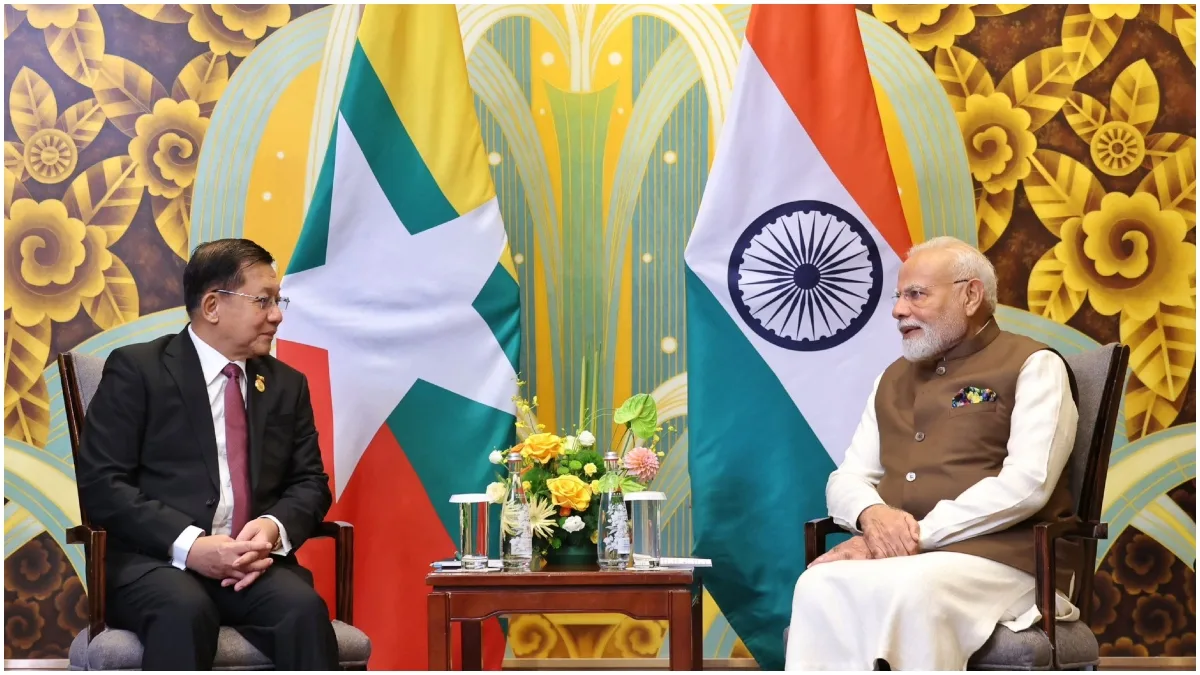
Five years after Myanmar’s military seized power and plunged the country into a prolonged civil conflict, a new reality is emerging across Asia. Whatever reservations governments may harbour about the legitimacy of Myanmar’s political order, few can afford to ignore the country any longer. The significance of Myanmar President Min Aung Hlaing’s trip to India lies not merely in the diplomatic optics of a state visit.
It reflects a broader recalibration in regional geopolitics. Nations that once hoped international pressure would compel a democratic transition in Myanmar are increasingly confronting a more uncomfortable fact: geography often outlasts ideology. For India, Myanmar is not a distant foreign policy concern but an immediate strategic neighbour. The two countries share a long and porous border. Instability in Myanmar has direct consequences for India’s northeastern states, affecting migration, security, insurgency management and cross-border commerce. No government in New Delhi can formulate a serious regional strategy while treating Myanmar as a diplomatic outcast.
Advertisement
This is not the first time India has balanced democratic ideals with strategic necessity. During the Cold War and afterwards, successive governments engaged regimes of varying political character when national interests demanded it. Myanmar presents a similar dilemma. Publicly emphasising inclusive politics and reconciliation remains important, but engagement has become unavoidable if India wishes to influence outcomes rather than merely comment on them. There is also a larger geopolitical calculation at work. China’s footprint in Myanmar has expanded steadily over the past decade through infrastructure projects, energy corridors and strategic investments. For Beijing, Myanmar offers access to the Bay of Bengal and a valuable alternative route that reduces dependence on maritime chokepoints farther east.
Any vacuum left by other powers is unlikely to remain vacant for long. India’s response appears increasingly shaped by this reality. Engagement with Myanmar is no longer simply about border management; it is about preserving strategic space in a region where competition among major powers is intensifying. The logic is straightforward. Isolation may satisfy moral instincts, but it rarely produces influence. Dialogue, economic engagement and security cooperation, however imperfect, provide leverage that distance cannot. The changing international environment reinforces this trend. Western sanctions and diplomatic pressure have not fundamentally altered Myanmar’s political trajectory. At the same time, global attention has shifted to other crises.
As external pressure weakens, regional actors are assuming greater responsibility for managing the consequences of Myanmar’s internal conflict. None of this means that concerns about democracy, human rights or political freedoms have disappeared. Rather, it suggests that governments are increasingly separating their long-term aspirations from their immediate strategic requirements. The lesson is clear. Asia’s geopolitical landscape is entering a phase where pragmatism is eclipsing symbolism. Myanmar’s future remains uncertain, but one conclusion is already evident: regional powers have begun adjusting to the government that exists, not the one they would prefer. For India, that adjustment is less an endorsement than an acknowledgement of reality.