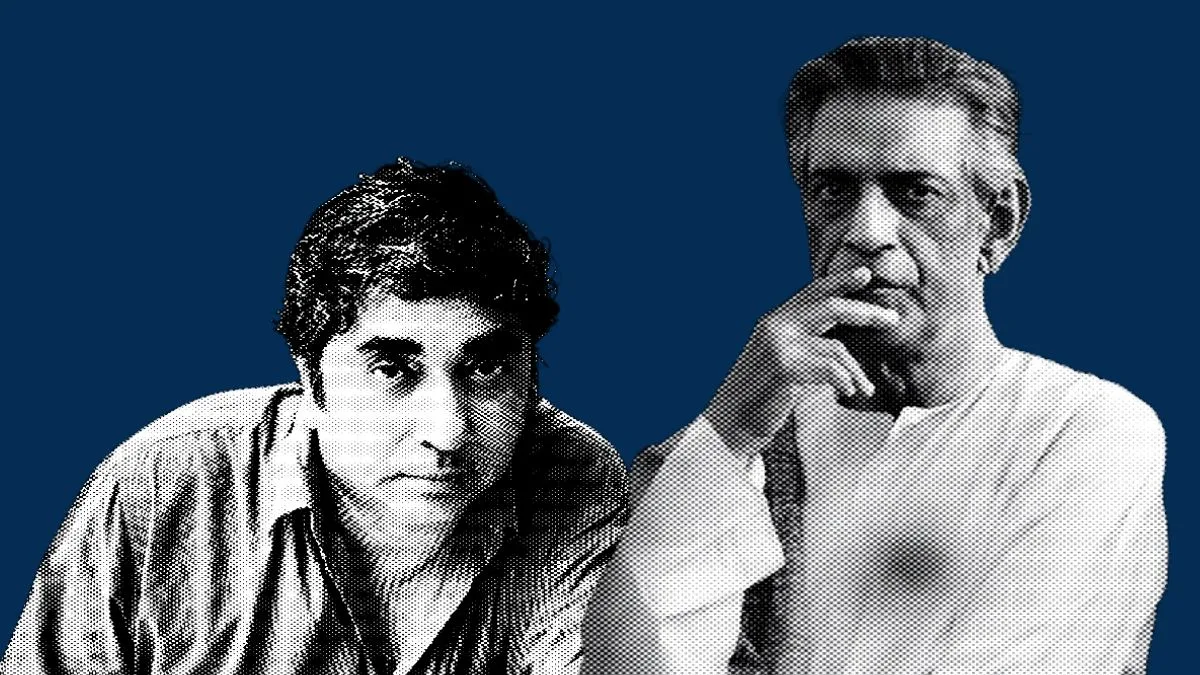
Anik Dutta was one of Bengali cinema’s most respected voices. His films carry a distinct personality. They are witty, rooted in Kolkata, and soaked in nostalgia. But there is another quality that runs through all of them: a deep, visible debt to Satyajit Ray. That debt is not a weakness. It is the spine of his creative life. To understand Dutta’s cinema, you have to understand what Ray meant to him and how that meaning translated onto the screen over more than a decade of filmmaking.
Growing up in Ray’s shadow
Dutta grew up in Jodhpur Park in south Calcutta. He describes his cinematic education as being shaped by what he calls the “Brahma, Vishnu, and Maheshwar” of Bengali cinema: Ray, Mrinal Sen, and Ritwik Ghatak. Of the three, Ray was the most inescapable. Dutta has spoken about how Ray is not just a filmmaker but an atmosphere.
“You breathe him in Calcutta,” he had said. “His influence paralyses you sometimes, you think, what’s the point, Ray has already done it. But the answer is not to compete, but to continue the conversation he began.”
That framing, continuing a conversation, matters. Dutta did not simply copy Ray. He responded to him. His films picked up threads from Ray’s work and pull them in new directions. Sometimes the references are clear and deliberate. Other times, they surface in tone, structure, moral outlook.
Bhooter Bhabishyat: Debut soaked in Ray
Dutta’s debut feature, ‘Bhooter Bhabishyat’ (2012), arrived as a major surprise. Made on a budget of Rs 0.6 crore, it earned Rs 3 crore over its theatrical run and became one of the biggest Bengali hits of that year. The film is a fantasy-comedy about ghosts from different eras of Kolkata’s history who are threatened by real estate developers.
The Ray influence is woven into every layer of the film. Several reviewers noted that the dynamic between the film’s narrator and its protagonist closely mirrors the relationship between Feluda and his assistant Topshe from Ray’s detective fiction. The rhyming dialogues throughout the film are a direct tribute to ‘Hirak Rajar Deshe’ (1980), Ray’s political fantasy in which characters speak in verse as a form of satirical commentary. In ‘Bhooter Bhabishyat’, almost every character rhymes their lines, creating the same comic and critical effect.
The film’s broader premise also draws from Ray’s ‘Goopy Gyne Bagha Byne’ (1969). Dutta himself was never shy about these borrowings. He acknowledged them openly.
The film’s theme also aligns with Ray’s own concerns. Ray was deeply attached to Calcutta’s heritage and was known for his sensitivity to the city’s changing face. ‘Bhooter Bhabishyat’ deals with exactly that; heritage buildings demolished, old culture erased.
The satirical thread
Ray’s ‘Hirak Rajar Deshe’ remains one of Bengali cinema’s most pointed political satires. Released in 1980, it used a fantasy setting to criticise authoritarianism. The film is part of Ray’s Goopy-Bagha trilogy and is famous for its brainwashing machine and its portrait of a vain ruler who suppresses dissent.
Dutta has cited this film repeatedly as a touchstone. His use of rhyming dialogue is directly lifted from that tradition. But the influence goes further than technique. Dutta has consistently used satire as his mode for political commentary. His 2019 film ‘Bhobishyoter Bhoot’ was pulled from cinemas in West Bengal just days after release. Dutta is a known critic of the Mamata Banerjee-led government, and the film was widely read as a political satire. The parallels with what happened to Ray, who also faced pressure over politically charged work, were not accidental.
In ‘Bhobishyoter Bhoot’, Dutta again used supernatural imagery and rhyming verse to construct social critique, keeping alive the tradition Ray had established in ‘Hirak Rajar Deshe’. It was a statement of artistic lineage.
Aparajito: The most personal tribute
Nothing defines Dutta’s relationship with Ray more clearly than ‘Aparajito’ (2022). The film is a fictionalised account of the making of ‘Pather Panchali’ (1955), Ray’s debut film and one of the landmarks of world cinema. ‘Pather Panchali’ went on to win the Best Human Document prize at Cannes in 1956 and earned the National Award for Best Feature Film in India.
Dutta shot ‘Aparajito’ in black and white. The film was made with the formal permission of Sandip Ray, Satyajit Ray’s son. Every character name was changed. Ray becomes Aparajito Ray, nicknamed Apu. His debut film becomes ‘Pather Padabali’. The title ‘Aparajito’ is itself borrowed from Ray’s own second film in the Apu trilogy, released in 1956.
Actor Jeetu Kamal played Ray with remarkable physical accuracy, reportedly undergoing dental procedures to match Ray’s appearance. Sandip Ray himself was moved by the portrayal.
The film covers the two-and-a-half-year struggle Ray endured to complete ‘Pather Panchali’. The entire crew was inexperienced. There was no financial support from established producers. Ray reportedly sold personal belongings to fund portions of the shoot. Dutta captured this period with care and restraint by avoiding hagiographic tone that derails most Indian biopics.
‘Aparajito’ was screened at the National Museum of Indian Cinema in Mumbai on the occasion of Ray’s birth anniversary in 2022 as part of a centenary retrospective. It was also shown at the London Indian Film Festival 2022 and selected for screening at the Toronto International Film Festival under the section titled “Satyajit Ray: His Contemporaries and Legacy.” The filmswept eight WBFJA (West Bengal Film Journalists’ Association) awards in 2023, including Best Film and Best Director. It also won the Best Screenplay award at the 21st Dhaka International Film Festival and took home two National Film Awards in 2024 for Best Production Design and Best Makeup.
Dutta described the process of making the film as a personal route to self-discovery. Working through Ray’s oeuvre again brought him face to face with how political Ray actually was. “Even though ‘Hirak Rajar Deshe’ is a children’s film, we know how relevant its message is even now,” he noted back in the day.
Joto Kando Kolkatatei: Feluda walks again
In 2025, Dutta released ‘Joto Kando Kolkatatei’, a mystery thriller set against the backdrop of Durga Puja in Kolkata. The film stars Abir Chatterjee as a character named Topshe, directly borrowing the name of Feluda’s assistant from Ray’s beloved detective fiction series.
Feluda himself, the fictional detective Ray created, is referenced as a living legend within the film’s universe.
The plot follows a young woman from Dhaka who arrives in Kolkata chasing her ancestral history through an old photograph. A letter from her great-grandfather sets off a trail across the city’s heritage spaces. Dutta described the film as not strictly a detective story but something closer in spirit to how Ray used mystery as a frame for exploring memory, place, and belonging.
Released on 26 September 2025, the film earned strong box office numbers during the Puja season and drew an IMDb rating of 7.4 from over one hundred thousand votes. It marked the fourth time Dutta collaborated with producer Firdausul Hasan, the same producer behind ‘Aparajito’.
What all of this means
Dutta’s films do not treat Ray as a museum exhibit. They treat him as a living interlocutor. Each film picks something from Ray’s body of work and puts it to new use. The rhyming dialogue from ‘Hirak Rajar Deshe’ becomes a tool for ghost comedy and political satire. The Feluda universe becomes a frame for stories about memory and identity. ‘Pather Panchali’ becomes a meditation on what it takes to make art without support.
This is not mere fanhood. It is a sustained creative dialogue with one of cinema’s great legacies. Dutta had said himself that Ray functions as an atmosphere in Calcutta. For Dutta, that atmosphere was both a weight and a wind at his back.