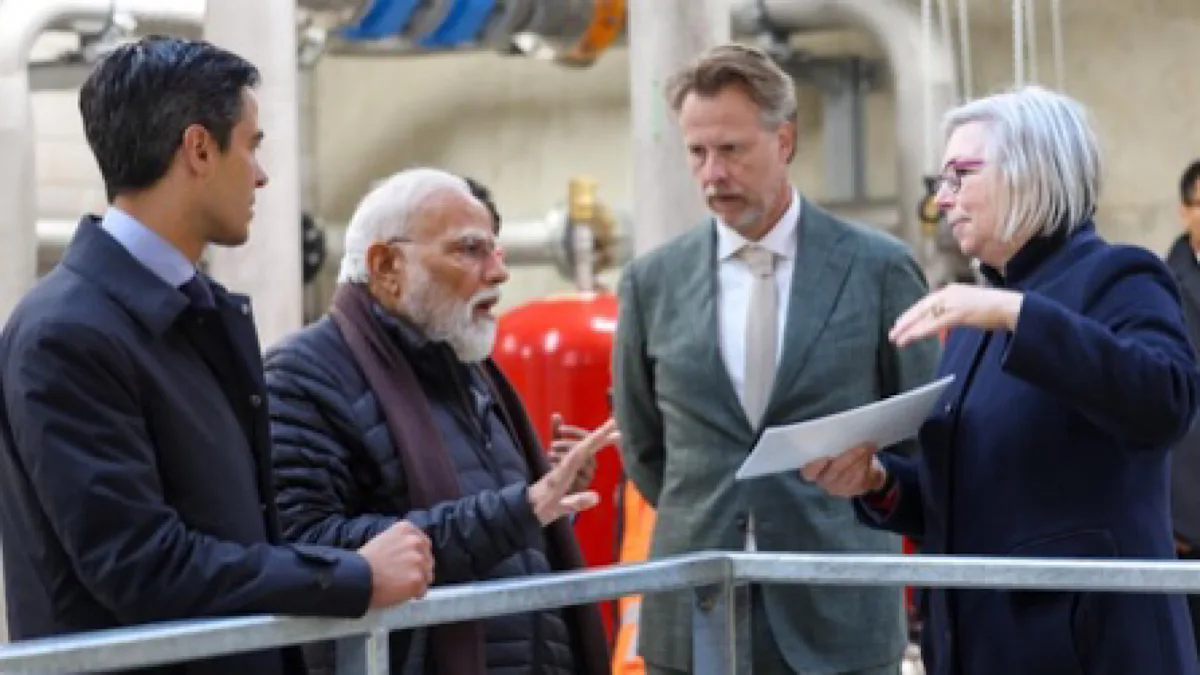
Prime Minister Narendra Modi wrapped up a high-profile visit to the Netherlands on Subnday (India time) with India and the Netherlands elevating their ties to a full-fledged Strategic Partnership and unveiling an ambitious five-year roadmap that significantly expands cooperation across semiconductors, clean energy, maritime connectivity, critical minerals, defence, healthcare, education and emerging technologies.
The centrepiece of the visit was the adoption of the “Roadmap of India-Netherlands Strategic Partnership 2026-2030” by Modi and Dutch Prime Minister Rob Jetten in The Hague, a document that officials described as one of the most comprehensive strategic frameworks India has concluded with a European partner in recent years.
Advertisement
Coming at a time of global supply-chain realignments, intensifying technological competition and growing Indo-Pacific engagement by European powers, the roadmap seeks to institutionalise long-term cooperation through annual ministerial reviews, sustained high-level political engagement and coordinated action across key sectors ranging from semiconductors and artificial intelligence to maritime security and renewable energy.
The visit also underscored India’s accelerating semiconductor ambitions, with Modi personally witnessing the signing of a landmark memorandum of understanding between Tata Electronics and Dutch chip-equipment giant ASML to support India’s first front-end semiconductor fabrication facility at Dholera in Gujarat.
“Strengthening cooperation in futuristic sectors!” Modi wrote on social media platform X after the signing ceremony. “Prime Minister Rob Jetten and I witnessed the signing of the MoU between Tata and ASML for advancing the semiconductor manufacturing ecosystem in India.”
Under the agreement, ASML will support the development and scaling of Tata Electronics’ semiconductor fabrication plant in Dholera, a flagship project under India’s $10 billion semiconductor incentive programme. The facility, which began construction in March 2024, is expected to manufacture 50,000 wafers per month using 28nm and 65nm technology nodes for automotive, communications and computing chips.
Modi linked the semiconductor partnership to India’s broader technological transformation and employment ambitions.
“India’s strides in the world of semiconductors offers immense opportunities for the youth of our nation,” the Prime Minister said. “This is a sector in which we will keep adding vigour in the times to come.”
The agreement carries major strategic significance because ASML, headquartered in Veldhoven, is the world’s only supplier of extreme ultraviolet lithography machines, which are essential for advanced chip manufacturing. Indian officials view Dutch cooperation as critical to India’s effort to move beyond semiconductor assembly and packaging into sophisticated front-end wafer fabrication.
The Tata-ASML partnership builds upon the India Semiconductor Mission launched in 2021 and Tata Electronics’ earlier collaboration with Taiwan’s Powerchip Semiconductor Manufacturing Corporation for technology transfer at Dholera. Officials said the Gujarat semiconductor facility is expected to create more than 20,000 direct and indirect skilled jobs.
The semiconductor push formed a central pillar of the broader India-Netherlands strategic roadmap, which commits both countries to deeper collaboration in artificial intelligence, photonics, quantum technologies, cybersecurity and advanced electronics. The two sides also agreed to connect the Dutch Semicon Competence Centre with the Indian Semiconductor Mission to support startups, SMEs, industries and suppliers through talent development and research cooperation.
During the visit, Modi and Jetten jointly met CEOs of some of the Netherlands’ biggest corporations, reflecting the growing economic dimension of bilateral ties. Business leaders from sectors including semiconductors, ports, logistics, healthcare, agribusiness, aviation and clean energy participated in the discussions.
Among those attending were executives from APM Terminals, ASML, Damen Shipyards Group, Heineken, KLM Royal Dutch Airlines, NXP Semiconductors, Philips, Port of Rotterdam, Power2X, Prosus, Randstad, Rijk Zwaan Zaadteelt en Zaadhandel, Royal HZPC Group, Royal IHC, Royal Vopak and Van Oord.
“We are very happy that companies like ASML, NXP and Philips are creating world-leading solutions with Indian talent,” Modi said during the interaction, while encouraging Dutch businesses to expand investments in maritime infrastructure, renewable energy, semiconductors, digital technologies, artificial intelligence and healthcare.
The roadmap outlines a sweeping expansion of economic cooperation, with both countries committing themselves to strengthening trade and investment through the Joint Trade and Investment Committee and encouraging industrial partnerships, technology collaborations, innovation ecosystems and SME participation.
Priority sectors identified include renewable energy, infrastructure, telecommunications, pharmaceuticals, medtech, agriculture, urban development, textiles, metals and chemicals. Both governments also agreed to deepen cooperation in critical minerals through a dedicated memorandum focused on exploration, supply-chain resilience, recycling, ESG standards and industrial integration.
Clean energy and maritime connectivity emerged as another defining feature of Modi’s visit. India and the Netherlands announced plans for a “Green and Digital Sea Corridor” aimed at building a sustainable and digitally integrated maritime route connecting India with Europe. Officials said the initiative would support India’s ambition to emerge as a major exporter of green hydrogen to European markets.
The two sides further agreed to establish a Joint Working Group on Renewable Energy and collaborate on green hydrogen, battery storage, bioenergy, bio-chemicals, circular feedstocks and waste-to-energy initiatives under frameworks such as the International Solar Alliance and the Global Biofuels Alliance.
The maritime dimension of the partnership also expanded considerably, with both countries committing themselves to green shipping technologies, environmentally sustainable ports and enhanced inland waterways cooperation under a renewed maritime cooperation agreement.
Another major area of collaboration involved water management and climate resilience, sectors where Dutch expertise has long been globally recognised. India and the Netherlands agreed to renew their Strategic Partnership on Water beyond 2027 and expand cooperation in integrated water resource management, flood resilience, urban water systems and river basin management, particularly in the Ganga Basin.
A Letter of Intent on technical cooperation for Gujarat’s Kalpasar Project was among the outcomes announced during the visit. The two sides also agreed to support urban river management plans and disaster-resilient water infrastructure through cooperation under the India-led Coalition for Disaster Resilient Infrastructure.
The roadmap also placed strong emphasis on agriculture, food security and biotechnology. Both countries agreed to continue the Joint Agriculture Working Group and deepen collaboration in climate-resilient agriculture, animal husbandry, veterinary and phytosanitary standards, dairy development, agricultural startups and food safety systems.
Among the key outcomes were the establishment of an Indo-Dutch Centre of Excellence for Flowers in West Tripura and an Indo-Dutch Centre of Excellence on Dairy Training in Bengaluru. A separate joint declaration on collaboration in animal husbandry and dairying was also signed.
Healthcare cooperation gained renewed momentum through a Letter of Intent between the Indian Council of Medical Research and the Dutch National Institute for Public Health and the Environment, focusing on infectious diseases, vector-borne illnesses, antimicrobial resistance, disease surveillance and One Health approaches.
The roadmap additionally calls for closer collaboration in pharmaceuticals and medical devices to strengthen resilient healthcare supply chains and deepen academic, regulatory and industrial partnerships.
Education and scientific research formed another important pillar of the visit. India and the Netherlands agreed to strengthen university partnerships, especially in STEM disciplines and semiconductor technologies. A major agreement was signed between Eindhoven University of Technology, the University of Twente and six premier Indian institutes — IISc Bangalore, IIT Bombay, IIT Delhi, IIT Gandhinagar, IIT Guwahati and IIT Madras — to create what officials described as a “brain bridge” in semiconductors and emerging technologies.
The visit also produced agreements involving Nalanda University, the University of Groningen and Leiden University Libraries, further broadening cooperation in higher education, archaeology and cultural research.
Defence and security cooperation figured prominently in the strategic roadmap as the Netherlands increases its engagement in the Indo-Pacific region. Both countries agreed to enhance naval cooperation, expand maritime exercises and explore defence technology partnerships and defence industrial cooperation. They also discussed the feasibility of institutionalising logistical support agreements for military exercises.
The two sides pledged to intensify cooperation against terrorism, cybercrime and emerging security threats while working towards a Mutual Legal Assistance Treaty and a new extradition agreement.
Migration and mobility also emerged as an important area of engagement, with India and the Netherlands signing a Memorandum of Understanding on Mobility and Migration to facilitate the movement of students, researchers, academics and highly skilled professionals while jointly addressing irregular migration.
Cultural diplomacy added a symbolic dimension to the visit, with India welcoming the restitution of Chola copper plates by the Netherlands. Indian officials described the move as a reflection of mutual respect for cultural heritage and a strengthening of historical ties between the two countries.
The leaders also reiterated support for the early conclusion of the India-European Union Free Trade Agreement, describing it as essential for building trusted supply chains, expanding open markets and promoting inclusive economic growth.
The Netherlands also officially expressed its support for India’s permanent membership in a reformed United Nations Security Council (UNSC).
For New Delhi, Modi’s Netherlands visit marked not only a significant diplomatic upgrade with a key European partner but also a strategic convergence driven by technology, resilient supply chains, energy transition and Indo-Pacific cooperation. For the Netherlands, the partnership reflects a growing recognition of India’s role as a major economic and geopolitical power at the centre of emerging global manufacturing, innovation and connectivity networks.