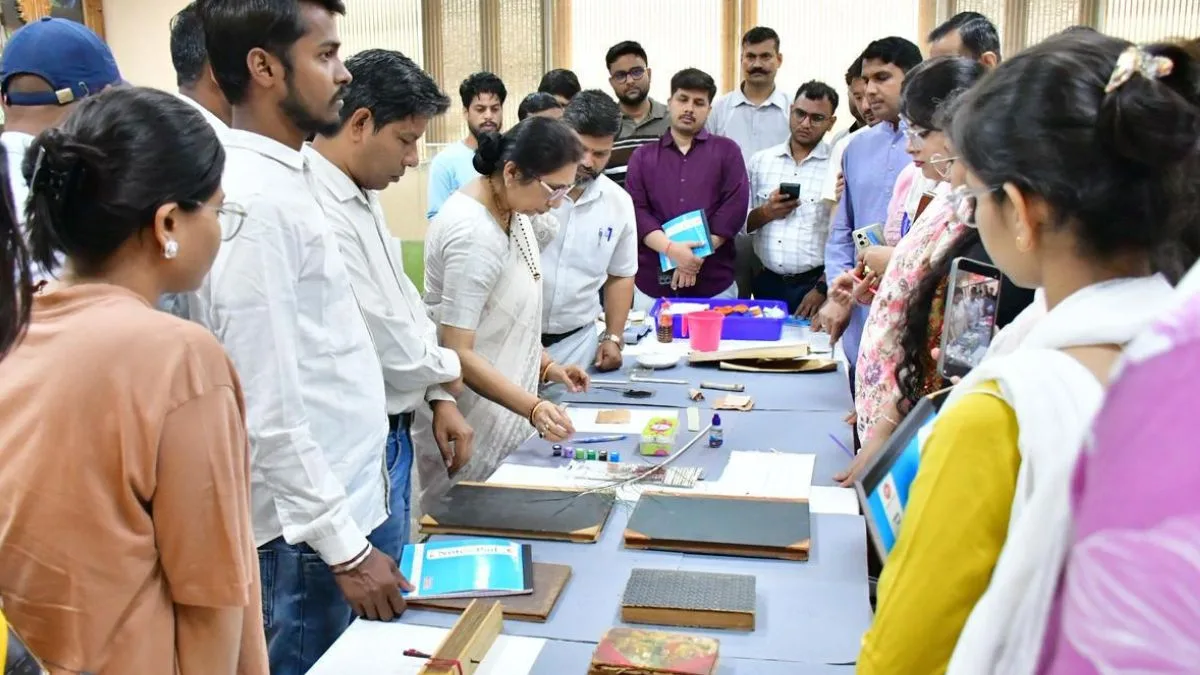
Under the Ministry of Culture (MoC), Government of India’s flagship initiative “Gyan Bharatam Mission,” a five-day workshop on “Preservation and Conservation of Manuscripts” was organized at the Patanjali Research Foundation, Haridwar.
The workshop focused on culture, heritage, conservation, and scientific methods for their stabilisation. Officials, experts, and representatives from the Ministry of Culture participated in the program. The chief guests were welcomed with garlands and presented with mementos.
Advertisement
On the fifth day of the five-day series, Acharya Balkrishna emphasized the importance of understanding the “original culture and intrinsic nature of the nation.”
He stated that the digitization of fragile and deteriorating manuscripts aims to preserve India’s ancient cultural and historical heritage for future generations.
He underlined that conservation alone is not sufficient; it is equally important to promote new writing alongside the study of ancient manuscripts.
He called for the revision and restoration of 400–500-year-old manuscripts and their presentation in renewed forms so that they may serve as invaluable heritage for future generations.
Acharya Balkrishna also stressed the need to preserve “evidence-based documents” and historical records, citing classical texts and sources such as the Babarnama and Ain-i-Akbari, to develop a deeper understanding of history.
He shared the ongoing efforts at Patanjali in the direction of evidence-based historical writing. He further stated that manuscripts are not merely ancient documents but a priceless reservoir of knowledge, culture, and heritage that must be preserved.
Referring to texts such as the Charak Samhita, Sushruta Samhita, and references to Dhanvantari, Balkrishna said that the study of manuscripts helps uncover the hidden dimensions of history.
He linked the vision of the Prime Minister in India’s knowledge tradition with the fundamental principles of cultural preservation and appreciated the efforts of the Ministry of Culture.
He also mentioned that under the Government of India’s “Gyan Bharatam” National Manuscript Survey, the identification, rewriting, and digital preservation of such texts has begun. He stated that culture, heritage, and conservation are concepts that connect a nation’s identity, history, and future.
While culture defines who we are, heritage tells us where we come from, and conservation ensures where we are heading while preserving our identity.
He also suggested incorporating manuscripts as a dedicated chapter in the curriculum of the Indian Education Board. According to him, preserving and protecting them is the hallmark of a developed and aware society.
Senior officials and representatives also visited the Patanjali Agricultural Research Campus. Dr. Manohari Rathi, a soil science researcher, briefed the delegates about the eight major types of soils found in India, soil testing procedures, and the automated soil testing machine “Dharti Ka Doctor” developed by Patanjali.
She also explained the working principles of various modern instruments, including the Atomic Absorption Spectrophotometer, UV-Vis Spectrophotometer, and Flame Photometer.
Archana Gehlot, Senior Curator at GBM, New Delhi, provided detailed insights from her extensive practical sessions on manuscript examination techniques. Emphasizing the importance of microfilming and photographic methods in manuscript preservation, she also demonstrated effective measures to protect manuscripts from moisture damage.
She explained that proper arrangement, binding, and the use of specialized tools and materials are essential for the safe management of manuscripts.
These measures help protect manuscripts from physical and environmental damage, insects, dust, and other degrading factors. She further clarified that safeguarding manuscripts from biological deterioration is a crucial part of the conservation process.
At the conclusion of the program, Dr. Vedpriya Arya, Head of Department at Patanjali Research Foundation, expressed gratitude to all distinguished guests and participants. This was followed by the screening of an inspiring documentary based on “Patanjali Yog Yatra.” Finally, the program was successfully concluded with a vote of thanks, acknowledging everyone’s cooperation and active participation.