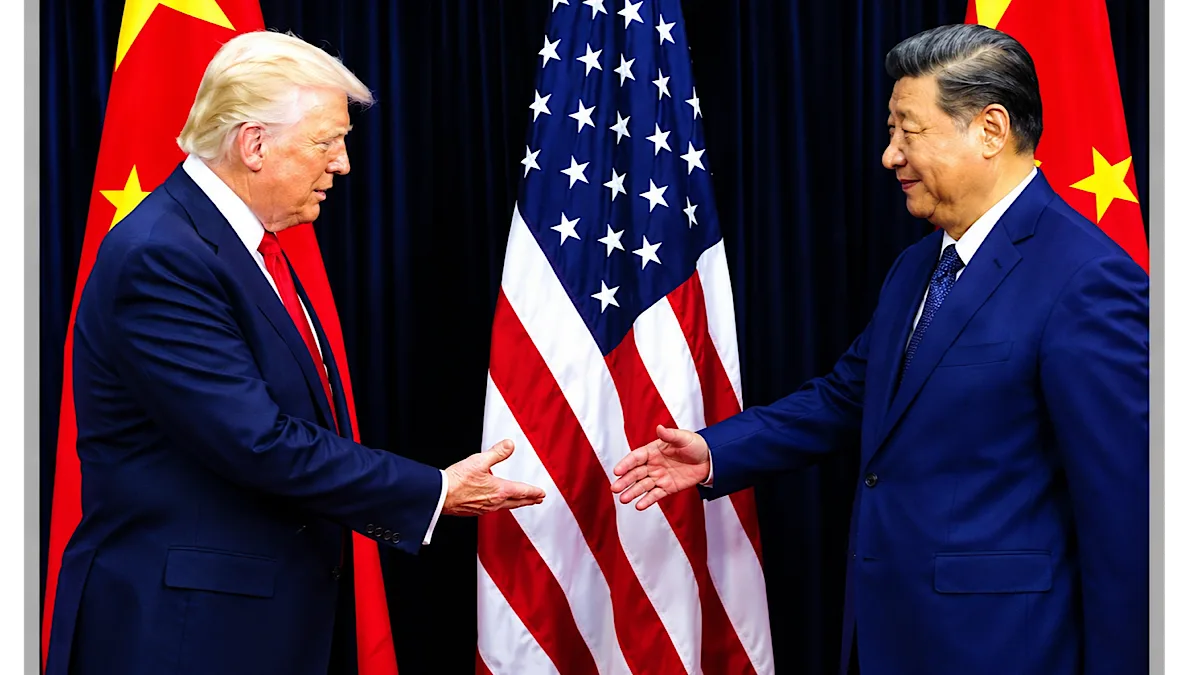
The scheduled visit o f President Donald Trump to Beijing on May 14-15 2026, marks a pivotal moment in global diplomacy , signalling an attempt to stabilize the world’s most critical, yet deeply strained, bilateral relationship. Coming after a period of intense economic volatility and geopolitical friction, the summit – the first by a U.S. president in nearly a decade – is less likely to yield a transformative “reset” and more likely to focus on damage control and the establishment of “managed competition”.
Expectations for this high-stakes meeting are diverse, ranging from hopeful trade deals to apprehensions regarding shifting stances on security. The most immediate expectation is the restoration of regular, high-level communication between the two leaders, which has been severely lacking. In an era marked by “tense stability,” the personal interaction between Mr Trump and President Xi Jinping is considered a necessary guardrail to prevent misunderstandings from escalating into open conflict. While both leaders have signalled an interest in dialogue, they are expected to navigate intense domestic pressures.
Advertisement
Trump is seeking to appear strong on China, while Xi wants to project authority aimed at tightening Party control and ensuring economic stability ahead of the 21st Party Congress in 2027. Trade will take centre-stage, with expectations focused on an extension of the current “trade truce”. Following intense trade war friction and heavy tariff adjustments, the summit is likely to yield some important results. China is expected to pledge large-scale purchases of American goods, particularly agricultural products, energy, and Boeing aircraft. This would be a “headline-grabbing” win for the Trump administration.
In exchange, the U.S. may offer partial relief from tariffs and a pause on technology export restrictions on Chinese subsidiaries. Discussions may also focus on establishing new bilateral “boards” for trade and investment to manage disputes in non-sensitive sectors. The geopolitical context of the 2026 visit is complex, influenced by the ongoing U. S. militar y engagement in Iran. Middle East Stability: A major priority for Trump is securing Chinese leverage to prevent further escalation in the Middle East and stabilize global energy markets, particularly given China’s role as a major energy importer.
Securing Chinese leverage to manage Middle East instability and stabilize energy markets is a central, yet complex, goal of the Trump administration’s foreign policy. Facing an intensified Iran crisis and a blocked Strait of Hormuz, the US is pressuring Beijing – a primary importer of Middle Eastern oil – to use its economic influence to curtail Iranian actions. While China has officially called for de-escalation and pledged a “greater role” in restoring peace in the Middle East, it has maintained its own diplomatic engagement with Tehran.
During Iranian Foreign Minister Araghchi’s recent visit, Chinese Foreign Minister Wang Yi called for an urgent “comprehensive ceasefire,” stating that a resumption of hostilities is unacceptable. China urged the reopening of the Strait of Hormuz for international shipping. China will benefit from stability, but it also gains leverage as the US deals with a “muddle” in the region. The Taiwan “Red Line”: China considers Taiwan the primary risk factor, viewing US actions as undermining sovereignty.
Beijing is expected to strongly press for a halt to U.S. arms sales to Taiwan, which reached record levels in late 2025. On 17 December 2025, the U.S. government announced a record-breaking arms sales package for Taiwan valued at approximately $11.1 billion, marking the largest single weapons deal in history between the two sides. This move, authorized by the Trump administration, followed a $330 million sale of aircraft parts in November 2025, reinforcing a rapid escalation in defense cooperation amid rising tensions in the Taiwan Strait.
The U.S. side aims to manage this tension while navigating concerns that a transactional approach could lead to shifts in long-standing security policies. The meeting between Trump and Xi Jinping highlights an attempt to manage intense rivalry through direct negotiation. The U.S. treats economic and security commitments to Taiwan as re-negotiable bargains, which boosts near-term deterrence but introduces volatility. Technology is the core conflict area of the U.S.-China strategic rivalry, surpassing trade in geopolitical significance by determining future military superiority and economic dominance.
The competition focuses on artificial intelligence (AI), semiconductors, and quantum computing, with both nations employing industrial policy and tech nationalism. While the U.S. has imposed severe re strictions on high- end semiconductors, there is an expectation of discussing guardrails for artificial intelligence (AI) to stop the rivalry from spiralling into a crisis. However, b o th sides are likely to ke ep collaboration in advanced technology, military applications, and frontier AI capabilities firmly off the table, focusing instead on risk management. Given the deep-seated structural issues and mistrust, there should not be high expectations for comprehensive breakthroughs.
The Trump-Xi summit is aimed at managing deep-seated structural rivalries rather than achieving a comprehensive, long-term framework. The summit is more likely to codify new, temporary rules of coexistence, useful for short-term stabilization rather than a durable, long-term framework. The ultimate goal is to move from a state of antagonism to a more predictable form of “managed competition”. The 2026 Trump visit to China serves as a crucial test of leadership for both presidents. It is a necessary exercise in ensuring that the world’s most significant economic powers can continue to engage despite fundamental differences.
While transactional deals on agriculture or technology are expected to dominate the headlines, the true success of the visit will be measured by the ability to prevent economic and technological competition from turning into military confrontation. The key metric for success is managing the rivalry to prevent it from escalating into military conflict, especially regarding Taiwan and regional disputes, amid a backdrop of significant trade friction. The meeting aims to transition from a “cyclical spiral” of mistrust towards a more structured competition, and lasting success depends on creating long-term frameworks to prevent escalation.
(The writer, a retired IFS officer, served as India’s Ambassador to Kuwait and Morocco and as Consul-General in New York.)