By the time Prime Minister Narendra Modi wrapped up his visit to Punjab on Friday evening, he had travelled through three states, launched projects worth thousands of crores, addressed multiple public gatherings and delivered several carefully crafted political messages. Officially, the tour revolved around infrastructure, healthcare and railways. Politically, however, it offered perhaps the clearest indication yet of how the Bharatiya Janata Party (BJP) intends to position itself as Punjab moves closer to the 2027 Assembly election.
The day began in Haryana’s Jind, shifted to Chandigarh by the afternoon and concluded with a high-profile rally in Jalandhar. At every stop, the themes changed, but the broader storyline remained consistent. Technology and self-reliance dominated the Haryana programme, governance and public infrastructure took centre stage in Chandigarh, while Punjab witnessed a mix of development announcements, religious outreach and political symbolism.
Advertisement
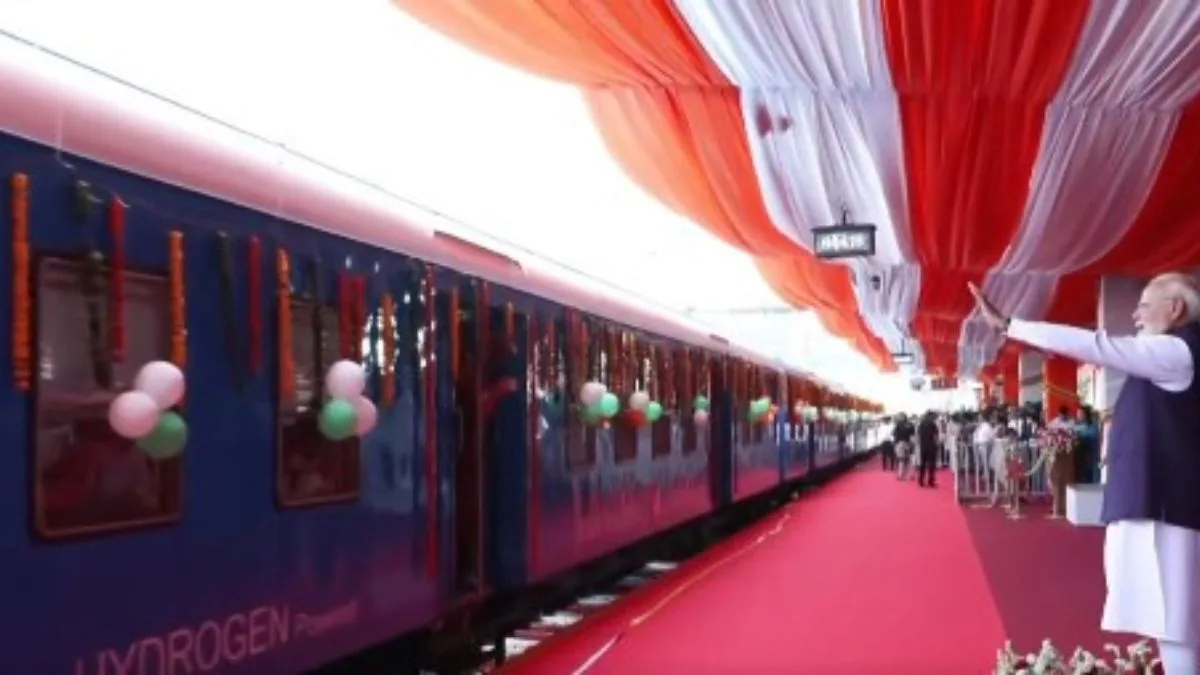
Jind served as the opening stage. Prime Minister Modi flagged off India’s first hydrogen-powered passenger train, describing it as an example of indigenous technology and the country’s changing industrial capabilities. Instead of limiting the speech to the train itself, he contrasted today’s railway network with the situation before 2014, arguing that rapid electrification had made the system less vulnerable to fluctuations in global fuel supplies. The comparison reinforced the BJP’s long-standing narrative of presenting infrastructure as evidence of administrative transformation.
Only a few hours later, the focus shifted completely. In Chandigarh, the Prime Minister inaugurated and laid the foundation stone for projects worth nearly ₹4,700 crore. The announcements ranged from healthcare facilities at PGIMER and educational infrastructure to road connectivity and smart urban projects. Rather than presenting Chandigarh as an isolated Union Territory, PM Modi repeatedly described it as a shared economic hub whose growth directly benefits Punjab, Haryana and Himachal Pradesh. The messaging subtly expanded the significance of the projects beyond city limits, framing them as regional investments rather than local announcements.
The political tone became more visible after the Prime Minister entered Punjab.
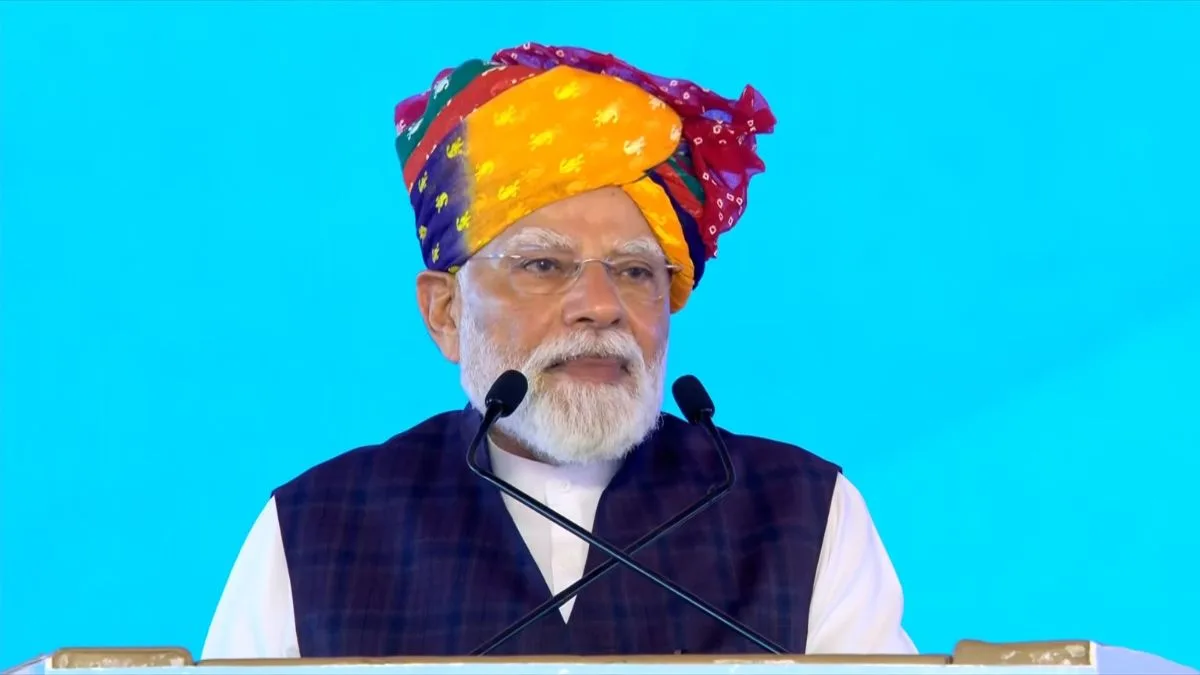
Walking onto the stage in Jalandhar wearing a green turban often associated with Punjab’s farming community, PM Modi opened his speech in Punjabi, asking the crowd, “Punjabiyon, kaise ho?” The greeting drew loud applause and immediately set the tone for an event that relied as much on symbolism as on policy announcements.
The symbolism did not end there.
Before addressing the rally, Prime Minister Modi flagged off the Seer Govardhanpur–Varanasi Express connecting Amritsar with Varanasi, a service expected to benefit devotees of Guru Ravidas. He also met Sant Niranjan Das of Dera Sachkhand Ballan aboard the train. While officially part of the day’s itinerary, the interaction naturally attracted political attention because of the Dera’s longstanding social influence among sections of Punjab’s Scheduled Caste community.
Sikh history and regional identity featured prominently throughout the programme. During the public meeting, Punjab BJP president Kewal Singh Dhillon presented the Prime Minister with a portrait of Maharaja Ranjit Singh. PM Modi, in turn, referred to initiatives linked to Sikh heritage and spoke about projects aimed at preserving that legacy. None of these gestures carried explicit political messaging, yet together they reflected the BJP’s continuing effort to engage with communities that have traditionally remained outside its conventional support base in Punjab.
Development, however, remained the central theme of the government’s announcements.
Projects worth about ₹5,470 crore were launched or inaugurated in Punjab, covering railway stations, rail connectivity, highways and transport infrastructure. PM Modi also announced that Chandigarh had received approval for a new MBBS college. Throughout his speeches, he maintained that the Centre would continue investing in Punjab regardless of which party governed the state, a line intended to reinforce the BJP’s development-first positioning.
The accompanying political messaging came from other leaders sharing the stage.
Railway Minister Ashwini Vaishnaw highlighted the sharp increase in railway investment in Punjab, the expansion of Vande Bharat services and the completion of railway electrification. Union Minister Ravneet Singh Bittu criticised the AAP government and argued that Punjab required a “double-engine government” to improve governance, accelerate development and strengthen law and order.
The event also showcased the BJP’s organisational strategy. Former leaders from other political parties, including Vikramjit Sahney, Harbhajan Singh and Ashok Mittal, appeared alongside the Prime Minister, signalling the party’s effort to build a broader leadership pool ahead of the state election.
Political observers also recalled remarks made earlier by Union Home Minister Amit Shah, who had indicated that Punjab would become an important political focus for the BJP after the party’s expansion efforts in other regions. Although BJP leaders continue to describe such visits primarily as development programmes, Friday’s sequence suggested that governance and political outreach are now being projected together rather than separately.
Unlike earlier campaigns that depended largely on organisational expansion, the BJP’s current approach appears considerably wider in scope. Large infrastructure announcements, railway modernisation, healthcare investments, outreach to Sikh institutions, engagement with Dera Ballan and repeated references to Punjab’s historical identity were all woven into the same political narrative over the course of a single day.
With Punjab expected to head into an Assembly election in the coming months, the BJP appears to have moved beyond simply preparing for the contest. Friday’s carefully planned tour suggested that the campaign has already begun taking shape on the ground. Instead of relying solely on conventional election rhetoric, the party seems intent on building its appeal through a combination of visible development, cultural symbolism, welfare messaging and sustained political engagement, hoping that together they can expand its footprint in a state where it is seeking to emerge as a much stronger electoral force.