Prime Minister Narendra Modi on Friday delivered a pointed message from Jind, declaring that the ongoing tension in the Strait of Hormuz would have thrown India’s railways into “serious crisis” had it occurred before 2014, when nearly 70 per cent of the network still ran on diesel.
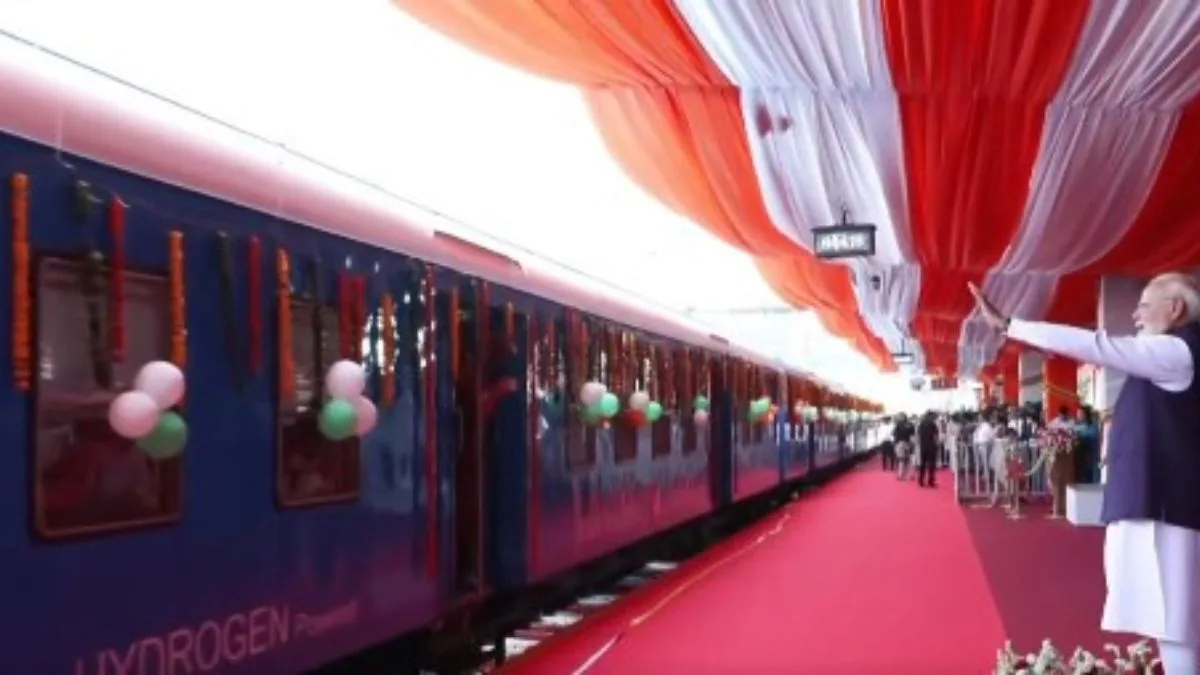
Flagging off the country’s first hydrogen train from Jind to Sonipat, he said the near-complete electrification of Indian Railways over the past 12 years had insulated the nation from exactly the kind of supply-line shocks now threatening global energy routes.
Advertisement
“This is not the India of before 2014. This is the new India,” Modi told the gathering, adding pointedly that today’s India “thinks ahead and acts on solutions well before problems strike.”
He said that if a war-like situation had erupted in the Hormuz Strait, a key route for India’s petrol, diesel and fertiliser imports under the old dispensation, train operations across the country could have ground to a halt.
The Prime Minister put the scale of the transformation in stark numbers: railway electrification, begun in 1925, covered barely 30 per cent of the network by 2014, meaning almost a century of work had left 70 per cent of the system diesel-dependent.
At that pace, he said, full electrification would have taken another 200 years. Instead, in just 12 years, nearly 99 per cent of the network has been electrified, he said, asserting that Indian trains kept running without disruption despite diesel-related global shocks.
Fastest, most powerful hydrogen train unveiled
The train launched from Jind, rated at 3,200 horsepower, is being described as the most powerful hydrogen train in the world and among the longest-range hydrogen rail services globally, designed and manufactured entirely by Indian engineers and an Indian company.
Modi said the service would run over a roughly 90-km stretch for now, but signalled aggressive expansion plans, saying continuous research would go into cutting costs and improving efficiency.
He noted only three or four countries currently operate hydrogen trains, and even there the technology remains nascent, making India’s capability a matter of national pride. He added that Jind would now see a wave of new infrastructure and investment on the back of the launch.
Cleanliness challenge to Jind residents
In a sharper, more direct segment of his address, the Prime Minister took on the sanitation drive he said he had been watching unfold on social media for a week, with residents jokingly urging him to “keep visiting Jind so the cleanliness drive continues.”
Modi turned the remark back on the crowd, asking bluntly whether cleanliness genuinely required his presence at all.
“If the people of Jind resolve on their own, there will be no need for Modi to come,” he said, urging citizens to make cleanliness a “sanskar,” an ingrained value rather than an event tied to VIP visits.
Projects, sports push, and a personal note
Modi said Haryana had received projects worth over Rs 14,000 crore in addition to the hydrogen train launch, spanning railways, highways, heritage works and two new medical colleges, which he said would open career paths for local youth into medicine and allied health professions.
Among the projects dedicated or foundation-laid: the Kurukshetra elevated railway track, Pandit Neki Ram Sharma Government Medical College in Bhiwani, Maharishi Chyawan Medical College and Rao Tularam Hospital in Narnaul, the Haryana section of the Delhi-Amritsar-Katra highway (157.92 km), the Ambala-Kala Amb national highway, the Jind-Gohana national highway, the foundation stone for a Sikh Museum in Kurukshetra, and the Hansi-Barwala national highway.
On sport, the Prime Minister said India will host the 2030 Commonwealth Games and is pursuing the 2036 Olympics, and revealed that following his recent visits to Indonesia, New Zealand and Australia, India will partner with the New Zealand and Australian governments on sports industry development and athlete training a collaboration he said would directly benefit Haryana’s youth and athletes, alongside the Centre’s national sports policy and Khelo India push.
Recalling personal history with the region, Modi said he first visited Jind decades ago on party organisational work and has never forgotten the warmth shown to him then, invoking Murrah buffalo milk, ghee, Jind’s desi boora and ghewar as memories inseparable from the town.
He said Jind’s name would now be written into history alongside Mumbai-Thane, India’s first railway route, as the birthplace of the country’s hydrogen rail era, with Jind, Sonipat and Haryana to be remembered “with pride” whenever the technology’s origin is discussed.