Auguste Comte, the 19th-century father of sociology, famously asserted that “Demography is destiny.” For a state as culturally resonant and strategically vital as West Bengal, this is no longer a mere academic observation, but has become a pressing existential inquiry. As we analyse the statistical trajectory of the state from the mid-20th century to the present, a profound shift in its socio-political gravity emerges.
As the state grapples with an asymmetric growth pattern, a critical question arises, not merely of numbers, but of national sovereignty: Is West Bengal undergoing a transition into “Bangladesh 2.0”?
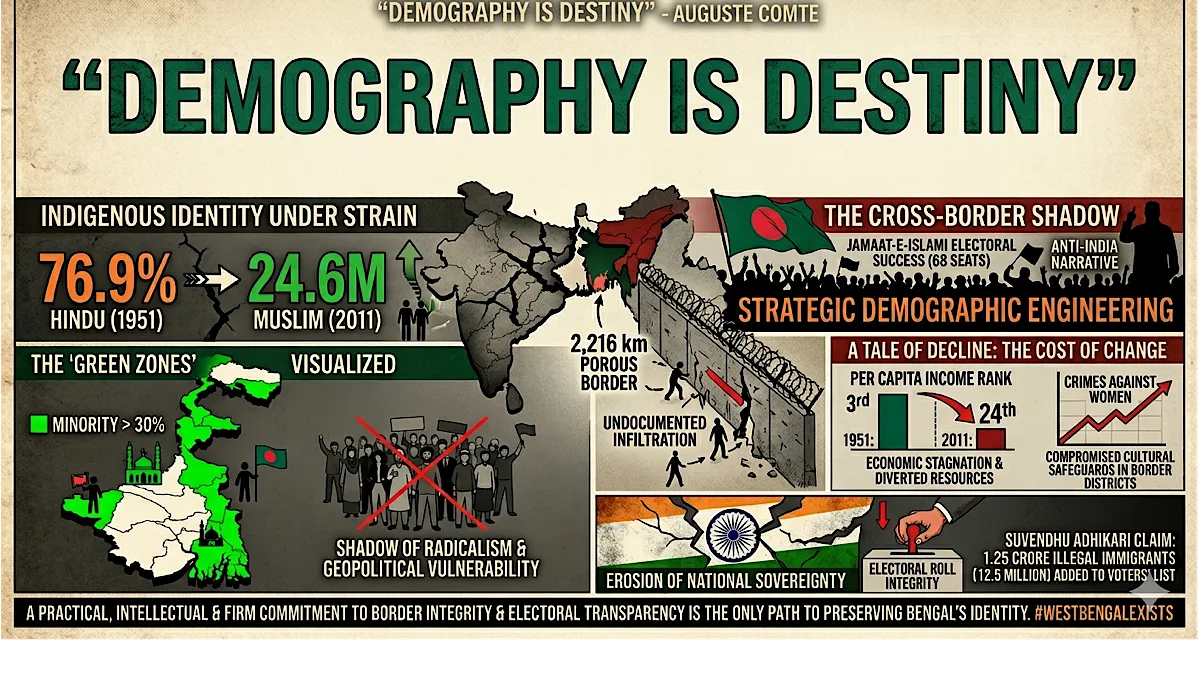
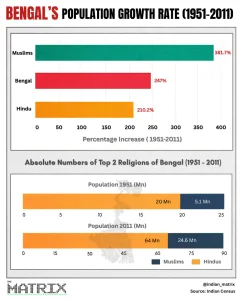
The quantitative foundation of this concern is found in the stark divergence of Indian Census data. In 1951, the social fabric of West Bengal was composed of a 76.9% Hindu majority and a 19.6% Muslim minority. While the logic of Partition was to create stable, sustainable homelands, the subsequent decades witnessed a radical departure from that equilibrium.
Advertisement
Between 1951 and 2011, the Hindu population grew by 210.2%, yet the Muslim population surged by an extraordinary 381.7%, leaping from 5.1 million to 24.6 million. This quintupling of a specific demographic, at a Compound Annual Growth Rate (CAGR) of 2.66% compared to the majority’s 1.96%, indicates a phenomenon that transcends natural biological growth. In a state where total population growth stood at 247%, such a disproportionate imbalance suggests that administrative priorities, who was counted, who was ignored, and who was treated with political convenience, have played a significant role in this transition.
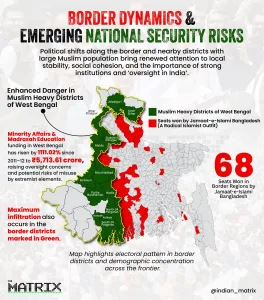
This demographic density is not uniformly distributed; it is strategically concentrated along the state’s 2,216 km porous border with Bangladesh. These “Green Zones” (shown in the map below), where the minority population now exceeds 30%, represent more than just a census category; they represent a geopolitical vulnerability.
This vulnerability is exacerbated by the rising shadow of radicalism across the fence. The recent electoral success of the Jamaat-e-Islami in Bangladesh, which secured 68 seats in districts directly adjacent to our border, presents a formidable national security challenge. Historically, Jamaat-e-Islami has been defined by its vitriolic anti-India narrative and ideological subservience to Pakistan, having vehemently opposed the very liberation of Bangladesh in 1971. The presence of such a radical, adversarial entity on the doorstep of a demographically shifting Bengal creates a volatile synergy that threatens the internal stability of the Indian Union.
The erosion of the state’s sovereignty is further evidenced by the integrity of its electoral rolls. Suvendhu Adhikari claimed that nearly 1.25 crore (12.5 million) illegal immigrants have entered the states’ voters’ list, which represents more than just “vote-bank politics.” They represent a dilution of the social contract. When the “demos” is artificially expanded through undocumented infiltration, the democratic process ceases to reflect the will of the indigenous citizenry. This “Strategic Demographic Engineering” has tangible, devastating consequences for the state’s prosperity.
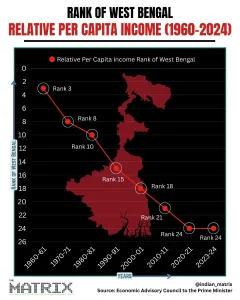
The consequences of this shift are not confined to political maps. They are felt in the state’s economic and social decay. West Bengal’s Relative per capita income tells a story of a precipitous decline. Once a titan of Indian prosperity, ranking 3rd in the country, the state has slipped to a sobering 24th position. This economic stagnation is the natural byproduct of a state struggling under the weight of unplanned demographic expansion and the strain of supporting a shadow population that diverts resources from indigenous development. Furthermore, social data indicates that these specific border districts are now epicentres of rampant crimes against women, suggesting that as the demographic gravity shifts, the traditional cultural safeguards and the rule of law are being systematically compromised.
The challenge facing West Bengal is neither purely communal nor purely political, but existential. West Bengal today stands at a crossroads where mathematics meets national security. The “Bangladesh 2.0” narrative is not a product of hyperbole, but an analytical conclusion drawn from decades of unchecked trends. To ignore these numbers is to ignore the historical lessons of the subcontinent. Preserving the identity of Bengal requires more than just political discourse. It demands a practical, intellectual, and firm commitment to border integrity and electoral transparency. If we do not address this “Mathematical Reality” today, we risk allowing the destiny of Bengal to be written by forces that do not hold India’s best interests at heart.
Without a rigorous, analytical, and firm intervention, the state risks becoming a demographic extension of a foreign narrative- a reality that India can ill-afford.
(The writer is a public policy researcher and strategic communications professional with a strong interest in data-driven policy analysis. Her work focuses on governance, national security, and emerging technologies, with particular attention to how they influence India’s global positioning and internal policy debates.)