INTACH’s ‘Project Gaja-Lok’ to document Odisha’s elephant traditions
The project was inaugurated in Puri during Lord Jagannath's Rath Yatra, underscoring the significance of elephants in Odisha's religious and cultural traditions.
Despite veterinarian experts attributing the death of the elephant Chanchal at Amer Hathi Gaon to old age and cardio-respiratory failure, the controversy surrounding the painting of the animal pink by Russian artist Julia Buruleva continues.




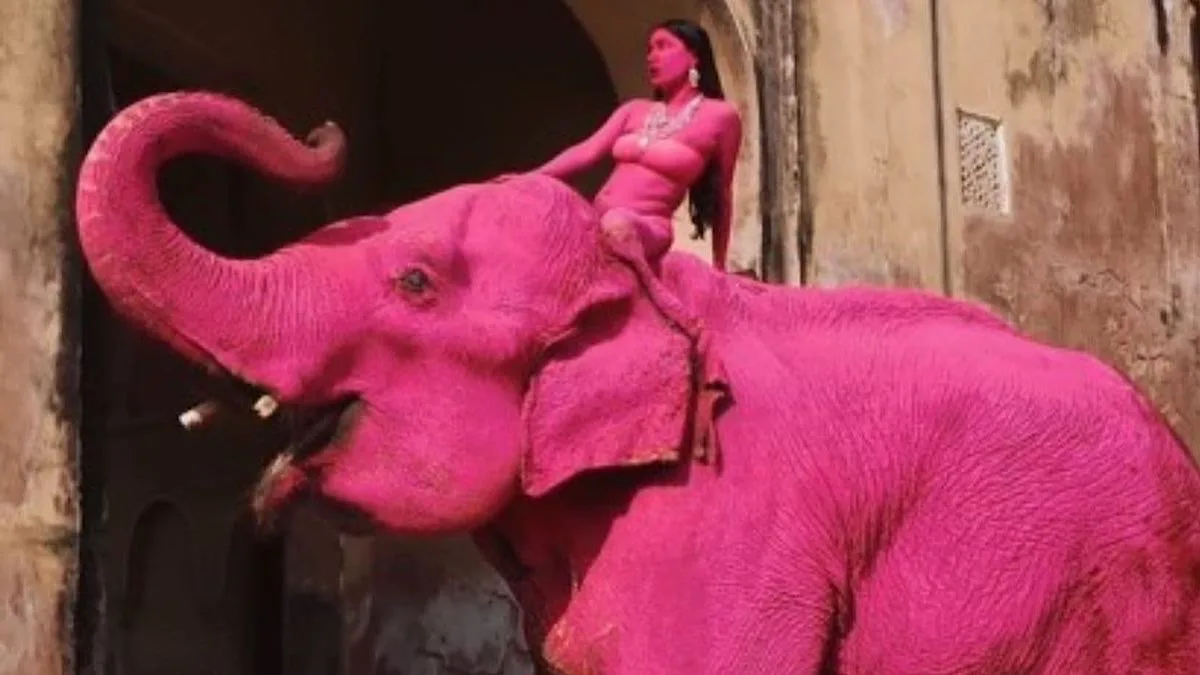
Photo:X
Despite veterinarian experts attributing the death of the elephant Chanchal at Amer Hathi Gaon to old age and cardio-respiratory failure, the controversy surrounding the painting of the animal pink by Russian artist Julia Buruleva continues.
Following Chanchal’s death in February, outrage resurfaced over images of the “Pink Elephant Chanchal,” who had been painted bright pink for a photoshoot in Rajasthan by Buruleva.
Advertisement
The People for the Ethical Treatment of Animals India (PETA India) has written to Buruleva, urging her to immediately remove the commercial prints from her website or donate all proceeds from their sale toward elephant conservation and protection efforts in India. Buruleva is reportedly selling the prints for over ₹3 lakh each, according to her website.
Advertisement
In the letter, Dr. Mini Aravindan, Senior Director of Veterinary Affairs at PETA India, states:
“I urge you to either immediately take down the print depicting the elephant Chanchal, who was used in your photoshoot and has reportedly died, or donate all proceeds from the sale of the ‘Pink Elephant’ print toward keeping elephants in their natural forest homes in India. This could include support for PETA India’s mechanical elephant project or reputable sanctuaries such as Wildlife SOS or Wildlife Rescue & Rehabilitation Centre.”
She added that in such sanctuaries, rescued elephants are kept unchained, are not controlled with weapons, and are allowed to live in the company of other elephants.
“If you choose to continue selling the prints, they should carry a clear message discouraging the use of captive elephants for rides or entertainment,” the letter further states.
Chanchal is reported by some media outlets to have been around 70 years old. Dr. Aravindan also noted that under the Ministry of Environment, Forest and Climate Change’s Project Elephant guidelines, captive elephants are recommended to be retired at 65 years of age.
Addressing Buruleva’s claim that the paint did not contribute to the elephant’s death, the letter states that “it is not possible to completely rule out the health impacts of the paint.”
“The paint was applied near the elephant’s eyes, ears, trunk, mouth, and genitals. Coating an elephant’s skin, especially around sensitive areas, can pose risks, including irritation, ingestion during grooming or feeding, stress, and aggravation of pre-existing conditions, even when products are marketed as ‘safe’,” Dr. Aravindan wrote.
The letter also highlights the conditions faced by elephants used for rides at Amer Fort, stating that they are often chained, kept on concrete floors when not in use, and controlled with concealed weapons.
It further alleges that Chanchal’s owner, Saddik Khan, appears to be the same individual who previously owned an elephant named Malti, who was rescued following a PETA India campaign after documented instances of severe abuse.
Dr. Aravindan also noted that captive elephants in Jaipur have, at times, attacked humans and other elephants. “In 2024, a Russian tourist was hospitalized after an elephant used for rides, Gouri, knocked her to the ground, breaking her leg. The use of elephants for rides and forced interactions poses risks to humans as well,” the letter states.
Chanchal, the elephant featured in the photoshoot, died in February. Her death intensified criticism, with some activists linking it to the photoshoot.
However, senior veterinarians who conducted the postmortem, along with local authorities and the artist herself, maintain that the death was natural. According to Dr. Mathur, a member of the veterinary medical board, “The elephant’s death was entirely natural and unrelated to the paint. She was 67 years old and died due to cardio-respiratory failure.”
Hathi Gaon Committee president Ballu Khan stated that Chanchal died nearly a year after the photoshoot and that the organic gulal used during the shoot had been washed off within about half an hour.
In a statement on her website, Julia Buruleva said: “For anyone concerned about the elephant, we used organic, locally made paint—the same kind used during festivals—so it was absolutely safe for the animal.”
Advertisement