India’s ICDS-anganwadi is one of the most extensive government-created networks of child and mother care in the world. At the same time important gaps exist particularly in remote villages, such as in the context of several tribal communities. In such situations the existence of one ICDS center in a village is no guarantee that its services can reach the most remote hamlet of the village. Such situations exist in many villages, particularly those of tribal communities, in south Rajasthan.
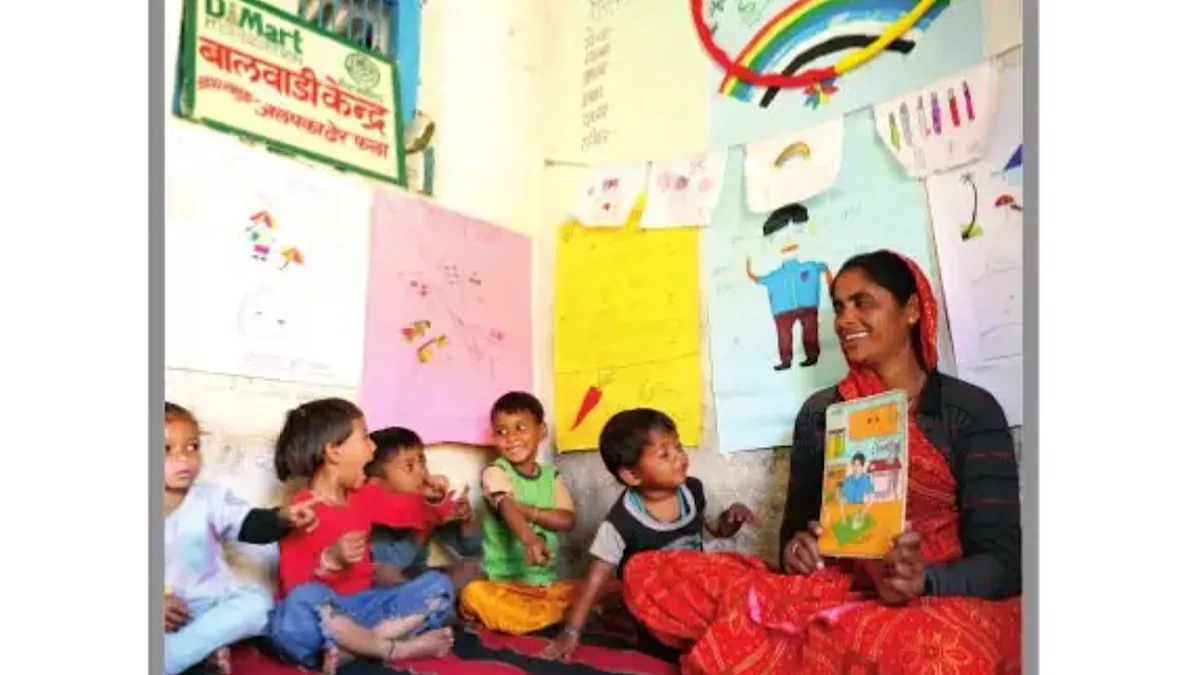
On the other hand, the need for child care is acute in many such villages which experience a high rate of work-related migration, imposing a heavy burden on women who stay behind. In these conditions the early child care and nutrition programme of a leading voluntary organization Seva Mandir (SM) has found important gaps where more child care facilities are needed and where it has set up 152 balwadis or child care centres for the age group 2 to 6 years. Now it is also setting up creches for even smaller children in the age group of seven months to 3 years.
Advertisement
In this way and by identifying ways of how it can contribute to improvement of anganwadis, SM has found a model of working in cooperation with the government to bring real improvements, while avoiding duplicity of effort. With its extensive community organizations in the area, SM can also help in identifying areas where mini-anganwadis can be set up, while community organizations in remote villages help to improve overall social consciousness on health and nutrition issues. Whenever SM members see that an anganwadi needs help that they can arrange, they offer to make this available.
This can be in the form of renovation or repair work, or in terms of supply of some much-needed materials. In Pal Sepur hamlet of Sarada block, the stairs needed repairs and some bushes needed to be cleared. With its strong community base in the area, SM could mobilize shramdan or contribution of voluntary work by villagers to resolve these problems. In Gadavan village of Rishabhdev block, the needs were identified as repair work as well as supply of utensils and toys. These needs too were attended to promptly. In both cases, these helpful interventions were immediately followed by a significant increase in the number of children coming to the anganwadis.
If there is a helping hand available, also enjoying strong community support, the government effort is helped in very useful ways. At present SM is working with such helpful objectives in 1,683 villages to contribute to 1,783 anganwadis. This effort is spread over five districts of south Rajasthan – Udaipur, Sirohi, Rajsamand, Salumbar and Chittorgarh. An increasingly important area of cooperation by SM is contribution to capacity-building of anganwadi staffers and helpers. A potentially life-saving area of work is to identify children affected to various extent by malnutrition or extreme malnutrition, and to arrange for their care and treatment.
With its extensive community reach, SM is able to help particularly in identifying those malnourished children who for various reasons may not be going to an anganwadi centre. SM helps parents of these children to go to government-run malnutrition treatment centres at the local level, or to access treatment at higher levels if the local treatment is not successful. In addition, SM organizes camps in villages for those malnutrition cases which do not have medical implications with the objective of securing significant improvement within the village. The best available nutrition from affordable foods in the village is explored. Those families within the village that have been able to achieve significantly better outcomes within the same constraints are invited to the camp so that important learnings from their experiences can be discussed to help others.
An important strength of SM is that it also works on issues relating to improvement of sustainable livelihoods, including agriculture and related activities. Hence its recommendations on nutrition can also be integrated with ways of being able to obtain better nutrition. One of its important programmes is to promote the spread of small vegetable gardens, often using natural farming methods, so that healthier vegetables can be obtained to improve nutrition. SM also has a hospital in a very remote area where facilities for treatment of malnutrition and related health problems are available in conditions where nurses and visiting doctors have a better understanding of such health issues. Community outreach programs of SM play the important role of taking important health and nutrition messages to more and more villagers with continuity.
Thus, even when a project has to end in a cluster of villages, more enduring impacts in the form of better and higher community consciousness on health and nutrition issues are likely to remain for a much longer time. Thus, the early child care and nutrition programme of SM has evolved as a combination of its own initiatives and cooperation with government health and nutrition efforts, to carefully avoid duplicity and fill significant gaps. There is certainly a need for such an approach of cooperation.
The National Family Health Survey (NFHS-5) revealed that despite all the efforts being made, only 26 per cent of children in the age group of 2-4 years were attending childcare centers in Rajasthan. Among the remaining children, particularly those with both working parents, surely there would be many children in great need of well-managed care centres. Similarly, according to other data, despite some improvements, various indicators of child malnutrition remain worrying. In these conditions there is a substantial need for a committed and creative role of all those who can sincerely contribute to improving early child care and nutrition.
(The writer is Honorary Convener, Campaign to Save Earth Now. His recent books include Protecting Earth for Children, Man over Machine and A Day in 2071.)