There is something quietly revealing about the way nostalgia functions for Gen Z. It now arrives compressed, aestheticised, and instantly consumable. A Rio de Janeiro filter, a grainy visual, a familiar Shah Rukh Khan melody ~ all working together to produce an emotional climate that feels safe to enter and easy to exit. This version of nostalgia fits seamlessly into daily scrolling, offering momentary relief in a landscape otherwise marked by informational excess and moral ambiguity.
The contemporary world demands constant contextualisation. Every image is freighted with politics, every opinion audited for correctness, every pleasure quietly interrogated for its moral cost. Intellectualisation becomes instinctive, almost compulsory, a reflex sharpened by years of exposure to crisis presented without pause or priority. Over time, this density begins to feel punitive. Thought ceases to liberate and begins to encumber. In response, a counter-appetite takes shape, one oriented towards cognitive rest, emotional immediacy, and forms of cultural intake that refuse complexity without apology.
Advertisement
Brainrot emerges as a response to this saturation, almost as a coping mechanism. In its embrace of redundancy, repetition, and surface-level gratification, brainrot offers a temporary release from analytical demand ~ a brief interlude in which the mind is allowed to idle. Likewise, Bollywood brainrot finds form in this moment, as Gen Z leans into its emotional maximalism, gravitating towards a cinema that simply exaggerates and moves on. Often read as the afterlife of what previous generations marked as ‘feel-good films,’ brainrot reorients comfort itself, privileging memeability over narrative. In this altered field of attention, a range of films make their comeback into mainstream discourse.
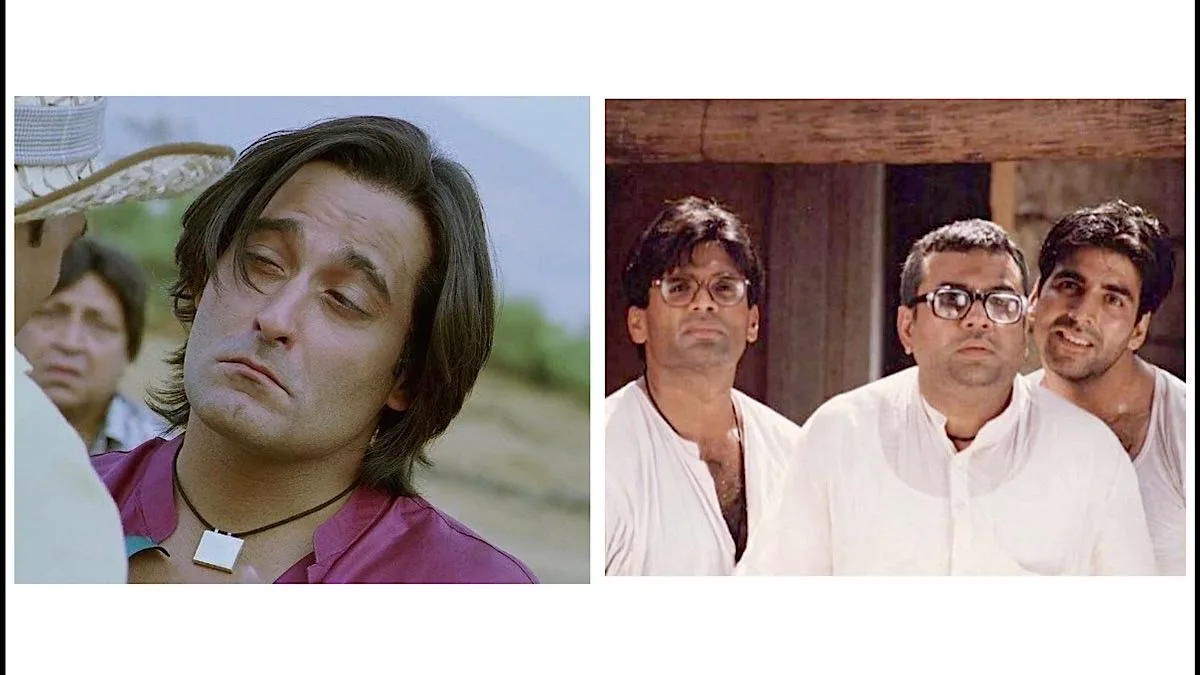
Few films illustrate this resurrection better than Farah Khan’s Tees Maar Khan. Released to scathing reviews and an unceremonious box-office collapse, it was once held up as a stand-in for everything gone wrong. Today, it moves through the feed with renewed affection, clipped into reels, revived as a fondly shared joke. Farah Khan’s cinematic logic consistently favours intensity over coherence. Om Shanti Om articulates this logic more explicitly, using reincarnation and revenge to stage Bollywood itself as archive, fantasy, and emotional touchstone, representing a cinema comfortable with its own surfeit wherein melodrama is pushed to the edge of parody.
The genre, however, finds its most disciplined practitioners in the Priyadarshan–Akshay Kumar duo. Their films operate on a principle of escalating absurdity, where misunderstanding compounds, performances remain pitched high, and plot functions largely as an excuse. Across the indomitable Hera Pheri franchise, Bhagam Bhag, Bhool Bhulaiyaa, De Dana Dan, and the likes, the films settle into mem1
3..0 e factories, sustained by recall, rhythmic chaos, and an animated pride in their own ridiculousness.
Akshay Kumar’s collaboration with Anees Bazmee in Welcome also distils this impulse into near-perfect density, packing an improbable number of meme templates into a single film. Kumar’s invocations of “miracle, miracle,” Anil Kapoor and Nana Patekar performing menace as farce, Paresh Rawal’s calibrated hysteria, and Feroz Khan’s unmistakable gravitas collectively produce a comedy that refuses exhaustion.
What is worth noting is how rarely this alchemy survives contemporary attempts at replication. Recent efforts to recreate the tone, rhythm, or irreverence of these 2000s cult classics often arrive overdesigned, overly self-conscious, and drained of spontaneity. While early entries in Bhool Bhulaiyaa or Welcome continue to live on as cultural shorthand, their sequels struggle to imprint themselves at all. What is missing is not scale or energy but ease. Brainrot demands an absence of self-monitoring; it is effective only when effortless. This clearly defines why many recent creative takes founded on scripts engineered for virality have collapsed under the weight of their own anticipation and rendered forgettable.
The metropolitan Gen Z’s renewed affection towards this particular category of content subtly rearranges the grammar of class. Films, songs, and comedic registers once coded as ‘mass’ now circulate without the social penalties that earlier accompanied their consumption. The embarrassment once attached to enjoying ‘chatpate gaane’ or masala movies dissolves into a collective echo, as what was earlier disavowed as lowbrow is reclaimed without irony. This shift can be best understood as a post-structural reconfiguration of aesthetic judgment. Where earlier engagements with mass culture required either defence or distance, the present-day dynamic thins out both.
This confident reclamation of the slapstick and the ‘cringe’ is less a rebellion than a structural outcome of social media’s democratisation of tastes. Algorithmic spaces dissolve hierarchies by privileging circulation over evaluation, neutralising inherited distinctions. The result is an environment of unpretentious consumption, where the average Gen Z intellectual no longer feels compelled to resist the pull of a barely comprehensible Himesh Reshammiya melody, only to seem above the room.