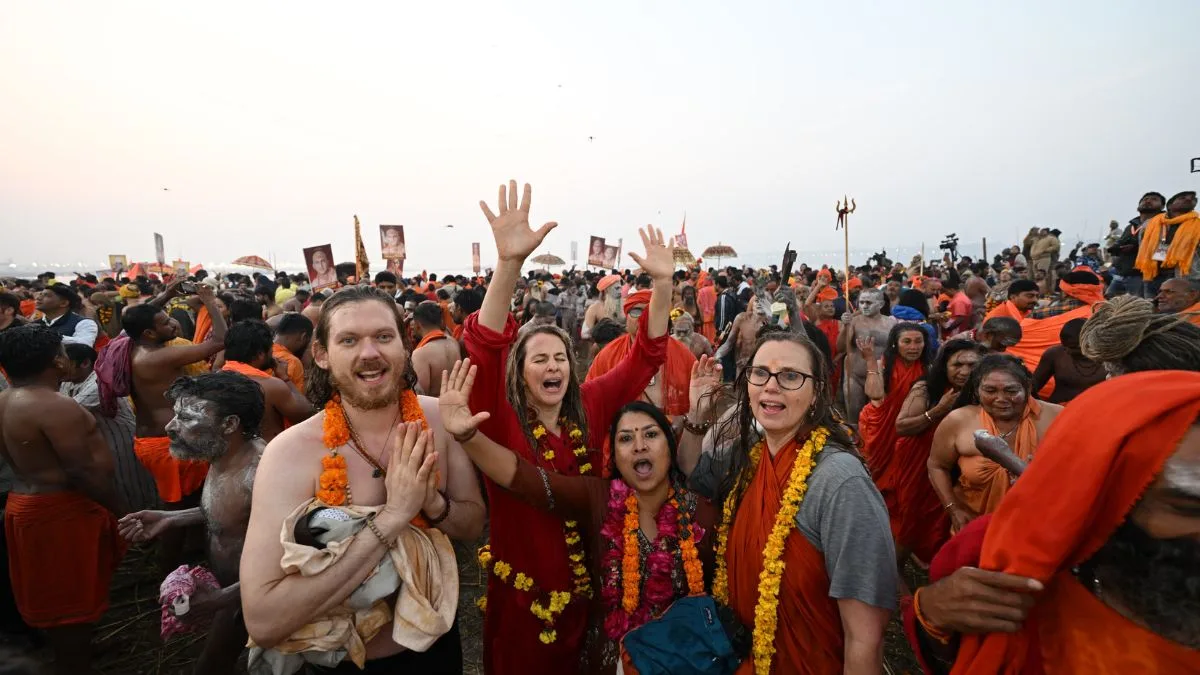
Millions of young people are starting the New Year by visiting and worshipping their deities in Kashi, Mathura-Vrindavan, and Ayodhya, against the earlier trend when, inspired by Western culture, they headed to discos, hotels, restaurants, and hill stations to celebrate the occasion.
The development of religious and tourist sites in Uttar Pradesh during Chief Minister Yogi Adityanath’s nearly nine years in power has resulted in this shift. This is a wave of spiritual and cultural renaissance originating from Uttar Pradesh, in which not only the youth of the state but also those from across the country are participating with renewed enthusiasm.
Advertisement
According to the tourism department, several days before the New Year, millions of young tourists have been arriving at the major pilgrimage sites of the state, including Kashi, Ayodhya, Mathura-Vrindavan, and Prayagraj.
In this regard, more than 5 lakh tourists had already arrived in Ayodhya to pray before Lord Ram on December 29-30, while more than 10 lakh tourists visited the Kashi Vishwanath Corridor and more than 3 lakh visited Mathura in the past three days. The number of young tourists is the highest among them.
Even more devotees are expected on December 31 and January 1, and keeping this in mind, the administration has made special security arrangements and also issued guidelines for the convenience of the visitors.
This trend of young people celebrating the New Year at religious sites is also visible on social media. Hashtags like #NewYear2026InAyodhya, #NewYear2026InKashi, and #SpiritualNewYear are trending.
Young people are celebrating the New Year by visiting these religious sites, offering prayers, and uploading selfies with friends and family. This trend was also observed last year during the grand Mahakumbh in Prayagraj, which attracted devotees and tourists from across India and the world, setting a world record.
The religious sites have been renovated, and cultural revival has taken place in the state, igniting a spiritual enthusiasm and cultural renaissance among the youth.
Vishwa Bhushan Mishra, Chief Executive Officer of the Kashi Vishwanath Temple in Varanasi, claims that “Sanatan culture is a haven of celebration, enthusiasm, and joy. All the world’s festivals find their highest expression in Sanatan traditions. Folk festivals often reflect the conduct of the prevailing power. Therefore, it is natural that in the present times, on every festival, whether Indian or Western, the flow of devotees to the centres of Sanatan faith is unprecedented.”
The grand inauguration of the Ram Temple in Ayodhya, the construction of the Kashi Vishwanath Corridor in Varanasi, and the renovation of ancient temples in Mathura-Vrindavan, Prayagraj, Vindhyachal, Naimisharanya, Sambhal, and Shukratirth (Shukratal) in Muzaffarnagar have instilled a new energy among the youth, particularly regarding Sanatan culture and their traditions. These places were neglected under previous governments. Road, rail, and air connectivity to major pilgrimage sites and religious places have improved, along with the development of accommodation, hotels, and restaurants.
Moreover, the grand festivals organised periodically by the state’s Tourism and Culture Department have further increased the attraction of these pilgrimage sites and religious places among the youth of the state. Chief Minister Yogi Adityanath’s efforts have not only boosted tourism in the state but have also given young people the opportunity to connect with their cultural roots.