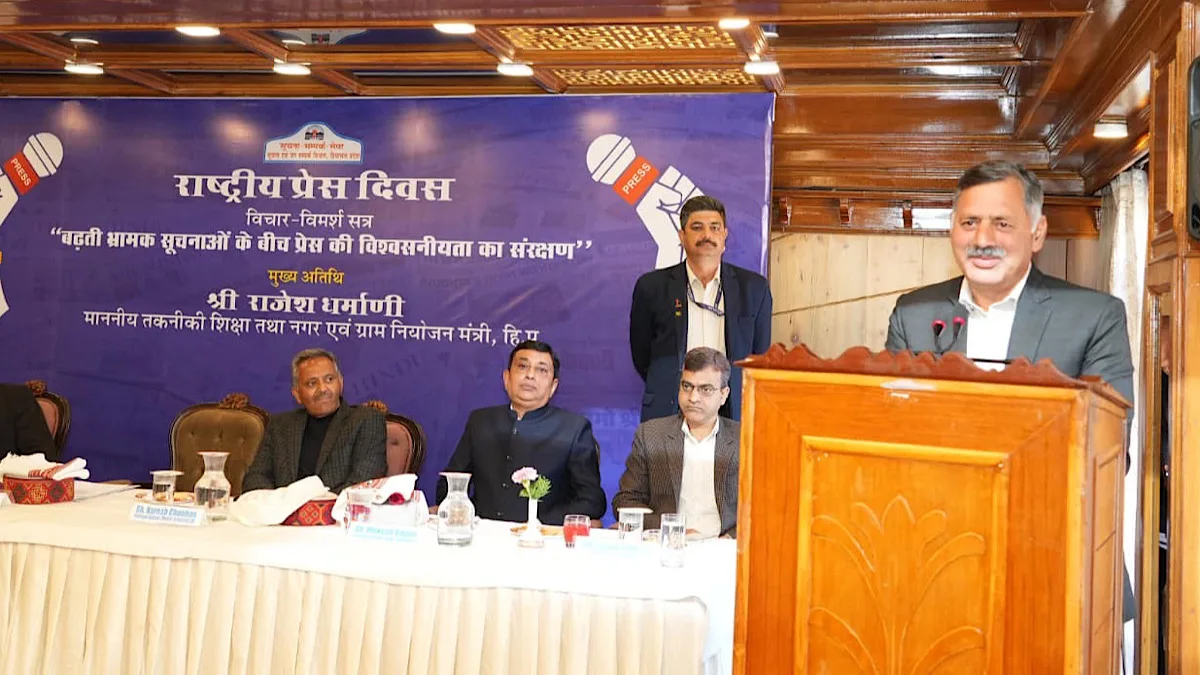
Himachal Pradesh Technical Education Minister Rajesh Dharmani, while presiding over the state-level function of National Press Day here on Sunday, said that the day serves as a reminder of both the freedom and the responsibilities of the press, and its indispensable role in building a transparent and accountable society.
He said that the press forms the backbone of a healthy democracy, and promoting transparency within the media will ensure that democratic values remain vibrant and alive. The minister stressed that the media must continue to highlight important public issues and amplify the voices of underprivileged communities.
Advertisement
Dharmani noted that in the age of Information Technology, the media faces unprecedented challenges. Technologies such as artificial intelligence and deepfakes have enabled misinformation to spread rapidly, blurring the line between truth and falsehood and directly influencing society. In this context, he said, the media’s role in shaping national discourse becomes even more significant.
He added that under the leadership of Chief Minister Thakur Sukhvinder Singh Sukhu, the state government has launched various welfare schemes and initiatives aimed at public good. It is the responsibility of the media, he said, to ensure that accurate information about these initiatives reaches the public so that citizens can benefit from them.
Speaking at the event, Principal Advisor (Media) to the Chief Minister, Naresh Chauhan, said that the media serves as a crucial link between the government and the people. Journalists, he said, must disseminate information on public welfare programmes and convey public concerns to the government. He emphasised the need for publishing fact-based news and called for introspection within the profession to safeguard credibility.
Earlier, Professor Shashikant Sharma, Chairman of the Department of Journalism and Mass Communication at Himachal Pradesh University, presented his views on the theme Safeguarding Press Credibility Amidst Rising Misinformation. He said that the race for breaking news has eroded credibility and that social media has transformed the landscape of journalism.
Many countries, he noted, are promoting the concept of “slow news,” which prioritises detailed, fact-based reporting over the rush for TRP-driven headlines. He stressed the need to ensure that accurate information reaches the public through technological platforms and called for renewed focus on investigative journalism.
Chief Editor of Hillpost, Ravindra Makhaik, said that the theme of safeguarding press credibility captures the very essence of the current challenge. He pointed out that policymakers, journalists and audiences alike struggle to distinguish between authentic information and fake news. Information wars, he said, are becoming more intense, and the weaponisation of misinformation poses a serious threat to society. In this era of social media, where fake news travels rapidly, journalists must uphold values, verify facts and deliver accurate information responsibly.
Consulting Editor of News-18 Network, Mukesh Rajput, said that asking questions in the public interest is at the heart of journalism. He said that journalists must focus on issues of public concern and avoid hidden agendas. Cross-questioning, he added, is essential for maintaining credibility and for arriving at meaningful conclusions.
During the interactive session, senior journalist P C Lohumi said that along with press credibility, character building is equally important in today’s environment. Journalists, he said, must speak impartially and fearlessly, without bias or personal interest. Senior journalist Ashwani Sharma added that presenting both sides of a story, instead of running one-sided narratives, enhances the credibility of both the news and the journalist.