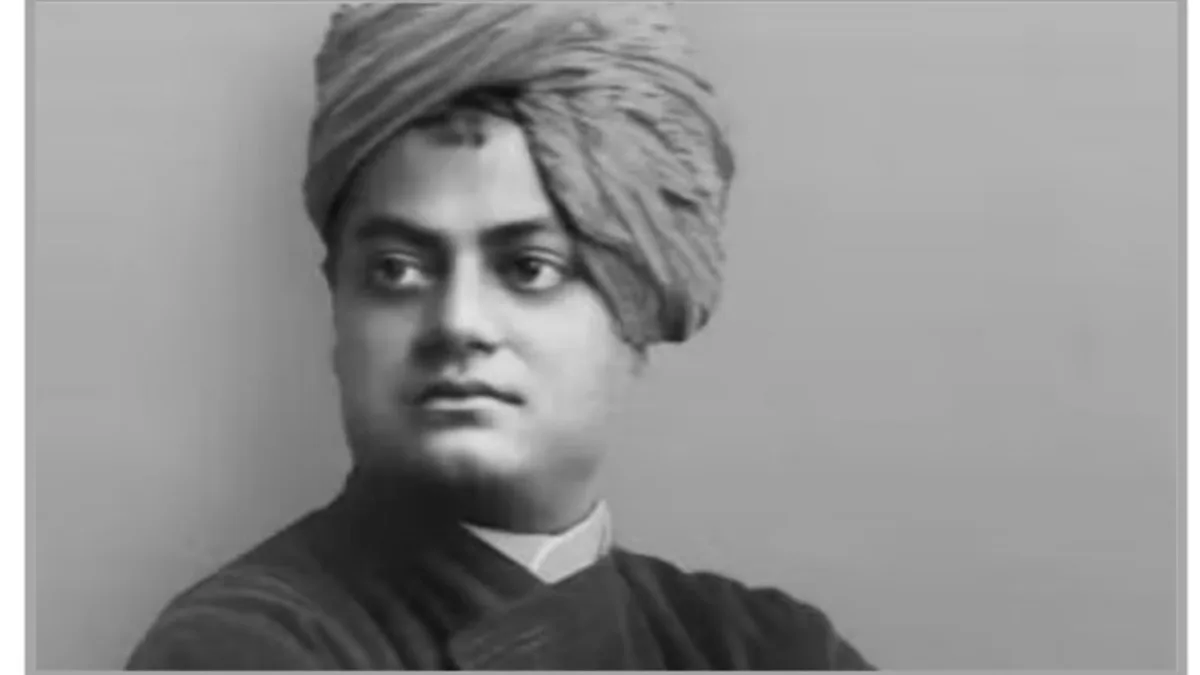
Swami Vivekananda shines in the annals of Indian history like a radiant dawn after a long night of despair. At a time when India was bound in chains of colonial subjugation, torn by caste barriers, and weakened by loss of self-confidence, he arose like a mighty lion, roaring forth words that awakened a sleeping nation. In saffron robes he stood, not merely as a wandering monk, but as a prophet of strength, a messenger of harmony, and an architect of unity. He gave voice to the soul of India, reminding her children of their eternal heritage and calling them to unite in love of their Motherland.
His role in national integration was not of a politician’s maneuverings but of a spiritual visionary whose torch of wisdom illumined the path of unity in diversity. The first gift Vivekananda gave his country was the rekindling of self-respect. Centuries of foreign domination had taught Indians to doubt themselves, to look upon their ancient culture with shame. Against this tide of despair, Vivekananda thundered with immortal words: “We are what our thoughts have made us; so take care about what you think. Words are secondary. Thoughts live; they travel far.” And indeed, he sowed thoughts of confidence and pride in Indian hearts. His resounding speech at the Parliament of Religions in Chicago in 1893 was not merely an address but a declaration of India’s spiritual wealth: “I am proud to belong to a religion which has taught the world both tolerance and universal acceptance.”
Advertisement
Those words were like nectar to his countrymen’s ears, for they reminded India that her strength was not dead – it was merely sleeping, waiting to rise once more. Thus, the foundation of national integration was laid in the soil of renewed self-confidence. Equally profound was his teaching of religious harmony. Vivekananda saw India not as a battlefield of creeds but as a vast ocean where many rivers of faith flow together. His voice resounded with clarity: “We believe not only in universal toleration, b ut we accep t all religions as true.” In this grand vision, there was no room for suspicion or hostility; rather, every faith was seen as a path leading to the same summit of Truth. By proclaiming this ancient Vedantic ideal in modern language, he gave Indians a unifying principle to rise above sectarian divides. He transformed religion from a dividing wall into a golden bridge – binding together Hindus, Muslims, Christians, and others into the fraternity of service to humanity.
“So long as the millions live in hunger and ignorance, I hold every man a traitor who, having been educated at their expense, pays not the least heed to them,” he declared, thus making service itself the highest religion and the strongest bond of integration. Swami Vivekananda was also a crusader against social divisions. He denounced untouchability and caste arrogance, proclaiming, “So long as the millions live in hunger and ignorance, I hold every man a traitor who…does not care for them.” He dreamed of a nation where no man would be despised for his bir th, and no woman chained by ignorance. His immortal call – “Arise, awake, and stop not till the goal is reached” – was not only an exhortation to individuals but a trumpet call to a fragmented nation to rise as one body.
He called the youth the “dynamic power of the nation,” urging them to dedicate themselves to the service of the poor, the weak, and the downtrodden. In his dream of integration, no caste, creed, or class could be excluded; the nation could only stand united when its weakest were embraced as equals. Patriotism, in Vivekananda’s hands, became a spiritual force. He saw India not as a political map but as a divine Mother. “For our motherland, a junction of two great systems, Hinduism and Islam – Vedanta brain and Islam body – is the only hope.” In these words, he envisioned a synthesis, a unity in which the best of all traditions could be harmonized into a strong and vibrant nation. His devotion to Bharat Mata was so intense that he turned patriotism into worship, declaring: “For the next fifty years, let this be our keynote – this, our great Mother India.”
With such fiery devotion, he transformed love of country into a sacred duty, lifting patriotism from mere sentiment to a spiritual vow. Thus, he created the emotional and moral cement that bound together the bricks of India’s unity. In the grand mosaic of his vision, Vivekananda saw India rising not as a uniform mass but as a splendid garland of diversity. “Unity in variety is the plan of creation,” he proclaimed, reminding his countrymen that diversity was not a curse but a blessing, so long as it was harmonized by the spirit of love .
His role in national integration was therefore not of era sing difference shutoff orchestrating them into a symphony – each voice distinct yet contributing to the harmony of the whole. Leaders like Mahatma Gandhi admitted, “I have gone through his works very thoroughly, and after having gone through them, the love I had for my country became a thousandfold.” Subhas Chandra Bose called Vivekananda “the spiritual father of modern nationalist movement .” Such testimonies reveal how deeply his message of unity sowed seeds in the hearts of India’s future builders. Swami Vivekananda’s role in national integration was like that of a divine sculptor, chiselling away fear, division, and despair to reveal the noble form of a united Mother India.
His thunderous words, his tireless call to youth, his insistence on service to humanity, and his profound vision of religious harmony created the spiritual foundations of unity. He awakened in India the consciousness of her own soul and reminded her children that their destiny lay in standing together as one. Even today, his voice rings like a temple bell across time: “Arise, awake, and stop not till the goal is reached.” In that call lies the eternal blueprint of national integration – a vision of harmony in diversity, of unity in love, and of strength in service. Swami Vivekananda was not merely a saint of his age; he was, and remains, the eternal architect of India’s oneness.
(The writer is a Thrissur-based accountant and freelance contributor.)