Lieutenant Governor Manoj Sinha on Sunday exhorted scientists and experts to establish a group that can help develop an advanced early warning system for flash-floods by making more sensitive and accurate sensors through nanotechnology.
Such technology will prove to be a game changer in preventing loss due to natural disasters in the Himalayan region of India in the future, the LG said.
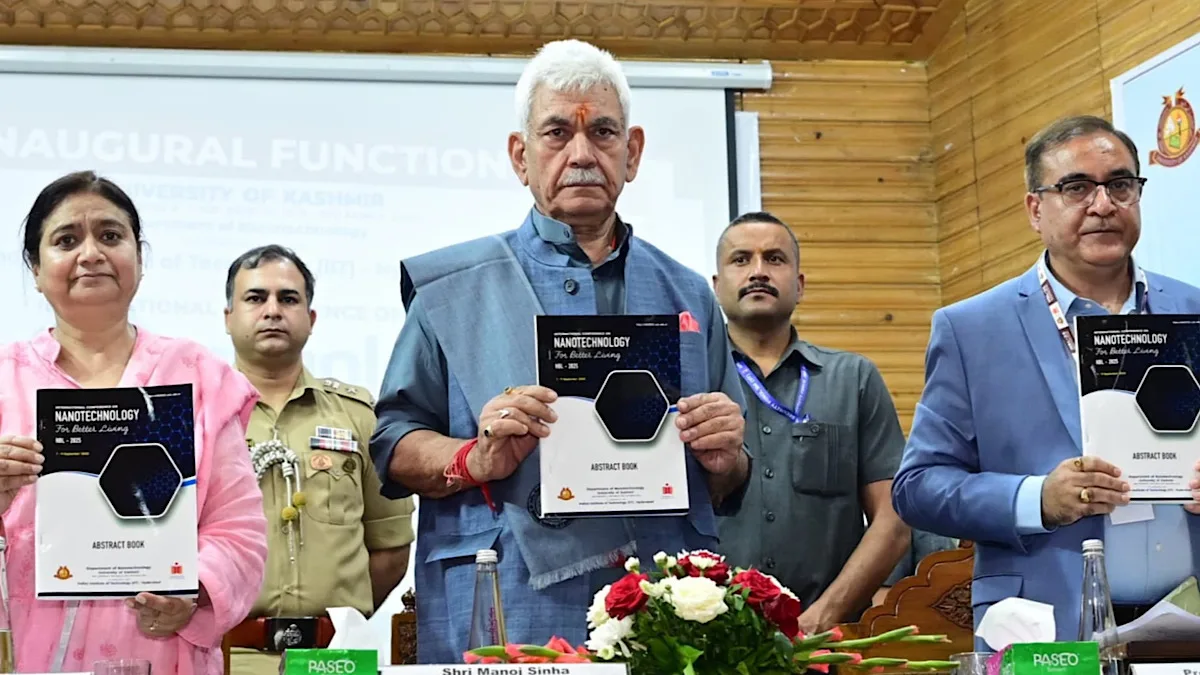
The LG was addressing the inaugural session of the International Conference on “Nanotechnology for Better Living (NBL-2025)” at the University of Kashmir.
Advertisement
The five-day mega event, organised by the University of Kashmir in collaboration with Indian Institute of Technology (IIT) Hyderabad, has brought together leading scientists and researchers to showcase recent advancements in nanotechnology and its applications for sustainable living.
LG Sinha said “Keeping in mind the challenges of climate change, we should focus on creating nanomaterials that can reduce pollution in chemical manufacturing”.
“We must also explore the new possibilities to develop soil sensors specifically for the Himalayan regions. These sensors would be part of an Advanced Early Warning System that can warn about the dangers of landslides in advance based on changes in soil saturation,” the Lieutenant Governor said.
“We simply cannot ignore the daunting challenges of climate change that confront us. Our inventions and initiative show how quickly we are leading various areas of Nano-Technology,” he said.
In the future, new innovations in nanoscale transistors, nano-particles, nano materials and nanoscale additives in energy, environment, food, agriculture and electronics will be very important for the welfare of humanity. I hope that the benefits of these technologies will reach the common man,” the Lieutenant Governor further said.
Speaking on the advancements and breakthroughs in Nanotechnology that is reshaping the lives and work environment and ensuring ease of living, he said, “Today, evolution in Nanoscience and Nanotechnology is having a transformative impact across various sectors. The cutting-edge research in the future will address critical global challenges in industries, healthcare and the environment. There is not a single area of global socio-economic development that does not bear the signature of Nanotechnology in some form or the other. In the years to come, this will become more prominent as we script the new advancements in technology.”
Mr Sinha called on the scientists and experts associated with nanotechnology to make their significant contributions in the defence sector, particularly in manufacturing the lighter components of defence equipment. Nanotechnology experts and scientists must join this effort and strengthen the self-reliance campaign in the defence sector, he said.
Vice Chancellor, University of Kashmir, Prof. Nilofer Khan; Dean Academics, BRIC-InStem, Bangalore, Prof. Praveen K. Vemula; eminent Scientist from IIT Kanpur, Prof. Ashok Kumar; Head, Department of Nanotechnology, Kashmir University and Organizing Chair of the Conference, Prof. Rabia Hamid; scientists, experts, researchers and heads of educational institutions were present.