Uttarakhand’s economy rose 26 times, per capita income grew 17 times in 25 years: Dhami
The state’s budget outlay, he added, has for the first time exceeded ₹1 lakh crore in 2025, compared to ₹4,000 crore in its first budget.
In a move to boost infrastructure and development in remote border areas, the Arunachal Pradesh government has identified 66 villages along the Indo-Myanmar frontier for focused attention under the Centre’s Vibrant Villages Programme (VVP).




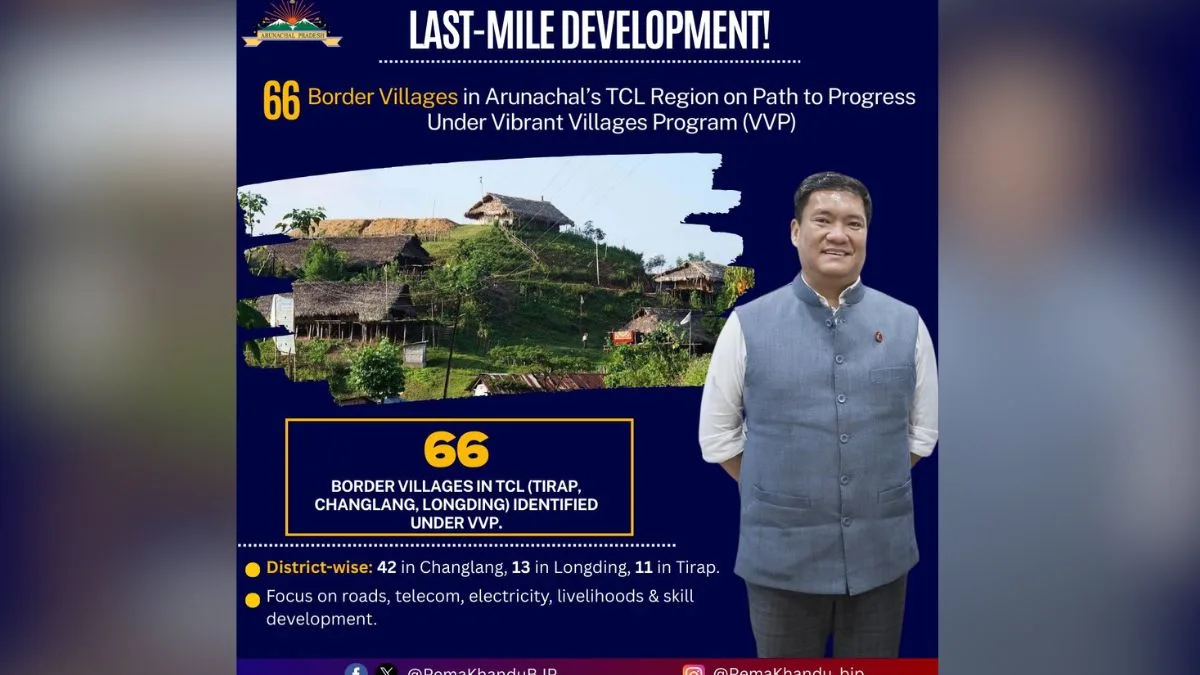
Photo: X/@PemaKhanduBJP
In a move to boost infrastructure and development in remote border areas, the Arunachal Pradesh government has identified 66 villages along the Indo-Myanmar frontier for focused attention under the Centre’s Vibrant Villages Programme (VVP).
Chief Minister Pema Khandu made the announcement on Monday, describing the initiative as a milestone for “last-mile development” aimed at bridging critical gaps in connectivity, public services, and livelihood opportunities in these strategically important regions.
Advertisement
The selected villages span the eastern Arunachal districts of Changlang, Longding, and Tirap— the regions that share porous and sensitive international borders with Myanmar and have long grappled with geographical isolation, poor infrastructure, and intermittent insurgent activity.
Advertisement
The Changlang district with 42 villages accounts for the highest number of the 66 such villages, followed by Longding with 13 and Tirap with 11.
Taking to social media, Khandu said the initiative is about more than infrastructure; it is about empowering the people living in these remote villages and securing India’s frontiers by promoting sustainable habitation in areas that are often left behind in the development discourse.
“This is more than infrastructure development—it’s about empowering lives in our border villages and ensuring sustainable habitation in areas critical to national security,” he posted.
Census data from 2011 sheds light on the demographic range of the selected villages.
The programme, launched by the Ministry of Home Affairs in 2023, initially focused on strengthening border villages along the Indo-Tibet and Indo-Bhutan frontiers. Arunachal Pradesh’s inclusion in the Indo-Myanmar sector marks a strategic expansion of the programme.
The VVP aims to bridge developmental gaps by focusing on all-weather road connectivity, telecommunications, electricity, housing, healthcare, and the promotion of local livelihoods through skill development. It also emphasizes tourism potential and renewable energy solutions.
Officials noted that the programme’s broader goal is to stem the tide of rural-to-urban migration by making these villages self-sustaining and attractive for habitation. This approach not only supports local communities but also ensures a civilian presence in sensitive border areas, reinforcing India’s territorial and strategic interests.
The Indo-Myanmar border stretches 1,643 kilometers across Arunachal Pradesh, Nagaland, Manipur, and Mizoram. Unlike the heavily guarded Indo-China border, it is not heavily guarded.
With rising geopolitical sensitivities in the region, particularly concerning China’s growing influence in Myanmar and the eastern Himalayan corridor, programmes like the VVP are being viewed as vital components of India’s border management strategy.
Advertisement