Five youths swept away in surging Chambal river in Kota, Rajasthan
According to police sources, six youths were seen stranded at an outcrop in the river bed, the water level in which was rising fast and continuously.
Around 80 people drown every day in India, which comes to more than 29,000 every year. This data was released by…




(Photo: SNS)
Around 80 people drown every day in India, which comes to more than 29,000 every year. This data was released by the National Crime Records Bureau. In fact, from 2010-14, each year recorded an average of 25,000 deaths by drowning. The World Health Organisation reports that, on a global scale, 1,008 people die every day due to drowning — thus it is the third leading cause of unintentional death across the world with more than half the number being below 25 years of age.
These statistics articulate a clarion call to safeguard people from such disasters. But does one plan for such an arduous task? India is a vast country, and with its diversity, gives the matter of logistics some challenges. A person with calibre, conforming to this role, may successfully meet the demands of synchronising activities, and adopting a methodology, which encompasses the length and breadth of India — introduce life-saving skills that will benefit every man, woman and child.
An organisation called Rashtriya Life Saving Society-India has been formed and incredible as it appears, India has been blessed by a personality from the Indian Navy who has resolved to help redeem a series of tragedies, which entail drowning.
PD Sharma, Rear Admiral (Retired), crystallised a vision that both he and his wife, Kavita, decided to first study as a microcosm by scrutinising a map of the sub-continent and then expanding a programme to embrace every part of the country into their fold.
The journey that unfolds is mind-boggling because of the fact that the entire plan has cruised along ever since RLSS-I was founded on 2 August 1998. Both Rear Admiral PD Sharma and Kavita, the president and vice-president respectively, were presented the Commonwealth Award on 22 November last year by Queen Elizabeth at Buckingham Palace.
RLSS-I teach people to protect themselves from drowning — be it a village pond covered with an impenetrable mass of water hyacinth, a swimming pool, a river or even the mighty ocean. The Pune-based organisation engulfs just about everything with its humble ethos, which is a cornerstone of its amazing pursuits — the RLSS-I is a non-profit making endeavour.
Theirs is a service to the nation, one that every citizen of our vast country must be enlightened about. The indefatigable and tenacious efforts of this husband and wife team have elucidated an extraordinary dimension to the word, protection.
Rear Admiral Sharma’s determination came into effect when he read the horrifying details of the number of people who drowned every year in India. Both he and Kavita began an incredible journey thereafter. Their training programmes in Kerala were highlighted by the government there — interestingly, Kerala has many water bodies and that intensified the involvement of RLSS-I in the state.
They went through central India, onto West Bengal and into Assam where they began with the Assam Valley School — owned by the Williamson Magor Group, it ensures that every student is trained to swim, taught to help rescue another swimmer, and administer first aid, if necessary. The RLSS-I have included Assam and Arunachal Pradesh’s fast flowing rivers, into their training programmes as their waters have taken away many lives.
Rear Admiral Sharma has designed a manual with simple but effective rules for fast-flowing rivers, such as never going into a river alone; never jumping from a great height like a tree or bridge and making sure both feet are firmly on the river bed. To gauge the current, one should check by throwing a piece of wood or a bottle, and assess the speed of it drifting. He warns of the dangerous difference when a river has a separate rate of a current on the surface compared to the current in its depths.
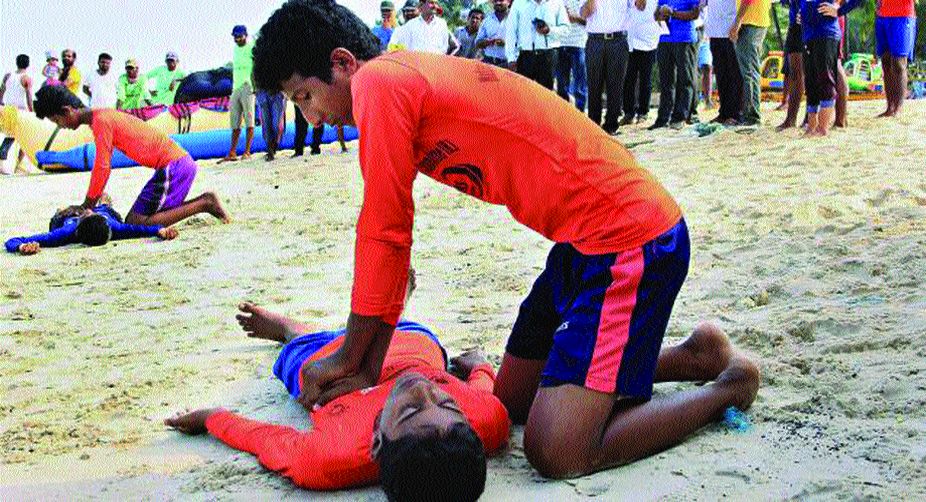
Apparently humans are not good swimmers and this is a principle that must be borne in mind because it excludes the possibility of taking risks. The core value of this programme is not preparing a learner for the Olympics. On the contrary, it teaches people to be safe in the water and to be of help to other swimmers around. In addition, the organisation conducts certifications in resuscitation (CPR), first-aid, lifeguards, and life saving.
Rear Admiral Sharma was elected the president of the International Life Saving Federation’s Asia-Pacific Region in 2012 — the first from Asia to hold such a position.
Advertisement
Advertisement