US pitches AI, LNG and SMR cooperation with ASEAN, opening opportunities for India
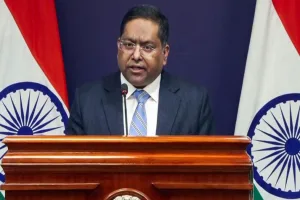
US Ambassador to ASEAN Kevin Kim in a virtual media briefing said Washington was prioritising advanced technologies and energy security across Southeast Asia.
The ruling is expected to affect employers, universities and healthcare systems that depend on skilled foreign professionals for specialised roles.




A US federal court has struck down the Trump administration's $100,000 fee on new H-1B visa petitions, ruling that the measure exceeded executive authority. | IANS
A US federal court has dealt a major blow to President Donald Trump’s immigration agenda, striking down his administration’s $100,000 fee on new H-1B visa petitions and vacating the policy nationwide.
The ruling is significant for technology companies, universities, hospitals, research institutions and Indian professionals, who form a major share of H-1B beneficiaries. It also opens a fresh legal front for the White House, which has said it will appeal the decision.
Advertisement
US District Judge Leo T Sorokin of Massachusetts ruled that the administration had exceeded its authority by imposing what amounted to a tax on H-1B petitions without approval from Congress, IANS reported.
Advertisement
“The Court finds that the Policy imposes a tax on H-1B petitions without the requisite delegation by Congress,” Sorokin wrote. “There are no statutory powers authorizing Defendants to implement a $100,000 tax on H-1B petitions.”
At the centre of the dispute was a September 2025 presidential proclamation that required employers filing new H-1B petitions to pay an additional $100,000.
The Trump administration had argued that the H-1B programme was being misused to replace American workers and suppress wages, especially in science, technology, engineering and mathematics sectors.
“Abuses of the H-1B program present a national security threat by discouraging Americans from pursuing careers in science and technology, risking American leadership in these fields,” Trump had contended in his proclamation.
But the court rejected the administration’s argument that broad presidential powers under immigration law allowed such a fee to be imposed as a condition of entry into the United States.
“While the Executive has broad discretion over the admission and exclusion of aliens, that discretion is not boundless,” Sorokin wrote, adding that such authority cannot cross constitutional limits or the powers granted by Congress.
The White House defended the policy after the ruling and said the administration was confident of success in appeal.
“President Trump has clear legal authority to restrict entry of any class of aliens he determines is not in America’s best interests, and that is exactly what he did,” White House spokeswoman Taylor Rogers told IANS.
“The H-1B program has been abused for decades, and President Trump finally took action to fix it. A federal judge in Washington already upheld a nearly identical order, and the Administration is confident this order will be reversed on appeal,” she said.
The court, however, found that the policy could not be treated merely as an immigration restriction.
“Taxes are not ‘restrictions,’” Sorokin wrote, while rejecting the government’s reading of presidential powers under the Immigration and Nationality Act.
The H-1B programme allows US employers to hire foreign professionals for speciality occupations requiring highly specialised knowledge and at least a bachelor’s degree or equivalent.
Congress currently caps most new H-1B visas at 65,000 annually, with another 20,000 reserved for applicants holding advanced US degrees. Universities, affiliated non-profit institutions and certain research organisations are exempt from the annual limits.
According to the State of California Department of Justice, employers petitioning for H-1B workers must submit applications certified by the US Department of Labour, stating that the employment will not negatively affect wages and working conditions of similarly employed US workers.
The ruling was welcomed by Democratic lawmakers, state officials and policy advocates, who argued that the fee would have hurt employers and public institutions already facing shortages.
Indian American Congressman Raja Krishnamoorthi called it “a welcome rejection of an unlawful policy that threatened America’s economic competitiveness and made it harder for businesses, hospitals, universities, and research institutions to attract the high-skilled talent they need to succeed,” IANS reported.
California Attorney General Rob Bonta, who led the multistate lawsuit challenging the policy, said the judgment had struck down what he called an unlawful and costly tax.
“The judgment is in! The Trump Administration’s unlawful and costly $100,000 tax has been struck down,” Bonta said.
FIIDS Chief of Policy and Strategy Khanderao Kand also welcomed the ruling, telling ANI that it restored “predictability and fairness” to the employment-based immigration system.
“This ruling is appropriate for preserving America’s competitive advantage in innovation, research, and entrepreneurship. Access to highly skilled global talent remains essential for the continued growth of the U.S. technology, healthcare, and advanced manufacturing sectors,” Kand said.
He added that major policy changes must be grounded in statutory authority and economic realities.
Beyond the constitutional question, the court also found that federal agencies violated the Administrative Procedure Act by implementing the policy without the required notice-and-comment rulemaking process.
“Defendants issued a legislative rule without engaging in notice-and-commenting rulemaking,” the ruling said.
The court also found the policy arbitrary and capricious, saying the administrative record did not show that officials had reasonably considered the impact of imposing such a steep fee on employers.
As a remedy, Sorokin declared the policy unlawful and vacated all agency actions implementing the payment requirement.
“The Policy implementing the Proclamation is declared unlawful and is VACATED in its entirety,” the ruling said.
Advertisement