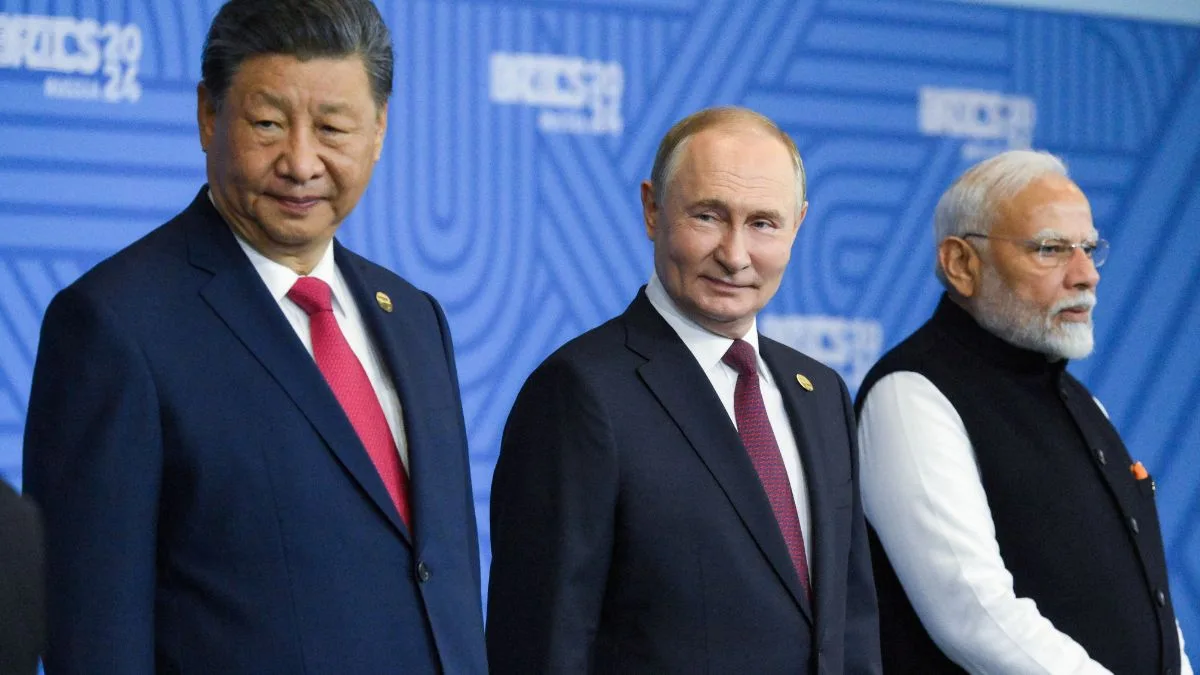
Russian President Vladimir Putin has strongly condemned Europe’s proposed sanctions against Moscow’s economic partners, particularly India and China, calling them a relic of colonial-era thinking and warning that such measures could carry serious political consequences for leaders in countries with historical sensitivities.
During a media interaction following his four-day visit to China on Wednesday (local time), the Russian President, responding to a question about Europe’s latest sanctions initiative over the conflict in Ukraine, took a firm stand against the West, asserting that such measures should not be pursued as they could destabilise the political standing of leaders in their own countries.
Advertisement
“You have countries like India, with almost 1.5 billion people, and China, with powerful economies, but they also have their own domestic political mechanisms and laws. So when somebody tells you that they’re going to punish you, you have to think: how can the leadership of those countries, of those big countries—which also endured difficult periods in their history, connected with colonialism and attacks on their sovereignty over prolonged periods of time—how can they respond? You have to understand that if one of them shows weakness, his political career will be over, so that influences his behaviour. Just as the colonial era is now over, they must realise that they cannot use this term in speaking with their partners,” Putin stated.
Also Read: Mega GST reforms announced! Slabs cut to two at 5% and 18%; sin goods to attract 40% tax
Despite the tension, Putin expressed optimism about a diplomatic resolution, saying: “But ultimately, things will be sorted out, everything will take its place, and we will see a normal political dialogue again.”
Putin further described the Ukraine conflict as a mere “pretext” used by Western powers to enforce broader punitive measures against countries maintaining strong economic ties with Russia.
He dismissed the relevance of the Ukraine situation to recent trade actions, noting that the narrative was being deliberately exploited to justify trade restrictions and tariffs that, in reality, serve unrelated political or economic agendas.
“Well, surprisingly enough, we almost didn’t mention this in our conversations because it’s not really something that concerns us. The Ukraine situation is only a pretext to take various steps against countries that have economic ties with us,” he said.
He also cited the imposition of additional tariffs on Brazil earlier in August as an example of sanctions with no direct connection to the Ukraine conflict.
The Russian leader argued that the true reason behind many of these sanctions lies in growing economic imbalances between the West, particularly the United States, and other major economies such as India, China, and Brazil.
“There is a trade disproportion between the United States and India or with China, but there is no such situation between Brazil and the United States, for example. And, by the way, Brazil faced additional tariffs on the 6th of August, even though the deadline was the 8th of August. So what does Ukraine have to do with this? Nothing. It’s only about domestic politics… Ukraine doesn’t have anything to do with that. Of course, there is some imbalance in trade, but I believe those should be addressed through negotiations,” the Russian President added.
This remark was made in response to global economic concerns stemming from the tariff policies introduced by US President Donald Trump, which have caused friction with several countries on the international stage, particularly India and China.
New Delhi is facing global uncertainties due to heightened economic tensions following the US imposition of a 50 per cent tariff on Indian imports, including an additional 25 per cent linked to its purchase of Russian crude oil, which Washington argues helps finance Moscow’s conflict in Ukraine.