Bengal’s chance to plant a new tree
In O. Henry’s The Last Leaf, ailing Johnsy clings to life because one painted leaf refuses to fall. Such is the power of optimism; it does not need to be certain to be effective.
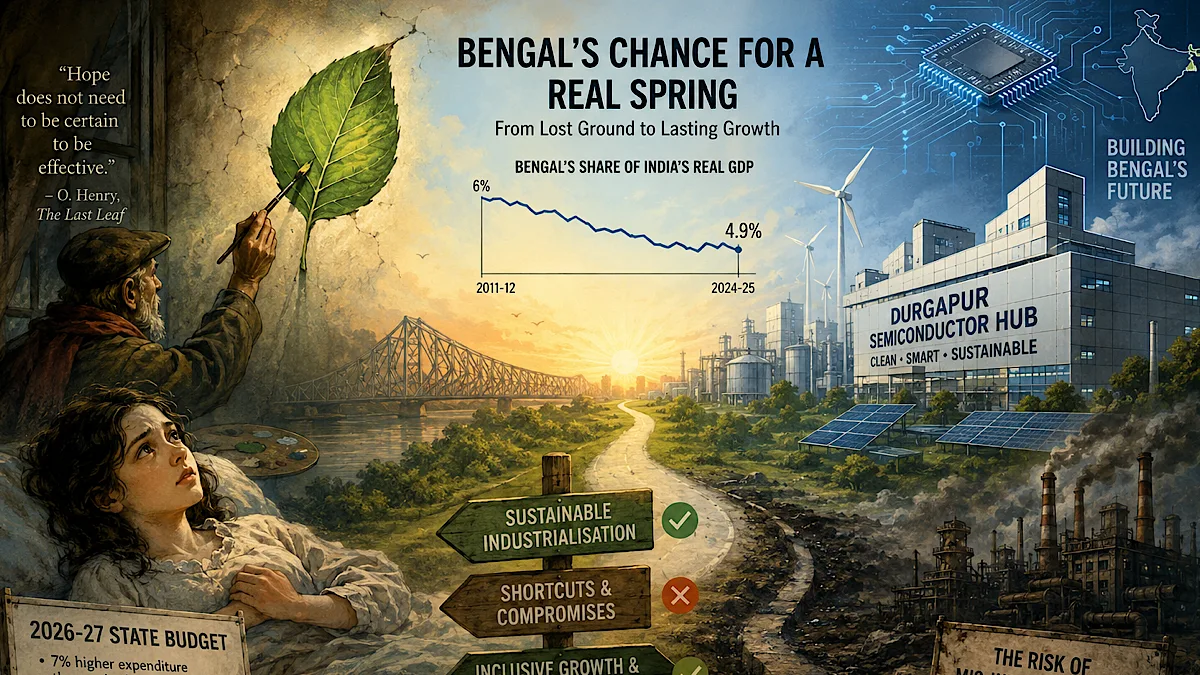
In O. Henry’s The Last Leaf, ailing Johnsy clings to life because one painted leaf refuses to fall. Such is the power of optimism; it does not need to be certain to be effective.

S&P Global Ratings cut India's GDP growth to 6.6 per cent in the current fiscal year, driven by energy stress, a sub-par monsoon and slowing global growth.
India's Gross Domestic Product (GDP) is set to grow at 6.6 per cent in the current fiscal as compared to 7.7 per cent in FY26, said BMI, a Fitch group company, citing weaker investments and consumption growth and trade shocks from the West Asia crisis.
India’s current account surplus moderated to $7.1 billion, or 0.7 per cent of GDP, in the fourth quarter (January-March) of financial year 2025-26, compared with $13.7 billion in the same period a year ago, according to the Reserve Bank of India’s latest Balance of Payments data.
Prime Minister Narendra Modi on Friday welcomed India’s latest GDP data, calling it proof of economic resilience, reform impact and the hard work of 140 crore Indians.

The Indian economy is expected to grow at 7.1 per cent in the first quarter (April-June) of the current financial year with the farm sector posting a robust performance, according to a report by SBI Research.

Driven by robust demand for government infrastructure projects, the country’s domestic steel production is projected to cross 300 million tonnes (MT) by 2030

Finance Minister Nirmala Sitharaman is expected to present the Union Budget 2024 on July 23.
It will be 3.4% of the country's GDP, and the government will endeavour to maintain strong fiscal support for infrastructure over the next five years, she said.
The latest survey released by FICCI here on Thursday predicted an annual median GDP growth forecast for the year 2024-25 at 7% and CPI inflation at 4.5% for the same period.