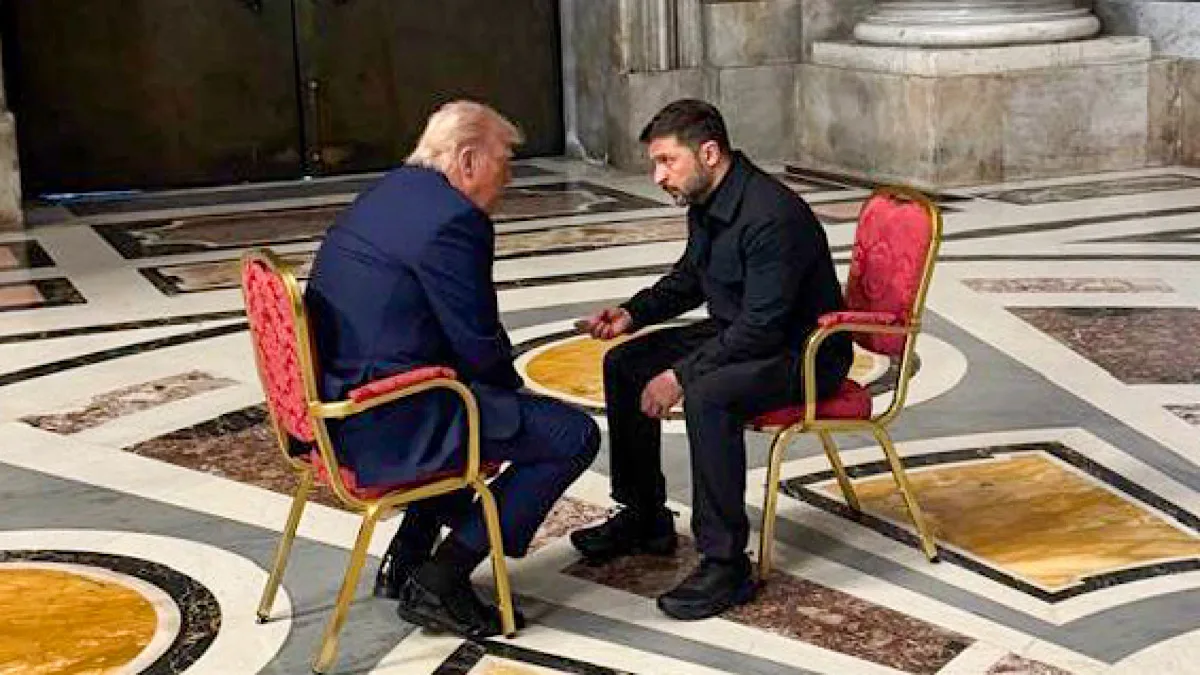
President Volodymyr Zelenskky’s latest visit to Washington offered neither triumph nor failure, only a stark glimpse of the shifting ground beneath Ukraine’s diplomatic feet. What unfolded was not a clash of positions but a quiet recalibration of priorities. The United States, once unwavering in its support for Kyiv’s military ambitions, is now speaking the language of de-escalation and “mutual restraint.” US President Donald Trump’s tone during his meeting with the Ukrainian President was strikingly cautious. By declining to commit to the supply of long-range Tomahawk missiles, he signaled a return to cold realism in Washington’s foreign policy, one that prizes negotiation leverage over battlefield advantage.
For Kyiv, the disappointment was palpable. The Tomahawks represented not just advanced weaponry but also a symbol of continued faith in Ukraine’s capacity to regain the initiative against Russia. Mr Zelenskky’s careful choice of words, calling himself “realistic” rather than optimistic, reflected an acute awareness of this new reality. His offer of drones in exchange for US missiles, while half in jest, betrayed the desperation of a nation fighting a war whose intensity far exceeds its means. Mr Trump, meanwhile, appeared more preoccupied with the optics of peace than the logistics of war. His statement that he hoped to “end the war without thinking about Tomahawks” captured the essence of a presidency eager to be seen as a global dealmaker rather than an arms supplier. The hesitation over missile supplies also reflects America’s growing fatigue with distant wars, a sentiment that could reshape its foreign policy priorities far beyond the Ukrainian battlefield. The timing of Mr Trump’s parallel engagement with President Vladimir Putin made the optics even more complex.
Advertisement
By speaking to the Russian leader on the eve of the White House meeting, and announcing plans for a summit in Hungary, Mr Trump effectively reminded Me Zelenskky that Washington’s diplomatic bandwidth is not exclusive. His insistence that “the threat” of Tomahawks was sufficient underscored an approach rooted in ambiguity: using deterrence as a bargaining chip rather than a commitment. For Ukraine, this is a difficult balancing act. Its Western partners continue to pledge humanitarian aid and limited military support, but the cohesion that once defined the alliance has begun to fray. Europe remains morally steadfast but militarily constrained. The United States, now treading cautiously between confrontation and compromise, seems increasingly guided by the belief that peace, even if imperfect, may be preferable to an endless stalemate. Mr Zelenskky’s predicament lies in this recalibrated geometry of global power. The road to peace now runs not just through Kyiv and Moscow but through Washington’s evolving calculations and the uncertain choreography of future summits. As the war grinds on, Ukraine faces an uncomfortable truth: its fate may hinge less on the weapons it receives than on the bargains struck in rooms where it is present but not always empowered to decide.