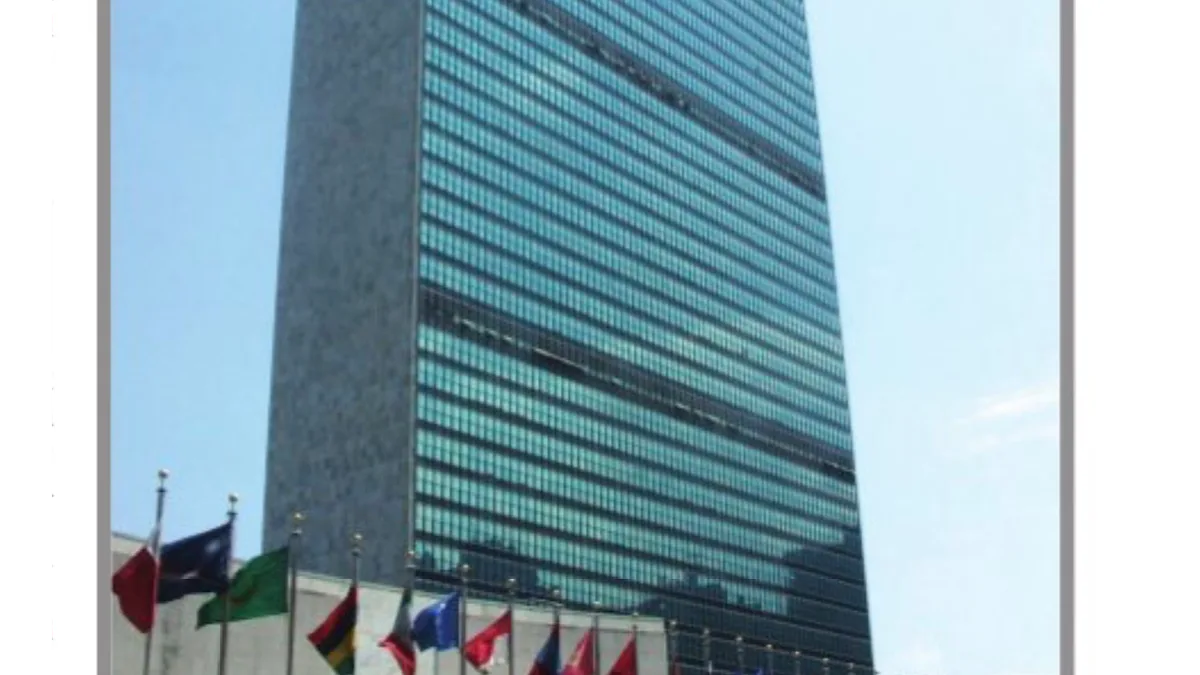
United Nations Day, celebrated each year on October 24, commemorates the entry into force of the United Nations Charter in 1945 – a document born out of the ruins of World War II with the solemn promise “to save succeeding generations from the scourge of war.” Marking eighty years in 2025, this day stands as both a celebration and a moment of reckoning. The world, burdened by conflicts in Gaza (amidst a ceasefire over 70,000 dead bodies), with Ukraine, Sudan, and Myanmar, and troubled by global polarization, climate catastrophe, and humanitarian crises, faces a critical question.
Has the UN lived up to its founding ideals of peace, security, and cooperation among nations? When established in 1945 by 51 nations, the UN’s purpose was to provide machinery for collective action to prevent conflict, promote human rights, and uplift global living conditions through cooperation rather than competition. United Nations Day, formally recognized in 1948 and later declared an international holiday in 1971, honours the institution’s mission – ‘to maintain international peace and security, develop friendly relations among nations, and foster social progress and better standards of life in larger freedom’. As the UN turns eighty this year, celebrations around the world – from educational panels to cultural exhibitions – reaffirm its ideals. Yet, behind these festivities lies a growing recognition that the UN’s capacity to act meaningfully has been weakened by geopolitical divisions and funding crises.
Advertisement
Reports indicate that the United Nations system in 2025 faces one of its most severe crises in decades. According to the ‘International Crisis Group’, the return of President Donald Trump to the U.S. presidency in January 2025 has had far-reaching implications for multilateralism. If reports are to be believed, the United States, the UN’s largest single donor, has significantly reduced its funding across agencies, including the World Food Programme and the UN High Commissioner for Refugees, both of which rely heavily on U.S. contributions. These cuts have forced the UN into what Secretary-General António Guterres calls the “UN80 retrenchment,” a drastic reform programme requiring a 20 per cent reduction in Secretariat staff and widespread budget tightening.
This has led to freezing peacekeeping funds and disputing even the use of terms like “gender” and “sustainability”. Moreover, other major powers, such as China and Russia, have exploited this vacuum by advancing their own spheres of influence rather than bolstering the collective mechanisms of peacekeeping and humanitarianism. The most immediate tests for the UN lie in the world’s active war zones. In Gaza, amidst the ceasefire and jubilations on the exchange of hostages, the devastation resulting from Israel’s campaign against Hamas since 2023 has exposed the limits of UN authority.
Israel has marginalized UN aid agencies, particularly UNRWA, the United Nations Relief and Works Agency for Palestine Refugees. The result has been mass starvation, widespread destruction of UN facilities, and the deaths of more than 360 UN staff members – making Gaza the deadliest mission in the organization’s history. Reports further indicate the institution’s inability to enforce international law or ensure civilian protection, thereby revealing a deep erosion in its foundational promise “to maintain international peace and security.” In Ukraine, the war with Russia continues into its fourth year, testing the UN’s relevance once again.
While the General Assembly reaffirmed Ukraine’s territorial integrity in early 2025, global support for such resolutions weakened markedly, with only 93 votes in favour compared to 141 in previous years, which is clearly a sign of diplomatic fatigue, highlighting that while the UN can facilitate dialogue or deliver aid, it struggles to shape outcomes in environments dominated by competing great-power interests. Despite these difficulties, the UN continues to lead vital humanitarian and development operations that no other organization can replicate. Agencies such as WHO, UNICEF, and WFP (World Food Programme) provide life-saving aid to millions, deliver education and vaccination campaigns, and coordinate climate and disaster responses. In Gaza and Sudan, UN convoys remain the only credible relief channels despite logistical barriers and active conflict zones.
Despite the challenges, the UN Sustainable Development Goals (SDGs), although delayed by economic crises and wars, still serve as a blueprint for inclusive growth that no state can achieve alone. While funding and the continuity of such programs are a concern, reports indicate that the UN is now pivoting toward “light-footprint operations,” focusing on mediation and local conflict prevention instead of large-scale interventions. In all these circumstances, it is essential to recognize that the UN remains the only truly universal forum where nearly every nation can voice its concerns. From steering international climate agreements under the Paris framework to coordinating pandemic preparedness through the WHO, the UN continues to offer a moral compass for cooperative action.
Humanitarian aid, refugee protection, and educational empowerment through agencies like UNESCO persist as daily expressions of global solidarity. These achievements demonstrate that the UN’s enduring value lies not in the power it wields, but in the legitimacy and ideals it embodies. In a fractured world defined by nationalism, technological disruption, and climate emergency, the path forward for the United Nations requires reimagining multilateralism beyond traditional state diplomacy. Partnerships with civil society, regional organizations, and private actors must complement formal state mechanisms. The UN’s focus should increasingly shift toward global challenges that transcend borders – climate change, cyber threats, and migration. Given the magnitude of growing challenges, it is undeniable that the United Nations continues to embody the world’s collective aspiration for peace.
Thus, the choice before humanity is not whether to abandon the UN but whether to empower it anew and prove, once again, that the quest for peace and justice among nations is not a relic of history but the unfinished task of today, which Antonio Guterres, the UN Secretary General had reiterated in his messages on the International Day of Nonviolence commemorating the 156th birthday of Mahatma Gandhi. Antonio Guterres said, “… We are witnessing a troubling erosion of our shared humanity. Violence is displacing dialogue. Civilians are bearing the brunt of conflict. International law is being flouted. Human rights are being trampled. And the foundations of peace are under strain”.
He added, “… In these dangerous and divided times, let us find the strength to follow his (Gandhi’s) lead, end the suffering, advance diplomacy, heal divisions, and create a just, sustainable and peaceful world for all”. Antonio Guterres further stated in his message for the UN Day on October 24, this year: “As we look ahead, we confront challenges of staggering scale: escalating conflicts, climate chaos, runaway technologies, and threats to the very fabric of our institution. This is no time for timidity or retreat. Now, more than ever, the world must recommit to solving problems no nation can solve alone…. Let’s show the world what is possible when “we the peoples” choose to act as one.” The choice is ours!
(The writer is Programme Executive, Gandhi Smriti and Darshan Samiti.)