‘Let her bring the best lawyers’: Bangladesh ‘welcomes’ Hasina’s possible return, says she must face justice
"We welcome her announcement as we want to ensure justice," Zahed Ur Rahman said, according to local media.
Mohammad Yunus formed the interim government after the July 2024 revolution and Prime Minister Sheikh Hasina’s escape to India.




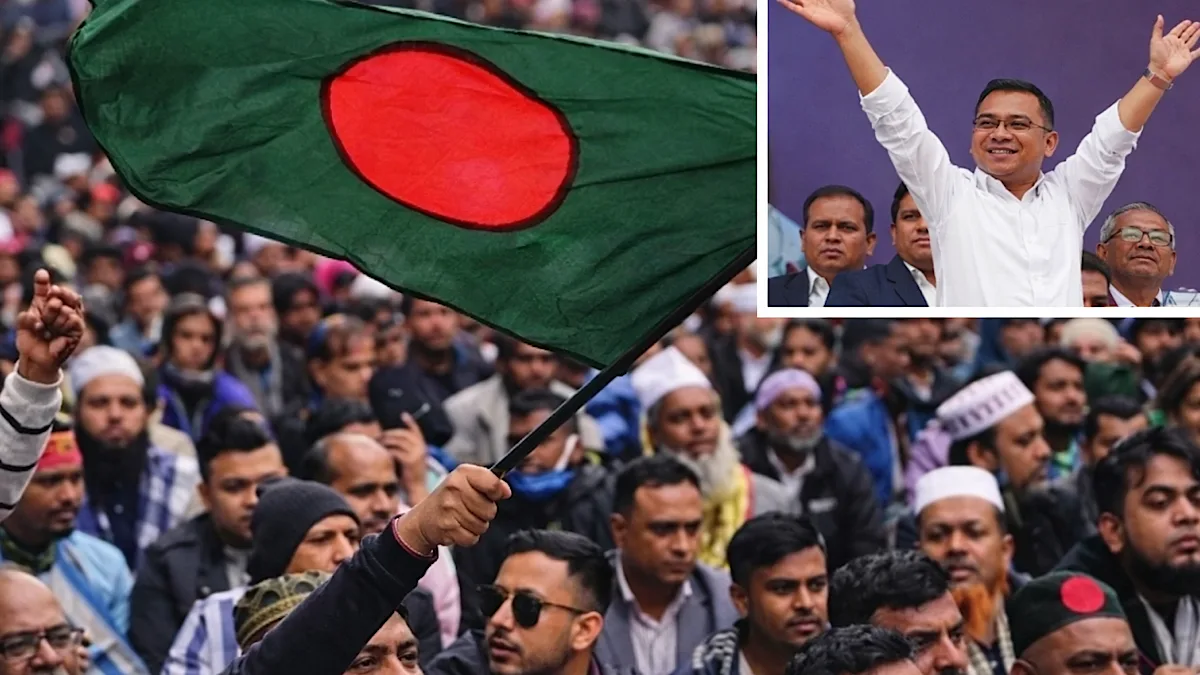
Photo:SNS
Mohammad Yunus formed the interim government after the July 2024 revolution and Prime Minister Sheikh Hasina’s escape to India. He had three important functions to perform: (1) to suggest reforms of the existing constitution, (2) trial of the guilty and (3) holding elections. It is to his credit that elections were held within 18 months, belying many observers who said the election might not take place at all or would be delayed indefinitely. Not only did elections take place within a reasonable period but Yunus was bold to advance it.
Yunus promised the best election in Bangladesh’s history and he delivered it. By advancing the election he endeared himself to his fellow citizens. The impressive victory of BNP defies the media projection of the Jamaat coalition gaining power or even projection of a hung parliament. Social media, mainly Facebook, used disruptive methods extensively to propagate against the BNP. The presence of many rebel candidates and even a certain amount of complacency of the BNP leadership created confusion but the astounding result in BNP’s favour settled the issues raised earlier. It is now a situation of one-party dominance with Tarique Rahman playing the crucial role of a catalyst who steered the victory after political exclusion and persecution for two decades.
Advertisement
The BNP’s historic comeback was earned and not given. BNP suffered immensely during the last two decades but the organization remained intact. Khaleda’s decision to stay on, and suffer humiliation and suffering made her more popular. Tarique remained constantly available and responded to any ill-treatment of the BNP cadre. Some help always came. The criticism that Awami League’s exclusion makes the election less inconclusive did not cut much ice. Hasina from Delhi called for the cancellation of the election citing low voting but that gets largely negated by 59 per cent voting which is enough to make the present regime legitimate.
Advertisement
The Awami League’s call for a boycott proved to be its second defeat. Its absence in the elections was not noticeable indicating its alienation from the ordinary people which was mainly because of the three previous rigged elections and the exclusion of BNP from the electoral process. Hasina in exile did not indicate any intention of return and the future was deliberately kept hazy. The last proper election was in 2008 and the latter three were stolen. It became a one-party state with both BNP and Jamiat boycotting. No organized plan for a return was visible with many leaders in jail and others in exile in Kolkata. It is not comparable to the situation of 1971 as in the contemporary situation these leaders were the accomplices of Hasina’s plunder and trampling of democracy.
A new brand of politics has ended two decades of authoritarian rule. BNP’s moderation, projecting itself as a catch-all political party, the promise of no retribution and emphasis on reconciliation and rehabilitation created misgivings about it even amongst substantial traditional rivals belonging to Awami League. Hasina’s appeal for a boycott failed; while some responded to the boycott call, the majority switched to BNP and a small segment voted for the Jamaat. Whether participation of Awami League in the election would be preferable or not was a moot point because the party’s top brass was either in exile in India or elsewhere, a large number were in jail and many were underground. It was in a dysfunctional state and its offices were shut.
Many analysts attribute the election as a victory of the Jamaat as its representation rose from a paltry 3 in 1996 to 70 in 2026. Jamaat is at the opposite pole of the BNP. Despite having well-organized, efficient, and dedicated cadre it exists at the fringe. The absence of the Awami League and the events of July 2024 propelled it to play an important role, though purely situational and transitory. Jamaat’s narrative was centred around denial of basic rights to women as it wishes to restrict women to the domestic sphere, primarily child bearing responsibilities ~ an anathema to educated middle class and self-reliant women who have savoured economic and social freedom because of rapid expansion of textile and pharmaceutical sectors and the extensive work done by Grameen Bank. The election was conducted peacefully with both the law administering authorities and the army playing a significant role in maintaining law and order through quick action against miscreants.
They worked as a team efficiently and responsibly. On the night of 11 February, there were efforts at buying votes but this was thwarted by prompt action of the authorities. The election had positive approval from all the sections of the population and even in the stronghold of the Awami League, Gopalganj, 43 per cent voted. Tarique Rahman by his moderation, even hinting that Awami League in future would function as a normal political party, and his quick action in expelling 7,000 members of BNP for extortion proved he is a man of action. However, BNP’s performance would have been more impressive had it not been for rebel candidates in the fray, triangular contests that allowed Jamaat to win with narrow margins and the eclipse of Ershad’s Jatiya party in North Bengal.
The latter, a supporter of Hasina, was wiped out without any meaningful presence. The NCP became a pivot following the July Revolution but was an eventual loser. It used novel tactics of social media and enjoyed substantive government support but the fatal mistake was its alignment with the Jamaat. It was short sighted and, in a hurry, it lost the opportunity of filling the vacuum created by the exit of the Awami League. It garnered only sectoral support. Jamaat and NCP were helped by the presence of a large number of BNP rebels, seven of whom won. The new parliament will not be very different from the old ones with many familiar faces, insignificant numbers of youth, and only seven women, six of them from BNP. During voting there were few charges of manipulation or malpractices.
It is expected that all parties would accept the results. The low voting was also because of a lack of incentive to vote and Dhaka was empty as the Government declared a three-day holiday. One very important revelation was that no party had a firm following of voters. The number of floating voters was extremely high. This was a gross miscalculation of the Awami League leadership. They thought its committed voters would always remain committed to it. A major concern for most citizens was nation-building and performance in which no incentive, bribe or any other persuasion really mattered. The election revealed the solidification of Bangladeshi nationalism with its civilizational roots and cultural plurality. The BNP despite decades of suffering proved to be an organization with a capacity for endurance thereby earning people’s trust.
The need to restore democratic values, strengthen the parliamentary system and broaden the framework of human rights resonated across the country. The Hasina factor was dominant, reminding that such acts will not recur. Bangladesh has proved that its unity is not merely tribal but like India, symbolic of unity in diversity. One reason for the youth not performing well was the general perception that Gen Z is not prepared to play long-term principled politics. The election rejected both religious obscurantism and the narrative that the BNP is corrupt.
The BNP endeared itself to a section of the educated by its declaration that its cabinet will reflect competence with experts heading departments. What endeared Tarique to people was that in a short period of six weeks he has demonstrated his level of tolerance, not being abusive of his opponents and not raking up past rivalries. His commitment to both 1971 and 2024 allowed him to fill the gap very well. People perceived this as a return of value based liberal politics.
(The writer is a retired Professor of Political Science, University of Delhi)
Advertisement