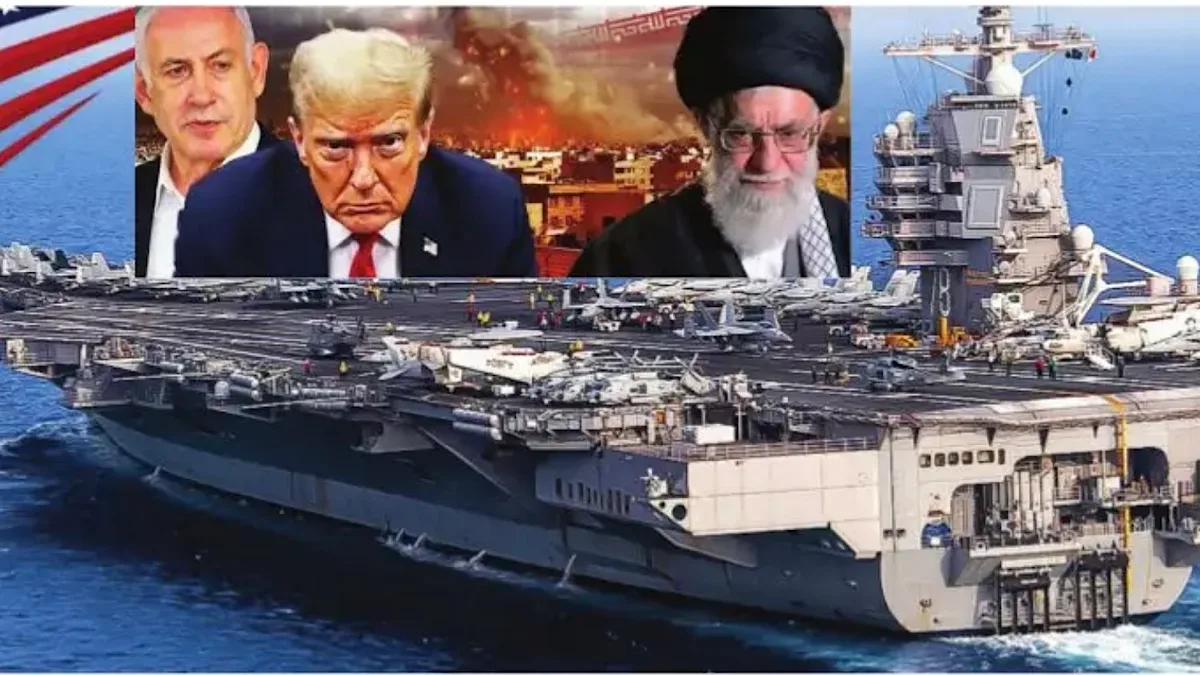
As American representatives negotiated with their Iranian counterparts in Geneva, an armada of US warships, led by USS Gerald R. Ford, the world’s largest warship, sailed towards the Middle-East. The scenario in February 2026 was uncannily similar to the one in June 2025, when talks on nuclear disarmament had lulled Iran into complacency, catching it unawares when Israel, and later the US, attacked it. However, Iran was much better prepared for the 28 February US and Israeli onslaught – it gave back almost as good as it received.
Iran’s supreme leader of 36 years, Ayatollah Ali Khamenei, along with Iran’s top political and military leadership, were all killed in an Israeli missile attack; bomb attacks destroyed Iran’s navy and grounded its air force; diminished its missile capability and arms industry; the Iranian debacle was capped by the sinking of its warship, near the coast of Sri Lanka. Along with military targets, US and Israeli bombs hit hospitals and residences in Iran, leading to around 1200 civilian deaths; the nadir was reached, when a US Tomhawk missile hit a school, snuffing out the life of 138 innocent Irani schoolchildren. Iran has retaliated by targeting US bases in the Middle-East, and attacking Israel and other Arab countries. Even though most Iranian missiles and drones were successfully intercepted, yet some crucial targets were hit, including US bases in the Middle-East, particularly Qatar, and Saudi Arabian oil installations.
Advertisement
Falling debris from missiles damaged malls and luxury hotels across the Arabian peninsula, and two Iranian missiles were intercepted in Turkish air space. Iran, on its part, has denied targeting Turkey or other Arab countries. Interestingly, just before the invasion, Prime Minister Narendra Modi, was on a State visit to Israel, where he confabulated with the Israeli Prime Minister, and also addressed the Israeli Parliament (Knesset). Modi’s hosts admitted that before launching their strikes, they had to wait for the Indian leader’s departure. There has been considerable collateral damage. Iran has blockaded the Straits of Hormuz that connect the Persian Gulf to the Gulf of Oman.
The Straits are 167 kilometres long, and a mere 39 kilometres across at their narrowest. Almost 20 per cent of the world’s oil, and 20 per cent of global LNG transits through this tiny corridor. The Iranian blockade has resulted in an immediate spike in oil prices, with crude touching US$120 per barrel on 9 March. Should the blockade continue, a global oil and LNG shortage is inevitable. As of today, gas prices have risen sharply in India, and gas shortages have hit restaurants, catering and other establishments – even gas-fired crematoriums have shut down in several Indian cities. Share markets are falling round the globe; the Sensex fell from 82,419 on 26 February to 77,510 on 9 March, with investors losing Rs.22 lakh crore in the process.
The South Korean share index fell by 12 per cent in a single day, and the US share market is falling daily. Dubai airport has been hit more than once, and airlines are intermittently cancelling flights, to and from the Gulf. Countries like India have deployed planes to evacuate their citizens from Gulf countries. Shipping costs have escalated sharply, as marine insurers are cancelling ongoing contracts, due to the enhanced war risk. As exports to the Gulf region become undeliverable, returned export consignments are piling up in Indian ports. Chipmaking is suffering in South Korea because helium gas from Qatar, is not available. Just before the US launched its murderous assault, a survey by the Economist and YouGov found that only 27 per cent Americans supported a strike on Iran.
Approval ratings spike once a war starts, but an NBC News survey, has found that 54 per cent of respondents disapproved of President Trump’s handling of the situation in Iran. This is to be expected, as there is no clear objective behind the US invasion of Iran. Many reasons have been offered by Trump and his cabinet; in the beginning the ostensible rationale for the strike was destruction of Iran’s nuclear weapons and missiles, which does not wash, because after the June war, Trump had victoriously declared that Operation Midnight Hammer had obliterated Iran’s nuclear programme. More recently, in an interview with Fox News on 22 February, Steve Witkoff, U.S. Special Envoy to the Middle East, had claimed that Iran was only a week away from producing industrial-grade bomb-making uranium, only to be contradicted by Trump, two days later, who said that Iran’s nuclear programme had been “ blown to smithereens.”
More importantly, even before the war started, Oman, which mediated in the Geneva talks, between US and Iran, had said that there had been an unprecedented breakthrough in nuclear negotiations, with Iran having agreed to zero stockpiling of uranium, and converting existing enriched material into fuel. Earlier this year, in the wake of murderous repression of protests by the Iranian regime, Trump had assured protestors that help was at hand, and that he would punish Ali Khamenei, the Iranian Supreme Leader. Khamenei is dead, but the war goes on with increased ferocity. Lately, Trump is taking the Israeli line that Operation Epic Fury was a pre-emptive strike on Iran, as Iran was about to attack Israel and the US. Thus, it is difficult to find a clear motive for the US attack on Iran, which may be the reason that the American public is not enamoured of Trump’s misadventure.
Trump is hard put to explain the reason for attacking Iran to the US public; he delivered the longest State of the Union address in history on 24 February, covering an array of his policies on the US economy, crime, trade, immigration and foreign policy ~ but mentioned Iran only in passing. Perhaps, the rationale for the American-Israeli invasion lies in realpolitik. The “axis of resistance” of terrorist organizations ~ Hezbollah in Lebanon, Hamas in Gaza, the Houthis in Yemen ~ built by the Iranian regime, were a permanent thorn in the flesh of Arab governments, but particularly Israel. After smashing Hamas, the Americans and Israelis are targeting both Hezbollah and Iran, simultaneously.
There are two more important, though unstated reasons for the American belligerence; first are Iran’s oil reserves, which the US would like to control, and second is the US desire to crush Iran militarily, so that Israel is the unchallenged boss of the Middle-East ~ ready to protect US interests against everyone. As the Iran war enters a decisive phase, no country stands with Iran ~ even its clients and steadfast supporters, China and Russia, only mouth platitudes. Supposedly neutral countries like India have kept mum. Apparently, no country wants to draw Trump’s ire, the buzz being that a statement in support of Iran will serve no purpose except that of antagonising Trump.
Israel is a country which ploughs a lonely furrow, and does not let international law stand in the way of how it achieves its goals. Also, Israel does not mind using its vast arsenal on the least provocation, and has full US financial and military support for whatever it does. In this backdrop, the entire world should ponder what could be done to stop the unnecessary bloodshed, and certain economic ruin for the world economy. On Trump’s part, he may mull over what Benjamin Franklin, statesman, polymath and one of the Founding Fathers of the USA, wrote to his friend, US Representative Josiah Quincy: “May we never see another War! for in my Opinion there never was a good War, or a bad Peace.”
(The writer is a retired Principal Chief Commissioner of Income-Tax)