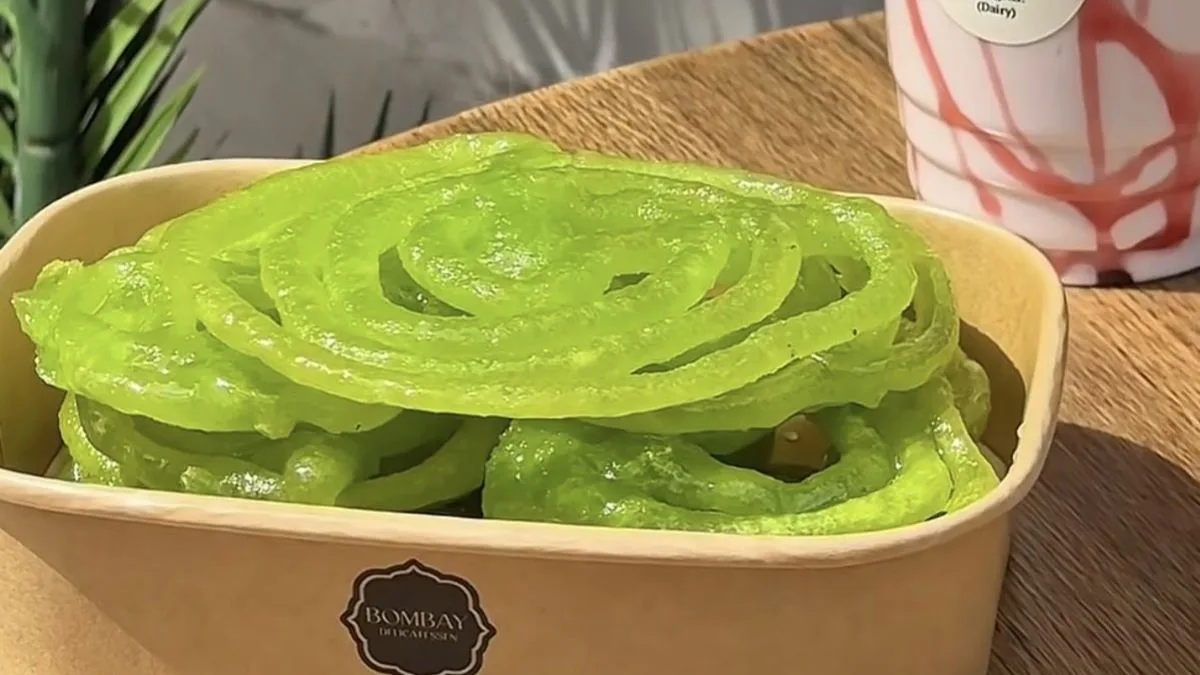
India has survived partition, demonetisation, and that one uncle who puts ketchup on dosas. But this week, the country faced its most serious threat yet. A Delhi woman named Vani posted a photo of matcha jalebi sitting next to a glass of strawberry lassi and, just like that, the internet snapped.
Vani shared her astonishment at the pairing with a simple remark: “Matcha jalebi with strawberry lassi, words I never expected to put in that order.” Relatable, Vani. Nobody expected that sentence to exist either.
Advertisement
What even is this thing?
For those blessedly uninformed, a quick explanation. Jalebi is a coiled, deep-fried sweet soaked in sugar syrup. It is orange, it is sticky, and it has been making people happy since roughly the 15th century. It does not need fixing. It’s not broken.
Matcha, on the other hand, is a Japanese green tea powder that Gen Z discovered sometime around 2022 and has since deployed into every known substance on earth. Lattes? Done. Ice cream? Done. Croissants? Done. Skincare? Somehow, yes. And now, apparently, jalebi.
The video showcases a traditional South Asian sweet in an unusual green shade, thanks to the addition of matcha powder. The result looks less like a dessert and more like something a science teacher would use to explain algae blooms. Paired with a pink strawberry lassi, the plate looks like someone let a five-year-old pick the colour palette for a wedding.
The internet reacts, predictably, with violence
The post spread with the kind of speed usually reserved for breaking news and celebrity gossip. The video garnered over 850,000 views, 63,000 likes, and approximately 800 comments. People had opinions. Strong ones. The sort of opinions usually reserved for political manifestos and cricket matches.
One commenter wrote “Don’t ruin jalebi like that,” while another sarcastically added: “Ab zyada ho raha hai.” A third was more philosophical: “There’s a global shortage of matcha for this reason.”
Someone invoked the Hulk. A user wrote, “Hulk became Hulk after he had this.” Another kept it brief: “That’s just wrong.” A portion of users questioned the authenticity of the image, suspecting it might have been created through artificial intelligence. Which raises an important philosophical question: at this point, which outcome is worse?
Another user provided what is perhaps the most vivid description of the dish: “This looks like someone vomited after drinking matcha.” Harsh? Possibly. Accurate? The comments section thought so.
It should be noted that none of these people have tried the jalebi. Their horror is entirely aesthetic. The green colour alone has done enough damage to public morale. The actual taste remains a mystery, because almost nobody was willing to find out.
The matcha problem
To understand how we got here, one must understand the matcha situation. Matcha is trending globally for its numerous health benefits and visual appeal. Rich in antioxidants such as polyphenols, it has been linked to reduced inflammation and enhanced cognitive function.
Wonderful. Matcha is good for your brain. And yet, somehow, the brains consuming matcha have decided to put it in jalebi. One wonders whether the cognitive enhancement is working as advertised.
The matcha craze has taken over everything from drinks and desserts to smoothies and even skincare, especially among Gen Z. This is a generation that made butter boards a thing. That put cream cheese on cucumbers and called it a snack. Nobody should be surprised that jalebi is next.
India’s jalebi has stood for centuries. It has outlasted empires. It survived colonisation. And, it made it through the peak of the molecular gastronomy era without anyone injecting it with liquid nitrogen. It will probably survive matcha too.