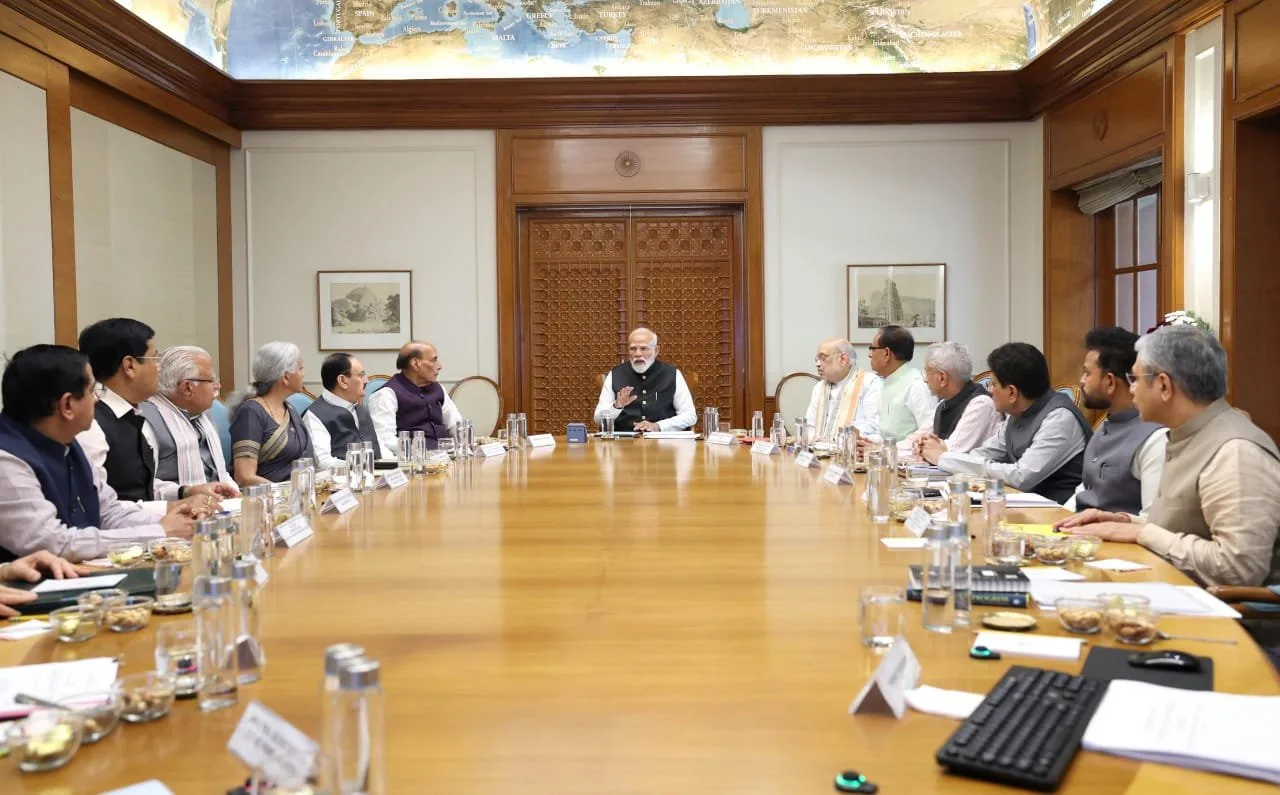
Amid a global energy crunch triggered by the ongoing Middle East conflict, Prime Minister Narendra Modi on Sunday chaired a meeting of the Cabinet Committee on Security (CCS) to review the situation.
The meeting was attended by senior cabinet ministers, including Home Minister Amit Shah, Defence Minister Rajnath Singh, Agriculture Minister Shivraj Singh Chouhan, Petroleum Minister Hardeep Singh Puri and Commerce Minister Piyush Goyal among others.
Advertisement
During the meeting, the Cabinet Secretary gave a detailed presentation on the global situation and measures taken so far and being planned by all concerned Ministries and Departments of Government of India.
Advertisement
The CCS assessed the availability for critical needs of the common man, including food, energy and fuel security was made. Short term, Medium term and Long term measures to ensure continued availability of essential needs were also discussed in detail.
PM Modi directed that a group of ministers and secretaries be created to work dedicatedly in a whole of government approach. He instructed for sectoral groups to work in consultation with all stakeholders.
The Prime Minister said that the conflict is an evolving situation and the entire world is affected in some form. In such a situation, all efforts must be made to safeguard the citizens from the impact of this conflict.
He further instructed that all arms of government should work together to ensure least inconvenience to the citizens. PM Modi asked for proper coordination with state governments to ensure no black-marketing and hoarding of important commodities.
India heavily relies on the Gulf region to meet its energy demands. However, the closure of the Strait of Hormuz, a key shipping route in the Persian Gulf, has severely affected energy supply.
Over the last two weeks, the Narendra Modi government has taken several steps to safeguard India’s energy security and manage gas and crude supply.
According to a senior government official, the government is continuously monitoring the situation in the Middle East to protect consumer and industry interests.
On Saturday, Prime Minister Narendra Modi spoke with Iranian President Masoud Pezeshkian to convey his greetings on the occasion of Eid and Nowruz.
During the telephonic conversation, PM Modi condemned the attacks on critical infrastructure in the region and reiterated the importance of freedom of navigation.
“Spoke with President Dr. Masoud Pezeshkian and conveyed Eid and Nowruz greetings. We expressed hope that this festive season brings peace, stability and prosperity to West Asia. Condemned attacks on critical infrastructure in the region, which threaten regional stability and disrupt global supply chains. Reiterated the importance of safeguarding freedom of navigation and ensuring that shipping lanes remain open and secure,” Modi said on X.
The Prime Minister also appreciated “Iran’s continued support for the safety and security of Indian nationals in Iran.”
PM Modi told NDA MPs the government acted immediately after reports of the NEET-UG paper leak surfaced, while Opposition parties demanded accountability and raised the issue inside and outside Parliament.
The robust growth in these industries offset weaker performance in other sectors. Output declined in crude oil, natural gas, refinery products and fertilisers during the month, highlighting the uneven nature of the recovery across the core industries.