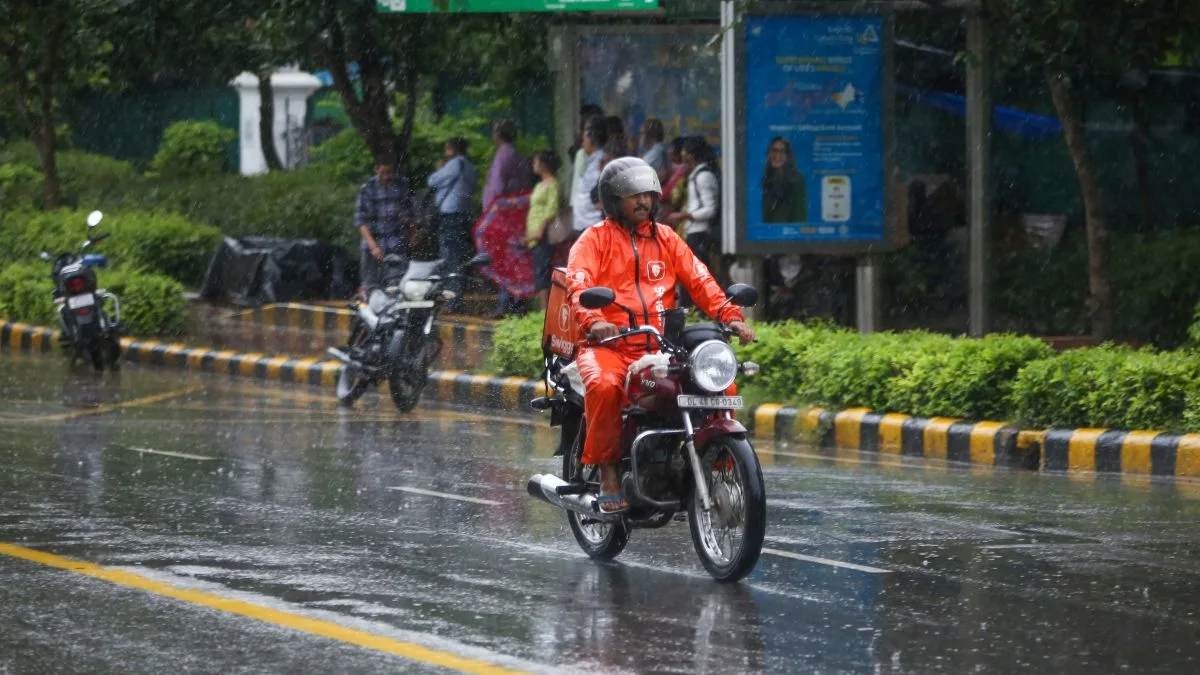
As torrential monsoon showers lashed North-East Delhi and adjoining Ghaziabad on Thursday, pushing several parts of the capital into the heavy rainfall category, the downpour also delivered the cleanest air Delhi has breathed this year.
The city’s daily average Air Quality Index (AQI) improved to 48 at 4 pm, entering the ‘Good’ category for the first time in 2026 and marking Delhi’s first ‘Good’ air quality day since September 10, 2023, when the AQI stood at 45.
Advertisement
The India Meteorological Department (IMD) officials said that the heaviest rain remained over North Ghaziabad and North-East Delhi, with weather radar consistently showing the highest reflectivity over these areas through the day. Central and East Delhi received the second-highest rainfall, while Gurugram and Southwest Delhi experienced comparatively moderate showers.
The rainfall was widespread and several stations recorded heavy to very heavy spells. Mayur Vihar emerged as the wettest among IMD’s principal observatories, logging 102.5 mm during the 24 hours ending 8.30 am, placing it in the heavy rainfall category. Other stations that recorded substantial rain included Delhi University (94.4 mm), Pharma Science and University (85.5 mm), Pusa (83 mm), Lodhi Road (80.2 mm), Ridge (77.8 mm), Safdarjung (72.6 mm), IGNOU/Chhatarpur (72 mm), Palam (63 mm), Narayana (62.5 mm), Janakpuri (62 mm) and Ayanagar (57.4 mm).
Rain continued through Thursday morning before gradually easing. Between 8.30 am and 11.30 am, Mayur Vihar received another 38.5 mm, while Lodhi Road recorded 29.2 mm, Safdarjung 26 mm and Ridge 23.2 mm. Thereafter, rainfall became scattered, with only isolated showers reported during the afternoon.
Beyond the principal observatories, some localities witnessed exceptionally heavy rain. Tukmirpur recorded around 160 mm, making it one of the wettest locations in the National Capital Region during the event, although IMD officials said historical comparisons are unavailable for the station.
The sustained rain also brought a sharp fall in temperatures across the city. Safdarjung recorded a maximum of 29.2 degrees Celsius, 7.4 degrees below normal, while the minimum settled at 24.3 degrees Celsius, 3.6 degrees below normal. Across Delhi, maximum temperatures largely remained in the 28-31 degrees Celsius range as dense cloud cover and persistent rain kept daytime conditions unusually cool for early July.
The widespread showers also flushed pollutants from the atmosphere, helping Delhi record its best air quality of the year. With the daily average AQI touching 48, the city entered the ‘Good’ category for the first time this year, a rare occurrence in the capital, where even the monsoon often struggles to keep pollution levels below the 50-mark. As per CPCB classification, an AQI between 0 and 50 is ‘good’, 51 to 100 ‘satisfactory’, 101 to 200 ‘moderate’, 201 to 300 ‘poor’, 301 to 400 ‘very poor’, and 401 to 500 ‘severe’.
The IMD has forecast one or two more spells of light to moderate rain at most places, with isolated heavy rainfall, thunderstorms and lightning during Thursday evening and night, before rainfall activity gradually weakens from Friday afternoon.