Long before ‘Jai Bhim’ became a greeting of solidarity and pride for Dalit communities across India, the slogan was born quietly on the banks of a river in rural Marathwada.
Its origin story, tucked away in Makranpur village of Kannad tehsil, goes back to December 30, 1938, when Dr Bhimrao Ramji Ambedkar addressed a historic gathering that helped shape a social awakening.
Advertisement
How ‘Jai Bhim’ took birth at Makranpur Parishad
At the first-ever Makranpur Parishad, which was organised by Scheduled Castes Federation of Marathwada’s first president Bhausaheb More, Ambedkar delivered a powerful address urging people not to support the princely state of Hyderabad, under whose rule large parts of central Maharashtra then fell.
According to Assistant Commissioner of Police Pravin More, Bhausaheb’s son, the transformative moment came when his father rose to speak before the crowd. He told the gathering that different communities greet one another by invoking their deities, and since Dr Ambedkar had shown them the road to progress and was revered like a god, they should greet each other with “Jai Bhim”.
The response was overwhelming. The gathering passed a resolution adopting “Jai Bhim” as the community’s slogan.
Nation remembers Ambedkar on Mahaparinirvan Diwas
As the country marked the 70th Mahaparinirvan Diwas on Saturday, tributes to Dr BR Ambedkar poured in from across the political spectrum, with leaders invoking his legacy of justice, equality and constitutional values.
Prime Minister Narendra Modi led the commemoration in Parliament, offering floral tributes and posting a message on X praising Ambedkar’s “visionary leadership” and commitment to democratic principles. “May his ideals keep lighting our path as we work towards building a Viksit Bharat,” he wrote.
President Droupadi Murmu, Vice-President CP Radhakrishnan, Lok Sabha Speaker Om Birla, Leader of the Opposition Rahul Gandhi, Parliamentary Affairs Minister Kiren Rijiju and several MPs joined the early morning ceremony at Parliament House.
Rahul Gandhi described Ambedkar as an “icon” whose ideas continue to guide India’s democratic framework.
“The Constitution of every Indian is under threat. We protect it, the citizens protect it,” he told reporters after the ceremony. In a separate post, he said Ambedkar’s legacy “strengthens my resolve to defend the Constitution.”
Congress president Mallikarjun Kharge also said the nation must uphold the values Ambedkar lived for. “Today, more than ever, we are called upon to uphold, preserve and defend the values he lived for and his greatest gift to the nation, the Constitution of India,” he said.
Opposition uses the moment to target the Centre
Samajwadi Party chief Akhilesh Yadav alleged that attempts were being made to undermine the Constitution and warned against the emergence of “one-man rule”. He called the Constitution the “sanjeevani” of democracy.
In Tamil Nadu, DMK MP Kanimozhi said Ambedkar’s teachings obligated political parties to resist communal forces. Chief Minister MK Stalin added that those who once sought to suppress Ambedkar now “pretend to praise him,” calling his struggles a lesson in the pursuit of an egalitarian society.
Public commemoration and the Ambedkar Foundation’s event
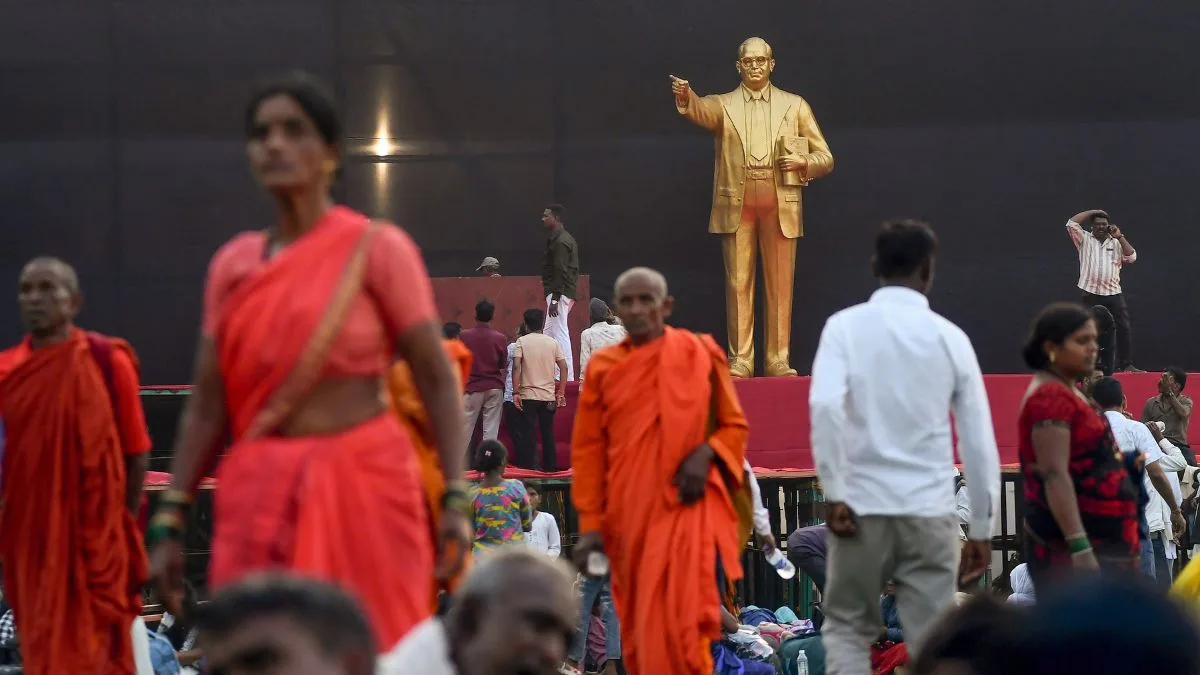
The Dr Ambedkar Foundation (DAF), under the Ministry of Social Justice and Empowerment, held its annual ceremony at Prerna Sthal inside the Parliament House campus. The event, marked by Buddhist chants by 25 monks, was later opened to the public for floral offerings at Ambedkar’s statue.
The Foundation also assisted visitors with storage facilities and emphasised its ongoing work to disseminate Ambedkar’s philosophy nationwide. Established in 1992, DAF functions as an autonomous organisation tasked with carrying forward the ideas of India’s foremost social reformer.
Dr Ambedkar, the principal architect of the Constitution and a towering advocate of social justice, passed away on December 6, 1956. Every year, Mahaparinirvan Diwas is observed to honour his role in shaping India’s democracy.