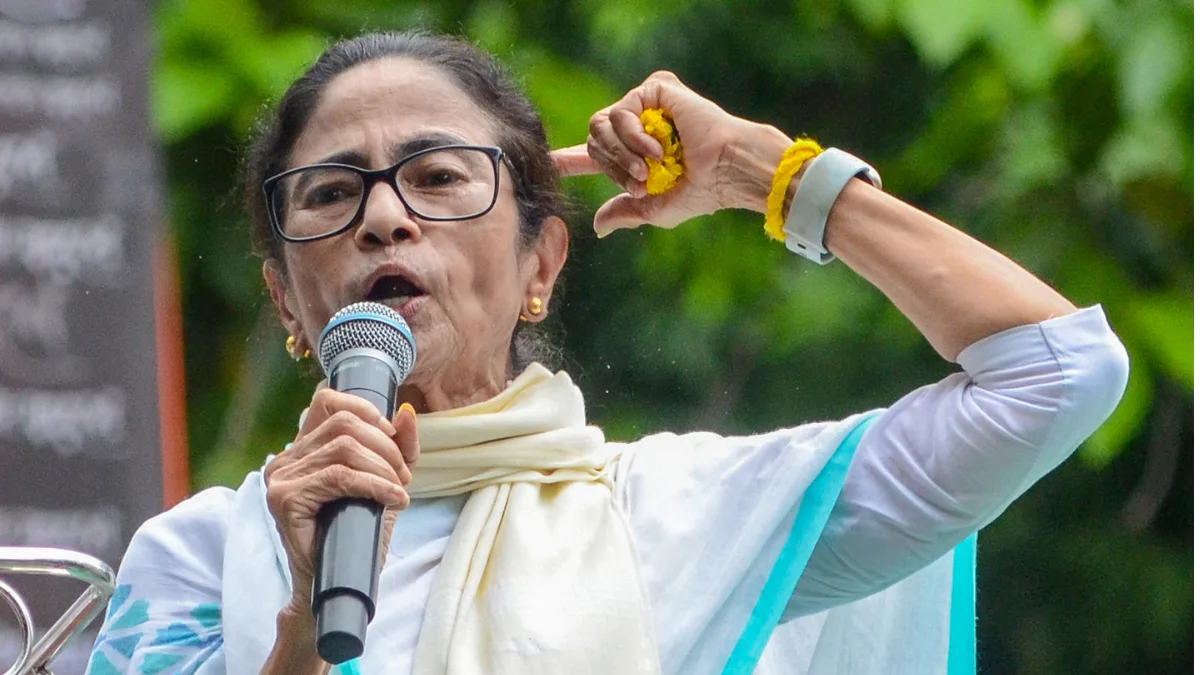
Mamata’s call for anti-BJP unity at Martyr’s Day rally junked by Congress, Left
Bengal BJP president Samik Bhattacharya said Mamata Banerjee should first focus on uniting her own party before attempting to forge an opposition alliance.
After Defence Minister Rajnath Singh called out on Pakistan in a veiled attack for indulging in cross-border terrorism and harboring terrorists during the Shanghai Cooperation Organisation (SCO) Defence Ministers’ Meeting at Qingdao, China, on Thursday





Photo: IANS
After Defence Minister Rajnath Singh called out on Pakistan in a veiled attack for indulging in cross-border terrorism and harboring terrorists during the Shanghai Cooperation Organisation (SCO) Defence Ministers’ Meeting at Qingdao, China, on Thursday, it was revealed that a joint statement could not be signed as certain member countries failed to reach consensus on certain issues.
In a briefing, Ministry of External Affairs Spokesperson Randhir Jaiswal said India wanted terrorism reflected in the document and it was not acceptable to one particular country. Stating that Singh called the 11 countries to come together to fight terrorism in all its forms and manifestations, the MEA spokesperson added, “India wanted concerns and terrorism reflected in the document, which was not acceptable to one particular country. The defence minister, in his address, called upon these 11 countries to come together to fight terrorism in all its forms and manifestations. He also reiterated the need to uphold that the perpetrators, organisers, financers, sponsors of reprehensible acts of terrorism, including cross-border terrorism, need to be held accountable and brought to justice.”
Advertisement
Earlier, in a scathing but veiled attack on Pakistan, Singh, who reportedly refused to sign the Joint Communiqué, had called upon the SCO for not hesitating to criticise nations indulging in cross-border terrorism and harbouring terrorists. “It is imperative that those who sponsor, nurture, and utilise terrorism for their narrow and selfish ends must bear the consequences. Some countries use cross-border terrorism as an instrument of policy and provide shelter to terrorists. There should be no place for such double standards. SCO should not hesitate to criticise such nations,” he had said.
Advertisement
Stating that peace and prosperity cannot co-exist with terrorism and proliferation of Weapons of Mass Destruction in the hands of non-state actors and terror groups, Singh, while taking a strong stance without openly naming Islamabad, stated, “There is a need to hold the perpetrators, organisers, financiers and sponsors of reprehensible acts of terrorism, including cross-border terrorism, accountable and bring them to justice.”
“During the Pahalgam terror attack, victims were shot after they were profiled on religious identity. The Resistance Front, a proxy of UN-designated terror group Lashkar-e-Taiba (LeT) claimed responsibility for the attack. The pattern of Pahalgam attack matches with LeT’s previous terror attacks in India. India’s zero tolerance for terrorism was demonstrated through its actions. It includes our right to defend ourselves against terrorism. We have shown that epicentres of terrorism are no longer safe and we will not hesitate to target them,” he said.
Meanwhile, sources quoted by ANI, stated that “India is not satisfied with the language of the joint document, there was no mention of the terrorist attack in Pahalgam, there was mention of the incidents that happened in Pakistan, so India refused to sign the joint declaration, and there is no joint communique either.”
Advertisement