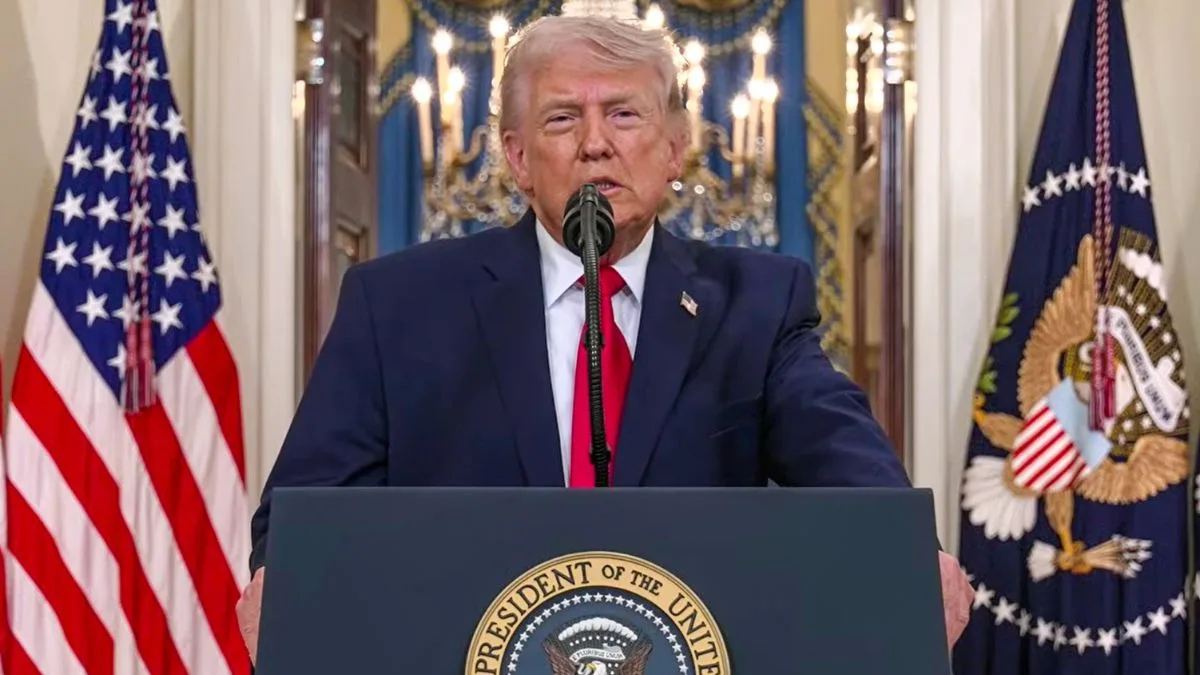
US Supreme Court blocks Donald Trump’s order, upholds birthright citizenship
The 6-3 ruling marks the second time in 2026 when the court invalidated a major Trump initiative. This comes months after it strike down his sweeping global tariffs.
While issuing an invitation to India in January to join the Gaza Board of Peace, US President Donald Trump asked PM Narendra Modi to join him in solidifying peace in the Middle East and to embark on a bold new approach to resolving global conflict.





World leaders and founding members of the Board of Peace at the inaugural meeting at the Donald J. Trump Institute of Peace. | Image courtesy: X/@BoardOfPeace
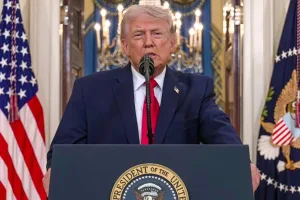
United States President Donald Trump on Thursday hosted the first meeting of the Gaza Board of Peace.
At the meeting attended by representatives from nearly 50 countries, including India, Trump unveiled the next phase of the US-brokered peace deal for the Gaza Strip. However, as expected, Trump did not hold back from pitching the Board as a platform to tackle other global conflicts.
Advertisement
“We will make Gaza very successful and safe and we are also going to maybe take it a step further, where we see hotspots around the world, we could probably do that very easily,” Trump said.
Advertisement
The United Nations Security Council (UNSC) had in October last year adopted a resolution on the Board of Peace and the ceasefire agreed between Israel and Hamas after three years of war. The resolution also laid out the next steps in the reconstruction of Gaza and the rehabilitation of its people.
At the Board’s first meeting yesterday, Trump pledged USD 10 billion for Gaza’s reconstruction. The White House said other countries have pledged some USD 6.5 billion to the Board, whose lifetime chairman is none other than Trump himself.
While Trump told the gathering that the Board of Peace is coordinating with the UN on Gaza, he did not shy away from indicating that the initiative could ultimately replace the 80-year-old global body instituted to tackle global conflicts.
“Someday I won’t be here. The Board of Peace is almost going to be looking over the United Nations and making sure it runs properly,” Trump said.
Many of the US’s allies in Europe, including the 27-member European Union, have so far declined invitations to join the Board amid fears that it could eventually replace the United Nations. They have also raised concerns with regard to the Board’s structure and the centralisation of decision-making power.
It is noteworthy that while Trump will be the lifetime chairman, he has offered memberships for life to countries that contribute USD 1 billion each.
At the meeting, Trump also had a message for holdouts – 26 countries have so far officially joined, while less than half of the invitees haven’t done so.
“Almost everybody has accepted, and the ones that have not, will be. Some are playing a little cute. That’s not working, you can’t play cute with me. They’re playing a little bit,” the US President said.
The spokesperson of the Ministry of External Affairs on Friday said India attended the February 19 meeting in Washington, D.C., as an observer.
“India has supported the Gaza peace plan initiative of President Trump and the efforts that are underway pursuant to UN Security Council Resolution 2803,” Randhir Jaiswal told a weekly press briefing, while commenting on the inaugural meeting of the Board of Peace.
While issuing an invitation to India on January 16 this year, Trump told PM Narendra Modi in a letter to join him in solidifying peace in the Middle East and to embark on a bold new approach to resolving global conflict.
It is this “bold new approach” that India is possibly wary of. While the MEA earlier this month confirmed that the invitation to join the Board of Peace was under consideration, the delay in doing so indicates a lot about the thinking in the government.
The Modi government appears to be adopting a cautious approach, considering the way Trump has been dealing with India since coming to power for a second term last year.
He has spared no effort in claiming credit for the ceasefire agreed between India and Pakistan during the May 2025 military conflict, following a deadly terror attack in Jammu and Kashmir the previous month. His tariff-based approach almost undid the bilateral gains made over the last two decades.
The recent interim trade deal agreed between the two nations is also being looked at through the lens of the fact that tariffs on Indian goods have in fact risen from the average 3 per cent earlier to 18 per cent, from last year’s high of 50 per cent. The US assertion on India “agreeing” to stop buying Russian oil has also spread unease in the government, which has not issued any official statement in this regard. The government continues to maintain its earlier position that it takes energy-related decisions based on the interests of its people and energy security.
Strategic and foreign affairs expert Brahma Chellaney summed up India’s unease in a message posted on X. It read:
“…Another holdout, India, has said little about the board — just as it has remained silent on Trump’s executive order turning the U.S.-India framework trade deal into a compliance test, pressuring New Delhi to stop buying Russian oil, directly or indirectly, and shift to American energy. India’s reported commitments to phase down Russian oil imports and prevent ship-to-ship (STS) transfers in its EEZ that bypass Western sanctions suggest a package deal with Washington tied to the suspension of the U.S. trade war against New Delhi.
“Against this backdrop, an Indian decision to join Trump’s board would suggest a further tilt toward U.S. preferences. Can India, which has long prided itself on strategic autonomy, really afford to create such an impression?”
The argument clearly is: if India chooses to join the Board of Peace that seems to have a bigger, wider mandate than just Gaza reconstruction, it could signal abandoning the well-established United Nations.
Chellaney pointed out that that is one key reason why America’s allies, especially in Europe, have chosen not to accept the invitation to join the Board.
“Canada and European powers have publicly expressed reservations about the board. Japan says it is considering whether to join,” he wrote.
Former Foreign Secretary Nirupama Menon Rao had last month explained India’s cautious approach with regard to the Board of Peace for Gaza, stating New Delhi’s position “reflects hard lessons learnt over decades of foreign and security policy-making.”
“India has made its support known for an immediate ceasefire, humanitarian access, and reconstruction for Gaza. But peace architectures matter. A mechanism centred on personalised authority rather than collective rules raises questions of legitimacy, predictability, and durability. For middle powers, the UN system — however imperfect — remains the primary source of legal mandate and restraint. Parallel structures that dilute this framework risk weakening the very norms needed to manage future conflicts,” she wrote on X.
“There is also the issue of precedent. A Gaza-specific mechanism that retains scope for expansion into other conflict regions invites concerns about mission creep and sovereignty. India would therefore be justified in being both principled and pragmatic: support peace and relief, but insist on mandate clarity, multilateral legitimacy, political inclusion, and defined limits,” she added.
That the Board of Peace will function as a personality-oriented initiative is amply clear: Trump, as a lifetime chairman, has the authority to invite members to the Board, veto resolutions, and nominate successors. And there is no reason to believe he would not exercise all his powers to his liking. This risks putting members in a spot.
Former Indian diplomat Kanwal Sibal had raised concerns on this exact aspect in a post on X in January when he wrote: “Trump will control the Board of Peace and will have the last word on all matters… all others will be subordinated to him and his decisions.”
He also cautioned that Trump’s goal would be to “bypass the UN in peace making and take personal credit for solving conflicts”.
For India, as explained above with regard to last year’s military conflict, this sounds like a very risky proposition. The forum runs the risk of taking up matters that are sensitive to India’s core interests and concerns. For example, Jammu and Kashmir.
Until the Board of Peace’s legitimacy is established and its mandate clearly defined, India can play the wait-and-watch game, attributing the delay to its well-established independent and non-aligned foreign policy position.
Advertisement