Two soldiers injured in accidental blast during training exercise in Poonch
According to officials, the explosion occurred in the forward area along the LoC during a training exercise.
In a post on X, the Additional Directorate General of Public Information posted an image of the Operation Sindoor. The logo read, “Some boundaries should never be crossed.”




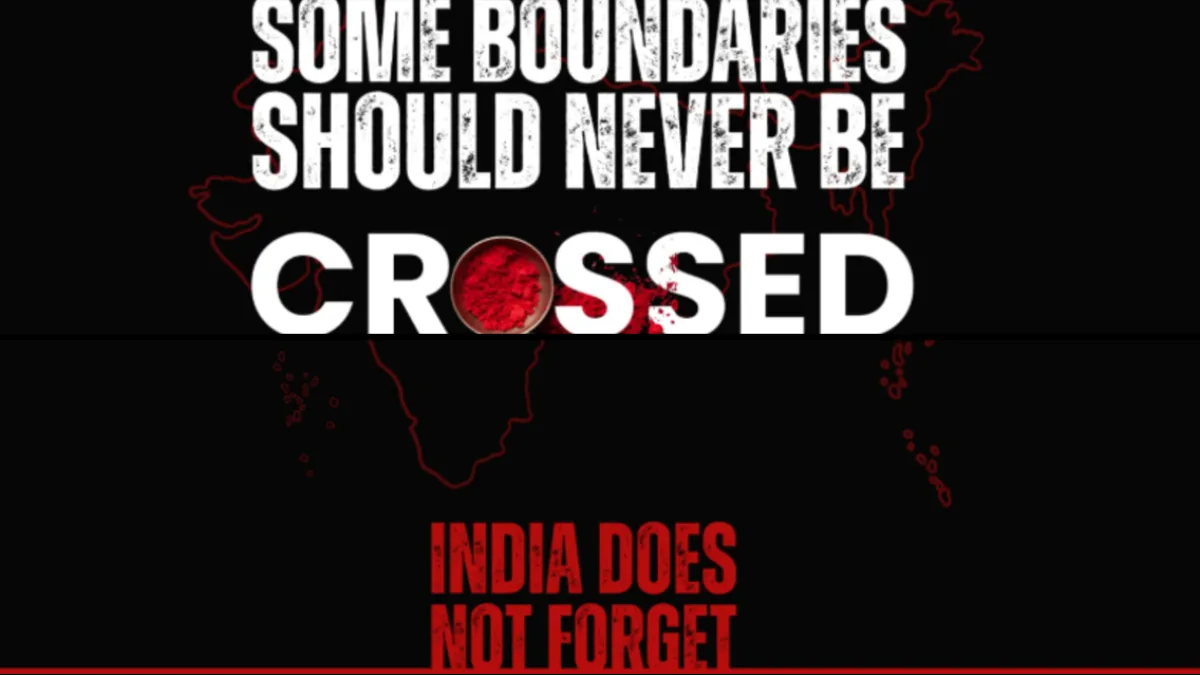
A day before the anniversary of one of the bloodiest and most dastardly terror attacks on 26 innocent civilians in India, carried out by Pakistan-sponsored militants in the picturesque Baisaran Valley of Pahalgam, the Indian Army issued a stark warning: “Some boundaries should never be crossed.”
In a post on X, the Additional Directorate General of Public Information posted an image of the Operation Sindoor. The logo read, “Some boundaries should never be crossed.”
Advertisement
“When boundaries of humanity are crossed, the response is decisive. Justice is served. India stands united,” the accompanying message read on the ADGPI’s official handle.
The Resistance Force (TRF), an offshoot of Lashkar-e-Taiba, had taken the responsibility of the Pahalgam massacre, which was carried out on April 22.
Advertisement
The victims of the attack included Sushil Nathyal (Indore), Syed Adil Hussain Shah (Pahalgam), Hemant Suhas Joshi (Mumbai), Vinay Narwal (Haryana), Atul Shrikant Moni (Maharashtra), Neeraj Udhawani (Uttarakhand), Bitan Adhikari (Kolkata), Sudeep Neupane (Nepal), Shubham Dwivedi (Uttar Pradesh), Prashant Kumar Satpathi (Odisha), Manish Ranjan (Bihar), N. Ramachandra (Kerala), Sanjay Lakshman Lali (Mumbai), Dinesh Agarwal (Chhattisgarh), Sameer Guhar (Kolkata), Dileep Dasali (Maharashtra), J. Sachandra Moli (Vishakhapatnam), Madhusudan Somisetty (Bengaluru), Santosh Jaghda (Maharashtra), Manju Nath Rao (Karnataka), Kastuba Ganvotay (Maharashtra), Bharat Bhushan (Bengaluru), Sumit Parmar (Gujarat), Yatesh Parmar (Gujarat), Tagehalying (Arunachal Pradesh), and Shaileshbhai H. Himmatbhai Kalathia (Gujarat).
Notably, days before the terror attack was carried out, Pakistan Army Chief Field Marshal Syed Asim Munir had given a provocative statement while addressing a Convention for Overseas Pakistanis in Islamabad.
Speaking about Kashmir, Munir said, “Our stance is very clear, it was our jugular vein, it will be our jugular vein, and we will not forget it. We will not leave our Kashmiri brothers in their heroic struggle.”
Later, while addressing the passing out parade at the Pakistan Military Academy (PMA) in Kakul, Abbottabad, Munir came up with the two-nation theory, which was based on the fundamental belief that Muslims and Hindus are two separate nations, not one.
“You have to tell Pakistan’s story to your children so that they don’t forget that our forefathers thought we were different from Hindus in every possible aspect of life,” he said.
“Our religions are different, our customs are different, our traditions are different, our thoughts are different, our ambitions are different. That was the foundation of the two-nation theory that was laid there. We are two nations, we are not one nation,” he had added.
To avenge the deaths of 26 tourists, the Indian Air Force and the Indian Army carried out a joint operation dubbed ‘Operation Sindoor’ targeting the terrorist hideouts in Pakistan, a fortnight later.
In the highly secretive operation, India carried out strikes against nine terror camps of Hizb-ul-Mujahidin (HM, Jaish-e-Mohammed (JeM) and Lashkar-e-Taiba (LeT) located in both Pakistan and Pakistan-occupied Jammu and Kashmir. It included Markaz Subhan Allah, Bahawalpur – JeM, Markaz Taiba, Muridke – LeT, Sarjal, Tehra Kalan – JeM, Mehmoona Joya, Sialkot – HM, Markaz Ahle Hadith, Barnala – LeT, Markaz Abbas, Kotli – JeM, Maskar Raheel Shahid, Kotli – HM, Shawai Nalla Camp, Muzaffarabad – LeT, and Syedna Bilal Camp, Muzaffarabad – JeM.
Advertisement