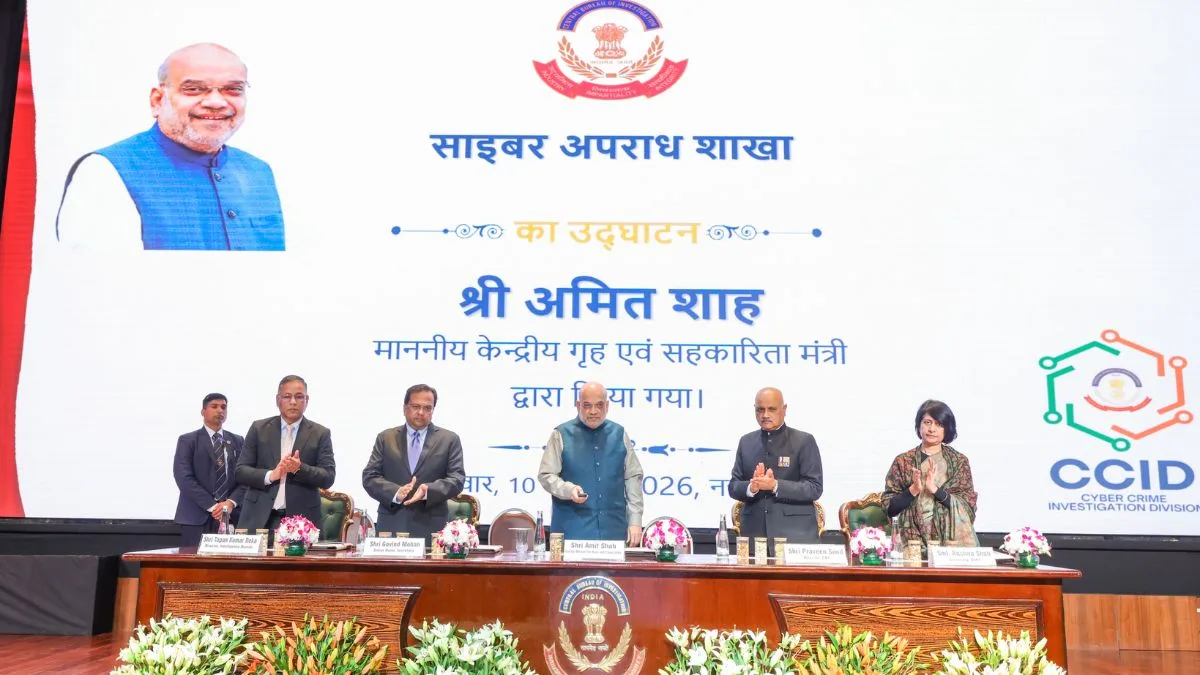
Home Minister Amit Shah on Tuesday inaugurated a new Cybercrime Branch of the Central Bureau of Investigation (CBI) and a national cybercrime dashboard, the State Cyber Crime Coordination Centre (S4C) of the Indian Cybercrime Coordination Centre (I4C), Ministry of Home Affairs, aimed towards dismantling the digital fraud infrastructure.
Shah has asked police across the country to enhance the 1930 helpline and its effectiveness by deploying more manpower, call handlers so that whenever a person tries to report a cyber fraud, there is a quick response and the complaint is addressed before the person loses all the money.
Advertisement
He stated that helpline 1930 has proven to be an effective tool in protecting victims from cyber fraud.
“If a victim’s call is not answered even after multiple calls, their money is lost, and the credibility of 1930 is seriously questioned,” HM said.
He added that similarly, all private, public, and cooperative banks should immediately adopt the Mule Account Hunter software, jointly developed by the Government of India and the Reserve Bank.
Until all banks fully sanitize their accounts with this software, it will not be possible to provide complete protection to consumers, Shah added.
Shah stated that the role of the CBI and NIA is crucial in preventing cybercrime, and strong communication and coordination with all agencies is essential to prevent cybercrimes originating outside the country.
He stated that flaws in the chain of custody of digital evidence can lead to failure to convict, posing a significant obstacle to justice, adding that if adequate steps are not taken, cyber fraud will no longer be a common crime but a national crisis.
He also shared that so far, around 795 institutions are now in touch with the I4C, that include e-commerce platforms, banks, fintech, NBFCs, and others.
Shah emphasized the need for integrated efforts by multiple agencies and reducing reaction time with respect to cybercrimes, adding that the investigation part with regard to the domain has indeed been accelerated, but much remains to be done.
The HM said that digital transactions have progressed rapidly in the recent past, which has also increased the risk, as now the criminals are making use of advanced technology for the execution of crimes.
Hacking is taking place in an auto mode these days, and what used to happen at individual levels has now transformed into an organized and systematic manner, like the organized crimes.
He shared that the government has frozen Rs 8,189 crore out of Rs 20,000 crore cyber fraud and returned it to the victims, which is a huge achievement, and congratulated I4C, CBI, and all the institutions concerned for this.
HM also informed that the MHA has cancelled around 12 lakh SIM cards and blocked IMEI of 3 lakh mobile phones by December 2025, bolstering cyber security, while 20,853 accused have been arrested so far, involved in cyber crimes.
He pointed out that factors like awareness amongst people, coordination, and determination are certain things that can protect from the problem of rising cybercrimes.
Shah was delivering a keynote address at the inaugural session of the National Conference on ‘Tackling Cyber-Enabled Frauds & Dismantling the Ecosystem’ at Bharat Mandapam, where he highlighted the usage of the Indian Cyber Crime Coordination Centre and its reporting portal in the country.
Meanwhile, the two-day conference being organised by the CBI along with the I4C under the MHA convenes at a time when the country’s rapid digital adoption has created new vulnerabilities exploited by criminals.
It aims to build a unified national strategy by strengthening prevention, investigation, and coordination.
A wide range of stakeholders, that include law enforcement officials from central and state agencies, regulators from the telecom and financial sectors, and also public and private banks, fintech companies, telecom service providers, and cybersecurity experts are taking part in the conference, who will share experiences, ideas and understanding of current trends in the cybercrimes, and boost inter- agency collaboration and coordination against the digital crime and networks.