Jashn-e-Azhar: A Celebration of Art, Culture and Expression
Organized by Little Thespian, founded in 1994 by Uma Jhunjhunwala and S.M. Azhar Alam, the festival continues their commitment to theatre as both art and education.
Aishmita Manna and Vedanta Dasgupta | Kolkata | June 8, 2026 5:09 pm
Photo: SNS
The inaugural ceremony of the 15th National Theatre Festival Jashn-e-Azhar was held at Gyan Manch, marking the opening of the six-day festival. Formerly known as Jashn-e-Rang, it was renamed in 2022 in tribute to S.M. Azhar Alam.
Organized by Little Thespian, founded in 1994 by Uma Jhunjhunwala and S.M. Azhar Alam, the festival continues their commitment to theatre as both art and education. The evening opened with the felicitation of Murari Raychaudhury, recipient of the 5th Azhar Alam Memorial Award. A veteran of theatre music with over 500 plays to his credit, he remembered Azhar Alam as “a golden man… honest, rare in theatre,” making the ceremony one of remembrance as much as recognition.
Advertisement
Art Emotion and Applause
The series of felicitations honoured distinguished figures in theatre and the arts. Veteran thespian Bindu Jaiswal of Proscenium Art Centre, urdu playwright, director, and actor Jawed Iqbal, known as Qamar Jawed, was felicitated alongside Dr. Gaurav Das, founder of Anuchintan Art Centre, theatre critic Prem Kapoor was recognised for his extensive contributions, including his role as Assistant Editor of Vishar Pravah and Jansatta. The stage also honoured mime artist Soma Das, founder of Soma Mime Theatre and recipient of the Ustad Bismillah Khan Yuva Puraskar, who reflected on theatre as an instinctive.
Advertisement
Pagla Ghoda: Memory without Redemption
Badal Sircar’s Pagla Ghoda, presented by Mumbai-based Ekrang and directed by Jayant Deshmukh, unfolded in a stark cremation-ground setting. Minimal yet evocative lighting, old brick backdrops, and scattered leaves created an atmosphere of abandonment and unease. The production balanced humour with pain, using moments of comic relief to expose deeper emotions of guilt, regret, and longing. Deshmukh emphasized the play’s continuing relevance, noting that the dilemmas women face remain unresolved today. A notable departure came in the ending, where the Compounder rejects hopelessness and turns toward the audience with Hope, shifting the play from fatalism toward possibility.
Sitayan: Rewriting the Gaze
Produced by Kolkata-based Purbaranga and directed by Malay Ray, Sitayan reimagined the Ramayana through Sita’s perspective. Rejecting realism, the production used red drapes, symbolic levels, and dramatic lighting to create an emotional landscape. The performance was physically and vocally intense, connecting myth with present realities of violence against women, domestic abuse, and female infanticide. In a striking staged interruption, an audience member appeared to protest the play’s treatment of Sita and Ram, only for it to be revealed as part of the performance, forcing viewers to examine their own reactions. The play ended with a reversal of hierarchy as Sita brought Raghupati Ram to his knees, not as spectacle but confrontation. The cast later revealed this was the 104th performance, reflecting the enduring urgency of its themes.
Begum Jaan Ki Haveli: The Architecture of Repression
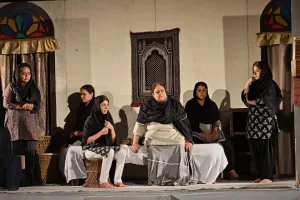
The evening’s staging of Begum Jaan Ki Haveli, an evocative Urdu adaptation of The House of Bernarda Alba by Federico García Lorca, unfolded as a compelling exploration of repression, honour and the suffocating weight of tradition. Presented by the Proscenium Art Center and directed by Anjum Rizvi, the performance laid bare the rigid expectations imposed upon women within a secluded household, where silence, obedience and reputation reign supreme. With a restrained yet powerful ensemble, the play captured the simmering tensions between individualistic desire and social conditioning, leaving the audience with a lingering sense of unease and reflection on the enduring structures of patriarchy.
Photo: SNS
Chaak: A Partition Story of Survival and Identity
On the sacred occasion of World Theatre Day, the stage became more than just a performance space it turned into a living memory of S. M. Azhar Alam’s final creation, Chaak. Written as his last offering before his passing, the play carries an almost haunting emotional weight, as if every dialogue breathes with his unspoken farewell which is directed by his wife Uma Jhunjhunwala.
Set against the turbulent backdrop of the 1971 partition of Pakistan and East Pakistan, it tenderly unravels the pain of a Muslim family. Gaffur Khan’s relentless legal struggles, Arshad’s silent anxiety, and the deeply personal wounds carried by Zohra, Majid, and Razia. Each character feels achingly real, mirroring the fractures, fears, and fragile hopes that countless families have endured. As the audience watches, they are not just witnessing a story but experiencing a shared human grief of loss, displacement, and longing for dignity.
On a day that celebrates theatre, this performance transforms into a tribute both to the enduring power of storytelling and to Azhar Alam Sir himself, whose final words on stage continue to echo in the hearts of those who listen, making Chaak not just a play, but a legacy of love, pain, and remembrance.
Photo: SNS
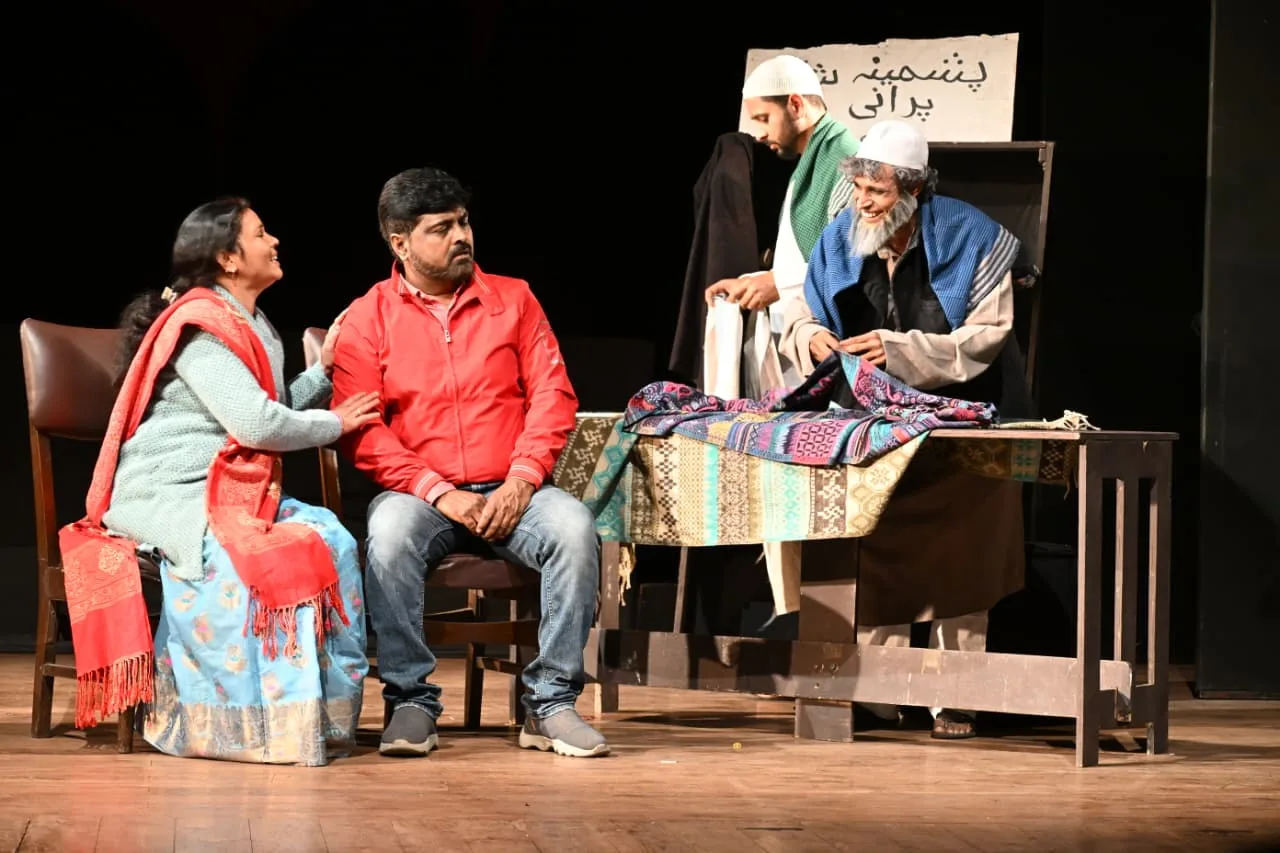
Pashmina: A Shawl, A Memory of Shared Loss
The evening then moved into Pashmina, presented by Ashirwad Rangmandal, Begusarai, and directed by Amit Roushan, a restrained yet deeply affecting meditation on shared grief in the context of Kashmir. The play follows the journey of the Saxenas parents of a martyred Indian soldier accompanied by Dr. Kaul, a displaced Kashmiri Pandit.
What unfolds is not merely a physical journey, but an emotional encounter with loss that transcends identity and geography. Interspersed within this heavy narrative is a measured strand of humour through Rabinder Dhillon, a typically affable Punjabi businessman, and his wife Sweety, whose exchanges bring moments of levity without undercutting the play’s emotional depth.
The significance of Pashmina emerges gradually. The shawl is revealed to be the last wish of the Saxenas’ son, expressed in his final letter that he had wanted to bring one home for his mother. Directed to a shop by Dr. Kaul, they encounter a Kashmiri Muslim shopkeeper who, like them, has lost his son to violence.
The shawl they eventually purchase becomes the last piece he ever wove. In that moment, the pashmina transforms into more than an object; it becomes a shared repository of grief, memory, and fragile reconciliation. Amit Roushan’s direction remains deliberately minimal, allowing the emotional weight of the narrative to surface without distraction.
Photo: SNS
Par Pazeb Naa Bheege : Love Faith And Devotion
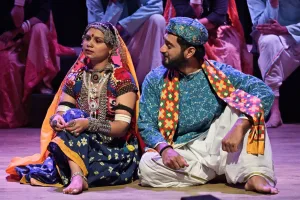
Par Pazeb Naa Bheege, written by Satyanarayan Patel and directed by Pragati Pandey and Vivek Pandey, is a poignant folk-inspired play presented by Vivechana Rangmandal. Rooted in the legend of the Banjara Dam, the narrative tells the story of a salt merchant deeply in love with a Banjaran, who challenges him to build a dam that would touch her feet but leave her anklets dry.
This seemingly impossible condition becomes a powerful metaphor for love, faith, and devotion. Through evocative storytelling, music, and ensemble performance, the play beautifully captures how true love can transcend limitations and turn the unimaginable into reality, while also celebrating the richness of folk traditions and collective theatrical expression.
Across the six days of Jashn-e-Azhar, the festival unfolds memory, myth, conflict, and human resilience. Beginning with the unsettling introspection of Pagla Ghoda by Badal Sircar, where memory lingers without resolution, the narrative moves into Sitayan, where the authority of the Ramayana is questioned and reimagined through a more intimate, critical lens.
Photo: SNS
Begum Jaan Ki Haveli, drawing from the emotional intensity of Federico García Lorca, further tightens this atmosphere, exposing spaces of repression where silence itself becomes oppressive. From there, the festival deepens into histories of fracture and shared suffering Chaak, the final creation of S. M. Azhar Alam, transforms personal loss into a haunting collective memory of partition, while Pashmina gently dissolves rigid identities through a shared language of grief, suggesting the possibility of empathy beyond conflict.
Finally, Par Pazeb Naa Bheege returns to the realm of folklore, where love and devotion transcend impossibility, offering not resolution but a quiet reaffirmation of faith in human connection. What emerges is not a singular statement but a continuum of lived experiences where memory unsettles, myth is questioned, histories ache, and love persists, where it finds its true voice: not in providing answers, but in sustaining a space where stories breathe, contradictions coexist, and the audience is left to carry forward the questions long after the stage falls silent.
The opening ceremony witnessed an evocative confluence of calligraphy, Pashmina craft, and Hindustani classical music, bringing together eminent artists, cultural practitioners, scholars, and distinguished guests from diverse fields.