A friend had invited me for dinner to his house. I went over around 7:30 in the evening. We gossiped for about an hour and then sat down for dinner. After a bite or two, my friend reached for the salt shaker.
His wife vehemently protested – “You have high blood pressure; you shouldn’t add extra salt to your food.” My friend said: “A pinch of salt does not cause a heart attack! Food is supposed to taste good, not like boiled cardboard.” Since when did we start using salt in cooking our food? There’s evidence of salt in proximity to food preparation areas at the Neolithic site of Çatalhöyük (present day Turkey), roughly 9 thousand years ago. Even prior to that salt was used for preservation of meat and fish primarily, and also of vegetables. Salt draws out moisture by osmosis.
Advertisement
Thereby, it deprives microbes – many of which spoil food –of the water they require for their survival. Preservation of food by salting became one of the foundations of civilization. Addition of salt made possible for food to be stored for long periods. It reduced dependence on seasonal harvests and enabled trade across continents. Salt was so valuable that it was often used as a form of currency – the Latin word salarium, from which the English word “salary” is derived, originally referred to payments associated with salt. Communities during the Neolithic period (10000-4000 years ago) collected salt by evaporating sea water. About 5000 years ago, the Chinese and later the Romans, started to harvest salt from the sea and lakes.
Advertisement
Salt became a prized commodity. Rock salt deposits were accidentally discovered. Much of Romania was covered by Paratethys Sea. Beneath the Slănic region, located about 120 km north of Bucharest, is a large salt dome. The salt deposit was formed during the Miocene period about 13-14 million years ago. Evaporation of the sea water concentrated the dissolved salts into massive underground layers of halite (rock salt, sodium chloride). Later geological processes associated with movement of the Earth’s crust folded the layers of salt into a huge salt dome. The name “Slănic” derives from the Slavic word slatina, meaning salty water or salt spring. The Slănic salt mine is the largest in Europe. The salt was easily accessible. Salt-mining likely started in the 13th century in Rumania.
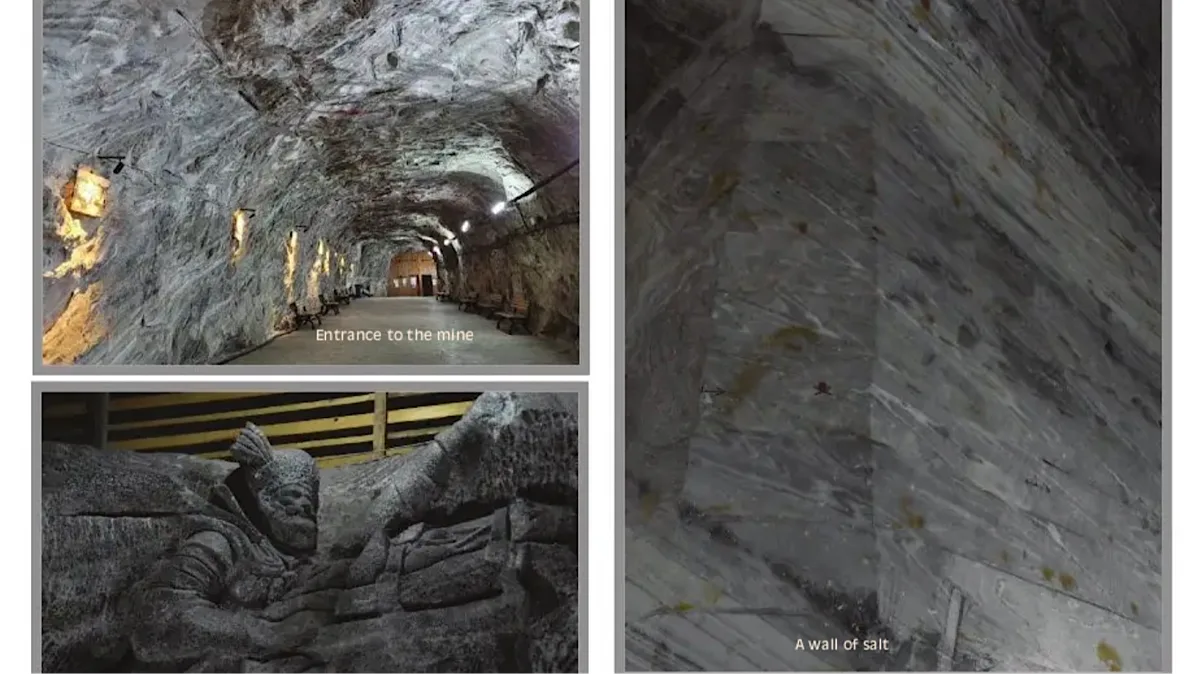
In 1685, Mihail Cantacuzino is credited with opening the first organized salt extraction. Soon salt created about one-third of Rumania’s annual revenue. Salt became known as ‘white gold.’ Many of the salt mines were hundreds of metres underground and stretched over hundreds of kilometres. In April this year, my wife and I visited the Unirea Mine, which is the most famous section in the Slănic region in which excavation started in 1943. Over time, many mining chambers were created, each about 50metres high, lying about 200metres below the ground.
After some decades of mining, the chambers became exhausted or unsafe and were abandoned. Mining in the Unirea Mine stopped in 1970. Soon thereafter, sections of the mine were repurposed for tourism and speleotherapy (salt-air treatment). Its clean, allergen-free air led to its use as a therapeutic environment, especially for respiratory conditions.Infrastructure such as lighting, transport tunnels, and visitor facilities were added. Today, the mine is managed by Salrom, the national salt company of Romania. Visitors are transported underground by a bus after they purchase tickets; about 1250 metres from the entrance to the touristic point.
The excavated space occupies a volume of 2.9 million cubic metres and it is extended on a surface of 7.8 hectares. Throughout the year, the temperature inside the mine is about 13oC, an atmospheric pressure of 730 mmHg and humidity reduced to an average of 10% of that at the surface. The writer is Distinguished Professor, John C. Martin Centre for Liver Research & Innovations Emeritus Professor, Indian Statistical Institute, Kolkata Adjunct Faculty Member, Indraprastha Institute of Information Technology Delhi University Council Member, Human Genome Organisation Member of Technical Advisory Groups on ‘Genomics’ and ‘AI & Health’, World Health Organization Formerly (7/2020-6/2025) National Science Chair, Government of India Founder, National Institute of Biomedical Genomics IND
Advertisement