In Delhi, the air pollution is increasing year after year. Political parties have their own excuses and their own solutions. But at the end of the day, the common man is suffering as health-related problems are spiking in the NCR.
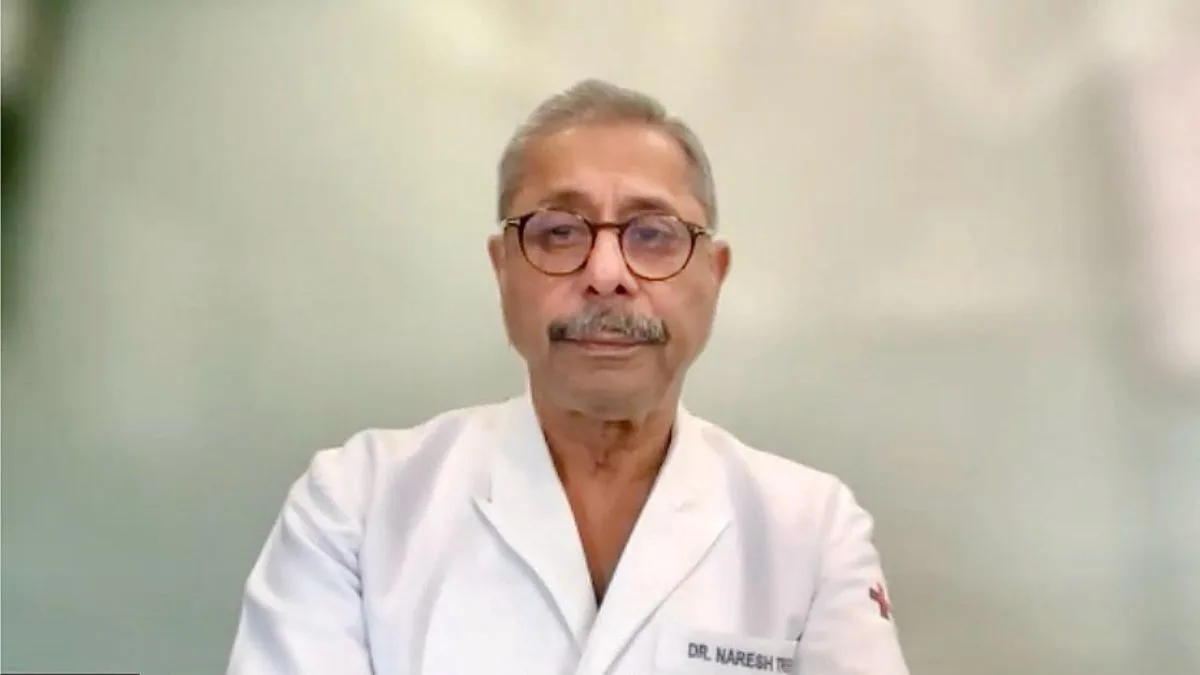
To discuss this and other health-related topics, The Statesman had an in-depth conversation with the founder of the Medanta Group of Hospitals and world-renowned cardiovascular and cardiothoracic surgeon, Dr Naresh Trehan.
Advertisement
Here are excerpts from the exclusive interview:
Advertisement
Q: What kind of diseases can a common man get from air pollution?
A: We used to think that air pollution only affects the lungs. Now, we know that the most minute particles get absorbed in the blood from the lungs, and then they go all over the body. What happens is that the lungs deposit PM 2.5, or PM 10, or PM 1. So, all these together become very toxic to the body.
I demonstrated many years ago that the lungs of people of Delhi or such urban areas are completely black. And those who come from rural areas or hills, like Himachal or Uttarakhand, have baby pink lungs. This means that the air pollution is depositing a lot of charcoal-type deposits on the lungs.
Because minute particles get absorbed by the blood, they go to the brain, heart, liver, and kidneys. What happens is that all underlying diseases get enhanced.
So, when the AQI reaches the unbearable limits in Delhi, above 500, then we see that our OPDs become full of people who have asthma attacks, coughs, pneumonia, and more importantly. It affects children, such as in their neurological development. Whatever gases are there, they get absorbed. They then have a very detrimental effect on the neurological development of small children. So, everybody is affected.
Now, what can be done? In China’s Beijing, it was extremely polluted, even more than Delhi.
But they actually progressively got rid of the toxins. And the air quality today in Beijing is quite good and tolerable. We all know what the constituents are that make the air so toxic.
That vehicular traffic, construction activity, and this burning (of Parali) in our neighbourhood states, all these together, are proving to be a very, very big burden on our society as far as our health is concerned.
So, if we don’t fix this, this gets multiplied every year. And we will see more and more asthma, more and more pneumonia, more and more cancer! We all must work together, along with the administration and the politicians, to immediately try to reduce everything (pollution) we can.
Q: When there is pollution, the authorities start sprinkling water. How effective is this?
A: The particulate count comes down with spraying and with misting. It definitely does. So, it settles the dust down to the ground.
Solar energy is clean energy. So, the efforts should be in that direction. I think the government is taking steps towards that. There is a lot of solar coming up. India has a natural edge. Because we have many sunny days, we can produce and harness it into energy.
But it’s taking time. Let’s go on a war footing.
Q: In India, healthcare is not affordable for many people. It is still a big challenge. What is the biggest reform you suggest in this direction?
A: There are two things that one must appreciate here. One is that the treatment that people are getting in India is of an international level of medical care.
The cost of inputs is very high. If we compare it with Europe or America, we are delivering healthcare at one-fifth to one-tenth the cost. Quality is the same as anywhere in the world. So, the input costs must be reduced. It will be helpful!
The second and more important thing is that access to healthcare, the delivery system, is good. There are good hospitals run by the government. There are many good hospitals in the private sector. So, the quality is very good. But the cost is still unaffordable for a lot of people.
So, we need to enable cost funding so that people can access proper healthcare. The government has made schemes, like ECHS, CGHS, ESI, ESIC, and now we have Ayushman Bharat. So, a very large population that was uncovered till very recently is now covered.
Over 10 crore people are actually covered by Ayushman Bharat today. So, these people who had no option because they were below the poverty line can afford it.
Q: Whenever we hear about private hospitals, the healthcare services are usually top-notch. But in government hospitals, things are otherwise. How can we reduce the gap between private and government hospitals?
A: If you see, this is a recent example. During COVID, the private and government sectors worked together, shoulder to shoulder! So, you saw how successful it was.
In India, the number of deaths and the number of people who suffered was much less than in some of the other, even developed countries, like Europe. Our results were good. The government also supported us a lot. The healthcare sector worked very hard. The doctors worked very hard. So, it says a lot about our healthcare sector, whether it’s in the government sector or in the private sector. We have to increase this example.
Q: Is India producing enough skilled specialists to keep pace with the rising population?
A: The quality (of doctors) is good. You will see that in the government sector, people work from morning to night in public service. Our medical education is very capable. The quality assures that the doctors who pass are actually knowledgeable.
Q: Are younger Indians at higher cardiac risk now? What is causing the shift?
A: Now, 10-12 per cent of people will have heart disease, and those who have diabetes will not even get a warning that they have blocked vessels. So, if your family has a history of heart disease, then your family should get a complete check-up. If you have coronary artery disease and you engage in vigorous activities, then it is necessary to do a stress test before doing these activities, because if there is any abnormality in your heart, it could cause heart disease.
Q: Tell us about your future plans.
A: We have six hospitals right now. We have announced one hospital in Mumbai, two hospitals in Delhi, and one hospital in Guwahati. These four hospitals are being built, and we will have a total capacity of 3,000 beds.
Recently, News League International, which surveys in 28 countries, has awarded Medanta as the best private hospital. Continuously for six years. We have maintained the standards that we have achieved. We aim to never dilute such standards.
For us, “Har Ek Jaan Anmol”!
Advertisement